Discovery Farms profile: A no-till true believer
written by Jonathan Eisenthal
John Peterson scarcely believed the transformation he witnessed — how the soil on his farm changed when he switched to the no-till method of cultivation.
“What no-till actually does to the earth is so captivating. It is unbelievable. You would never dream that it could be like that. It is very, very much alive,” said Peterson, who became a farmer 38 years ago when he decided that working outdoors was the only life he wanted. Peterson describes how the soil, left undisturbed, becomes a menagerie of earthworms and non-pest insects who till the soil and make it an ideal growth medium for his crops.
“You would hear a cloudburst come by, and after, you could actually hear the ground gurgling, absorbing the water,” Peterson said.
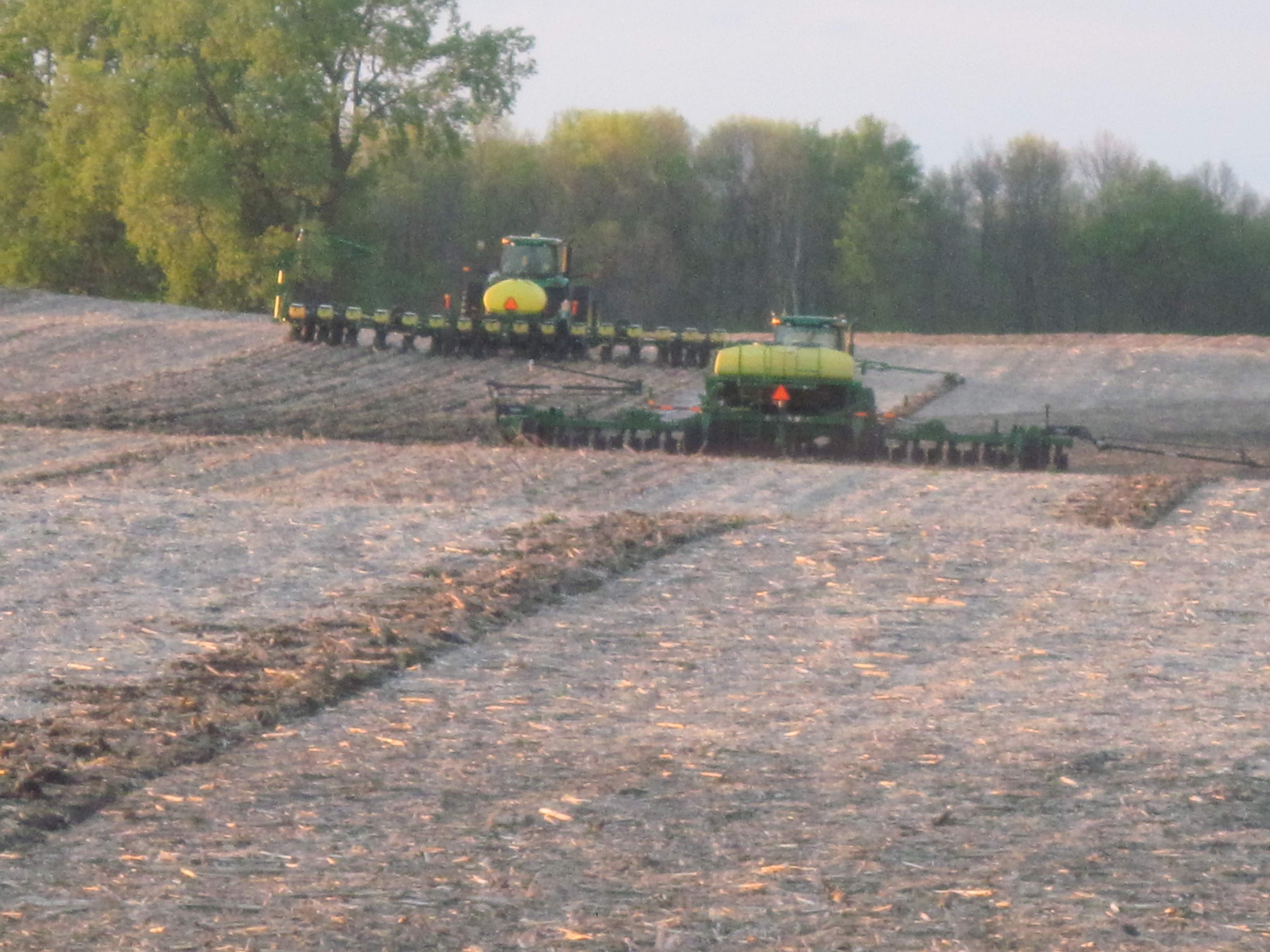
He and wife Jewell, their sons Nic and Nate and daughter Natasha are all involved in their 3,000 acre farm, raising corn and soybeans near North Branch (another daughter, Nikki, grew up helping on the farm and now cheers everyone on in the family farm operation).
Theirs is one of 11 sites in the Minnesota Discovery Farms network. Discovery Farms sites represent a spectrum of different farm practices, different soil types and topographies. The common thread is that all these farms have equipment monitoring the sediment and nutrients running off their fields — either surface runoff or from tile drainage outlets, or both.
With pride, Peterson notes that their farm, the only no-till operation being monitored, has shown the lowest sediment and nutrient loads in the four years Discovery Farms has monitored their site. He doesn’t like to push his ideas on other people, Peterson says, but he is a firm believer in what he does.
Peterson changed to no-till 12 years ago.
“The ground gets firmer, when you do no-till, to the point that, when it gets wet, you can drive out there and you don’t make ruts,” he said. “Other people can’t touch their fields and we can go out and not make tracks. And they are like, ‘well, if it’s that compacted how can you grow anything?’ It is firmer. But you take a spade shovel and you dig up a scoop full of dirt and leave it in a clump.”
Peterson also compared his no-till ground to a popular dairy item.
“The dirt is like swiss cheese,” he said. “The earthworms have just got it cut every which direction full of holes. The root can grow through those holes down to nutrients, the water flows down through those holes, the fertilizer goes down through those holes. The worms constantly are drilling little holes and making little huts on top of the ground, to the point where when your field is completely converted to no-till you will have fist-sized clumps of trash on the ground that the earthworms have cannibalized. And it’s covering their hole. It gets to the point that the tractors actually vibrate from all of those little huts.”
The Discovery Farms flume and monitoring station collect and sample water from an 8.3 acre section of field, which, like the rest of Peterson’s operation is a 50-50 rotation of corn and soybeans.
“I joined Discovery Farms because I wanted a good base of printed facts to show how farmers take care of the ground and the ground water and Mother Earth,” Peterson said.
This post is part of an ongoing series to highlight Minnesota corn farmers participating in Discovery Farms Minnesota, which is a farmer-led effort to collect real-world, on-farm water quality information from different types of farming systems.
You can learn more about Discovery Farms here and here. Look for other Minnesota corn farmers participating in Discovery Farms to be profiled in the near future.