Video tells the story of farmers as water quality producers
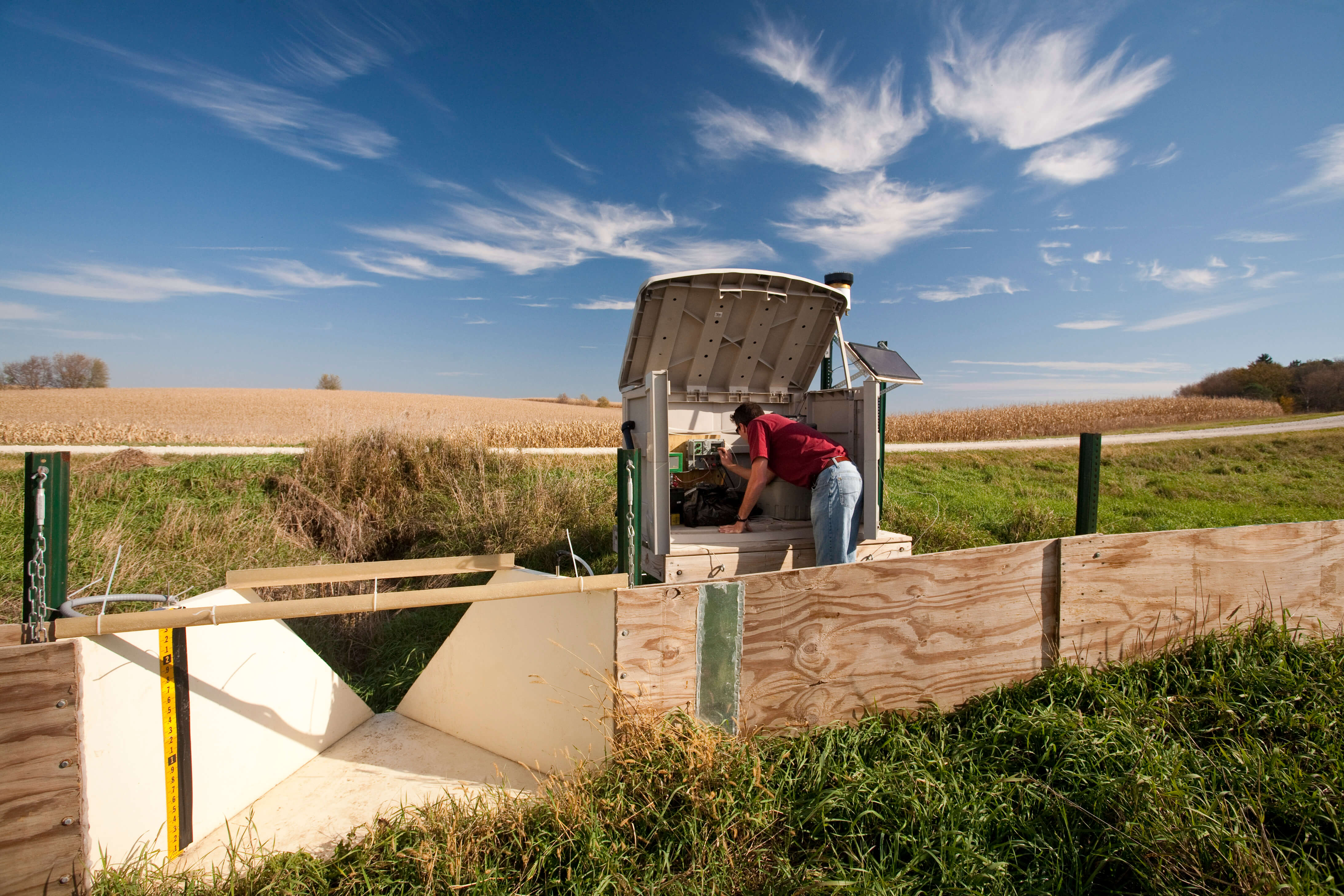
(Soil scientist Kevin Kuehner checks the edge-of-field monitoring equipment at a site near Bridge Creek in Southeastern Minnesota.)
Written by Jonathan Eisenthal
A newly released video (see below) shows the efforts by farmers to implement practices that prevent soil and nutrient loss in three small watersheds of southeastern Minnesota’s Root River. The ultimate goal over the decade-plus effort by farmers in the watershed is enhancing the water quality of nearby streams.
To ensure the future of their farms, the common sentiment among these farmers is they have to both produce food and assure the water draining from their field remains clean.
“Our goal is to have a farm that’s viable 25 years from now,” said Dave Mensink in one of the interviews featured in the video. Mensink is one of 47 farmers taking part in the partnership. “We have to save the dirt. We have to have clean water. It all plays into that (goal of preserving the future of the farm).”
The partnership, organized by Minnesota Department of Agriculture soil scientist Kevin Kuehner in 2009, brought farmers together with technical resources to improve their conservation practices. Looking to a successful model, the partnership borrowed a method from Discovery Farms called a “field walk over,” which is primarily a private tour of the land. The farmer walks with a technician to document what’s working and what needs improvement.
Through this process, they were able to focus on what they labeled “critical source areas,” and identify practices that could eliminate problems in these areas.
“Runoff monitoring during the study showed that a relatively small area of the field during a short period of time contributes the highest amount of annual soil and nutrient loss. It’s important for farmers to focus on these high risk areas and high risk time periods,” said Kuehner.
In typical years, 7 percent of the annual precipitation that falls on the field runs off the field surface, but this can vary from 1 to 25 percent depending on precipitation totals. They also found that May and June are the riskiest months for soil and nutrient loss. During that time, less than 30 percent of the annual runoff occurred, but that runoff carried over 80 percent of the soil and 60 percent of the phosphorus and nitrogen loss.
Among the simplest solutions often proves the most effective—creating a grassed waterway on a slope where water tends to concentrate after a rain event.
The partnership saw the installation of 65,000 linear feet of targeted grassed waterways last year and expects another 10,000 feet in the coming year. Sod-forming grass holds the soil in place and slows the flow of runoff water, as well as allows sediment and attached nutrients to drop out before the water reaches the receiving stream.
“It’s really nice to come out here after a hard rain and see that there’s no damage,” said farmer Mike Oian. “Not seeing a whole bunch of gullies and dirt going down the river. It’s not only benefitting me, but the people (farther downstream).”
Of 48 farmers in the three Root River watersheds, 47 elected to take part in the project—a 98 percent engagement rate.
“I think 98 percent is a remarkable number, and one the farmers should be really proud of, not only in these watersheds, but among all our farmers throughout the region,” said Kuehner. “It really highlights the positive story that farmers want to improve their operations, be more efficient and effective in their conservation practices, and I think this process really delivered on that.”
The Minnesota Corn Growers Association helps fund efforts in the Root River project as part of its mission to become the most environmentally responsible and sustainable corn farmers in the nation.