State elections bring major changes to St. Paul
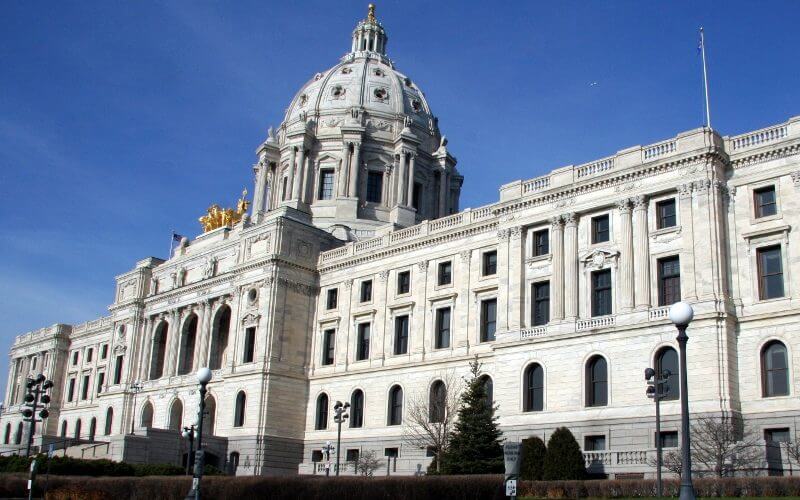
The 2018 midterm elections came and went Tuesday with near-record voter turnout for a midterm election. Nearly 2.6 million Minnesotans voted, and with a nearly 64 percent turnout, it was the highest midterm turnout since 2002.
While many observed that the 2016 election was a year when rural areas around the country had exerted more clout, the 2018 election in Minnesota was largely the result of a “suburban wave.” For example, voter turnout in Hennepin County was 77 percent, compared to the statewide average of nearly 64 percent.
When the dust cleared, election results pointed to historically democratic leaning areas in and around the metro becoming more so, with the same happening for republicans in Greater Minnesota.
Governor
Democratic Farmer Labor (DFL) candidate Tim Walz defeated Republican candidate Jeff Johnson to become the next governor of Minnesota. Walz carried 21 counties in the state with a strong advantage in the Twin Cities metro and Northeast Minnesota.

Governor-elect Walz and Lieutenant Governor-elect Flanagan now have the significant responsibility of selecting commissioners and other key leadership positions for Minnesota state agencies. Selection of these positions will be important for setting the direction for the administration and will signal how Governor-elect Walz will work with various constituencies to achieve policy outcomes and deliver services for Minnesotans.
In addition to the Department of Agriculture, the Minnesota Corn Growers Association (MCGA) has a strong interest in agency appointment at the Pollution Control Agency, Department of Natural Resources and Revenue. Beyond selecting members of their administration, Governor-elect Walz and his team will have to assemble his proposed two-year state budget and develop policy proposals on a host of issues.
During the summer of 2017, MCGA launched a new initiative, MN Corn Grows MN, to engage with candidates for public office to encourage dialogue about corn farming with all Minnesotans. The initiative has been a great success and the MCGA has received praise from candidates, farmers and others for taking the initiative in communicating the important role of corn farming and key issues that deserve support.
“The objective of the ‘MN Corn Grows MN’ initiative and its efforts to bring candidates like Governor-elect Tim Walz to the farm was to raise awareness of the importance of corn farming in our state and develop deeper relationships with candidates for elected office.” MCGA President Brian Thalmann said. “We now look forward to continuing those productive conversations at the Capitol to address the issues impacting our state’s corn growers.”
In total, the MCGA hosted 19 individual farm visits last summer and fall with candidates for Governor, U.S. Senate and Congress. The effort also attracted positive media interest.
During his campaign, Walz has repeated his support for the Buffer Property Tax Credit, which provides a $50/acre property tax credit to farmers for their acres that are in compliance with the buffer law. MCGA looks forward to continuing this conversation with Walz throughout the transition and into the 2019 legislative session.
Walz has also stated the need to accomplish tax conformity early in 2019. MCGA will work with his administration to prioritize conformity on Section 179, which would increase the deduction amount from $25,000 to $1 million on equipment expensing and bonus depreciation.
Legislature
In the end, the DFL Party gained control of the Minnesota House of Representatives by flipping 19 seats from red to blue (pending a recount in district 5A). Most of these legislative districts were located in the suburban metro. The Minnesota Senate remained 34-33 with Republicans maintaining a one-seat edge after a special election in Senate District 13 for the seat previously held by Michelle Fischbach, who has been serving as Lieutenant Governor following Tina Smith’s appointment to the U.S. Senate.
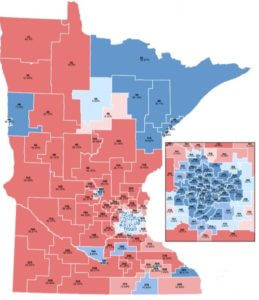
DFL and GOP caucuses in the House and Senate have also recently announced caucus leadership positions. When the legislature convenes in January, we can expect the following:
- Minnesota House DFL – Melissa Hortman (Brooklyn Park) as Speaker and Ryan Winker (St. Louis Park) as Majority Leader.
- Minnesota House GOP – Kurt Daudt (Crown) as Minority Leader.
- Senate GOP – Paul Gazelka (Nisswa) as Majority Leader, Jeremy Miller (Winona) as President of the Senate and Michelle Benson (Ham Lake) as Deputy Majority Leader.
- Senate DFL – Tom Bakk (Cook) as Minority Leader.
The outcome from Tuesday’s election gives Minnesota the special distinction of being the only state legislature in the country to have divided control when the legislature convenes in January, something that hasn’t happened since 1914.
On day one of the legislative session on January 8th, there will be 38 new members of the Minnesota House. Many of these new members will be appointed to key committees where MCGA will be looking to advance important policy priorities for our members. The key to the success of MCGA’s advocacy efforts has been the active participation of our farmer members at a grassroots level; communicating with legislators and discussing the reality of how policy impacts their farming operation. It will be extremely important for farmers to develop relationships and stay in touch with lawmakers now and as we head into the legislative session. Your active involvement does make a difference!