Distillers grains ready for a culinary debut?
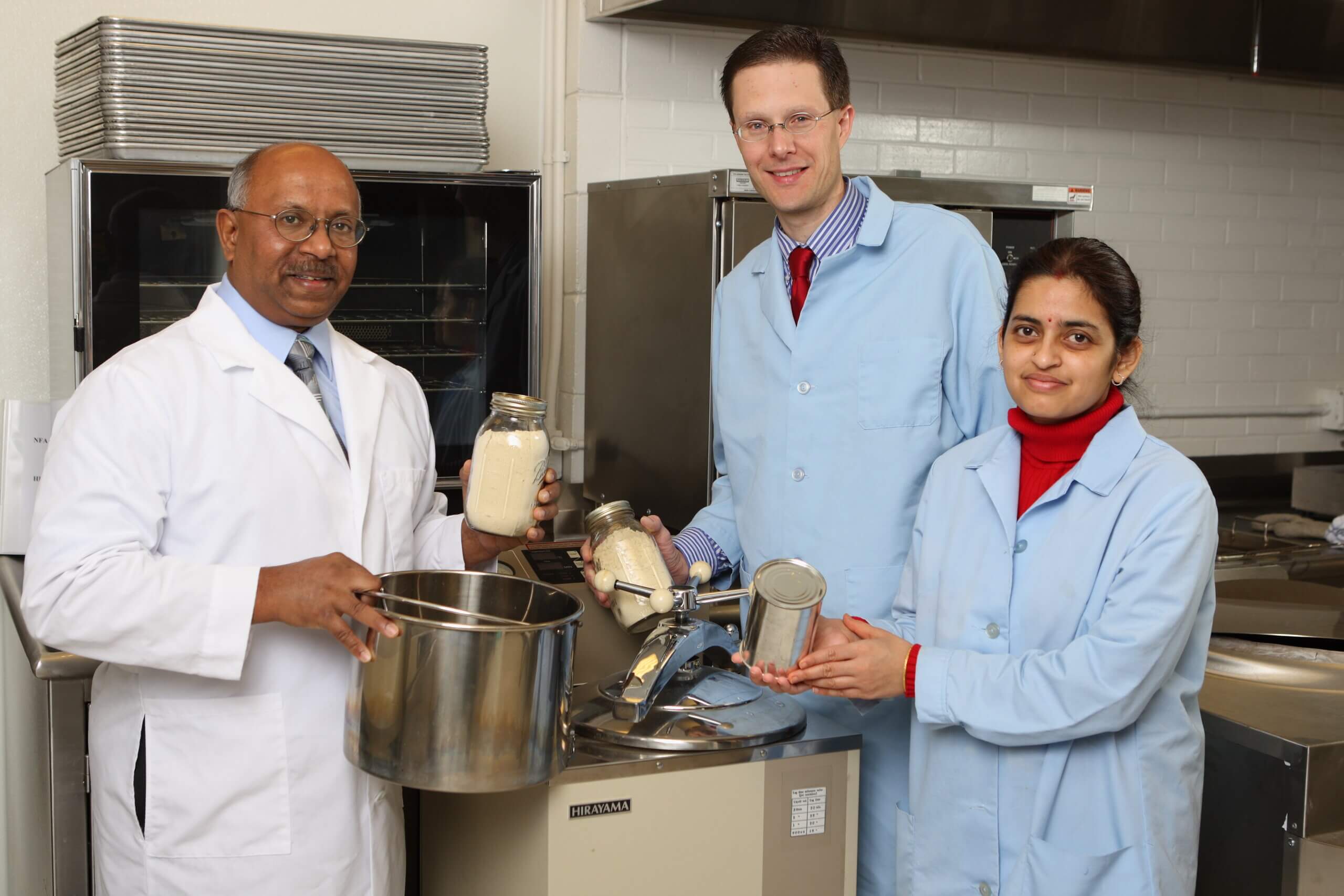
(Krishnan (left) with refined food grade distillers grains, joined by Kurt Rosentrater and Sowmya Arra)
By Jonathan Eisenthal
Padu Krishnan, a professor of food science at South Dakota State University, believes distillers grains could be a wonder-food fit for humans in need of protein and fiber.
Krishnan has worked with this material for over two decades, proving its utility as human food. Distillers grains are the corn material left over from ethanol fermentation. Ethanol producers have used this leftover mash as a food for cattle. In recent years, scientists have proved it can make a good addition to poultry and swine rations.
Food grade distillers grains have, up to now, been conceived as a ‘stealth food,’ Krishnan noted, meaning that one could, for example, sneak it into the recipe for bread or tomato sauce to increase dietary fiber. The theory was that food manufacturers would be careful to add only as much distillers grains as would remain undetectable to most people’s taste buds.
With the right handling, Krishnan believes distillers grains could become a treat to the palette and be used as a feedstock for aesthetically-pleasing foods. The quest has taken him through a series of experiments in how to refine distillers grains. It comes down to washing, Krishnan believes.
Because ethanol production creates a huge volume of carbon dioxide, Krishnan is exploring an innovative method to use ‘Supercritical CO2’ as a ‘green solvent’ to take impurities out of the raw distillers grains. His method is yielding exceptional food grade flour.
Not only does carbon dioxide, which is handy and cheap for ethanol plants, make an excellent cleaning medium, but Krishnan has also discovered that the product is brighter with increased eye-appeal.
Work to add value to an ethanol co-product produced in abundance is supported through corn farmers’ investment in the Minnesota corn check-off. The project is one of many identifying opportunities to add value to each bushel of corn grown in the state.
Krishan discussed his distillers grains research in a recent episode of the Minnesota Corn podcast. Give it a listen today: