The future of farming under a changing climate
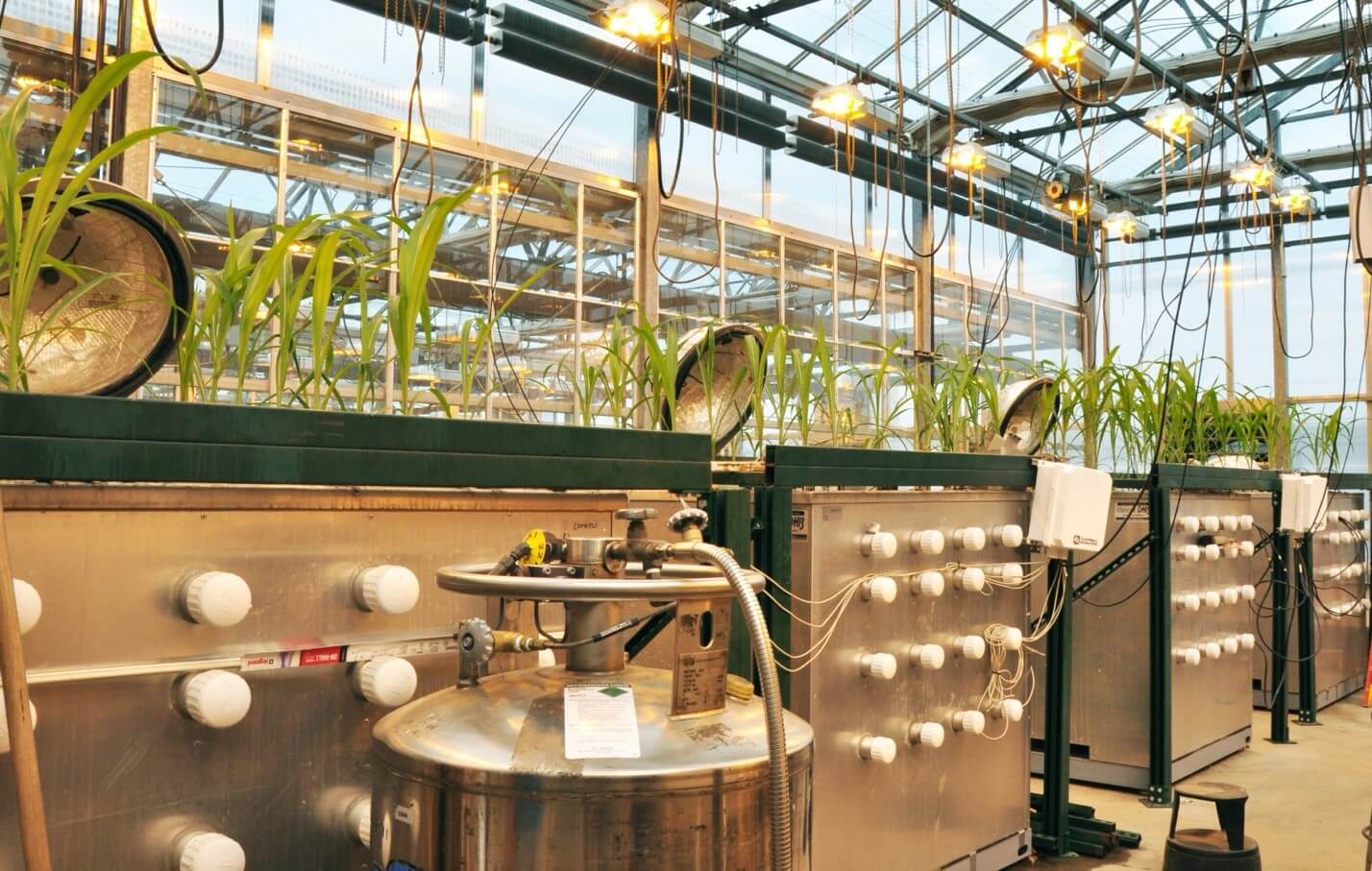
(Mesocosm chambers at the University of Minnesota allow the rapid testing of how corn grows under different climatic conditions)
Written by Jonathan Eisenthal
A mesocosm is like a farm field in a laboratory. Or a very scientific container garden.
University of Minnesota Biometeorologist Tim Griffis is using a mesocosm facility to model the future of farming, and test management changes that promise to help agriculture and the environment.
It’s no secret that springs have gotten wetter and summers more dry for the past decade or more. What many people don’t realize is how this affects farming.
“Under wetter and warmer conditions, the farmer’s nitrogen use efficiency is going to drop because you are going to have more unintended losses (of nitrogen) to the atmosphere in the form of nitrous oxide,” says Griffis.
What’s more, it’s a dynamic feedback loop. Nitrous Oxide, which only exists in small amounts in the atmosphere, is a highly effective greenhouse gas that traps thermal radiation and raises the climate’s temperature. The warmer the temperature, the more moisture in the atmosphere, meaning springs will likely trend even wetter in the near future. Air sampling stations placed on high radio antenna towers have collected atmospheric data for the past decade, documenting the rising levels of nitrous oxide in the atmosphere.
“A mesocosm is a large growth chamber situated in a greenhouse, which can simulate outdoor conditions, so that we can rapidly test scenarios,” said Griffis. “Applying the model of wetter springs and drier summers, we see a 22-percent increase in nitrous oxide emissions.”
Griffis has found the answer to reduce nitrous oxide emissions is increasing nitrogen use efficiency. The mesocosms have shown the effectiveness of splitting nitrogen applications.
“In a perfect world, we would feed the plants nitrogen as they demand it,” Griffis said. “If we could come up with better technologies for applying the nitrogen, some of our work shows that you could greatly reduce the amount of nitrogen losses.”
Griffis has collected data from the mesocosm chambers for six years now. The next phase in the experiment will look into ‘designer soil microbes.’
The professor and his assistants, masters candidate Lee Miller and post-doctoral fellow Alexander Frie, have inoculated some of the soil with microbes that can fix nitrogen out of the atmosphere.
“In this scenario, we are able to reduce the amount of synthetic nitrogen we would normally use by about 20 percent,” Griffis said. “What we are seeing is much less nitrous oxide emission …with equal, or even more biomass being produced. It’s very promising.”
Minnesota’s corn farmers support this project and more increasing sustainability on the farm through their investment in the Minnesota corn check-off. Hear Tim Griffis discuss this project in a recent episode of the Minnesota Corn Podcast: