Legislative Update: Final budget agreements take shape
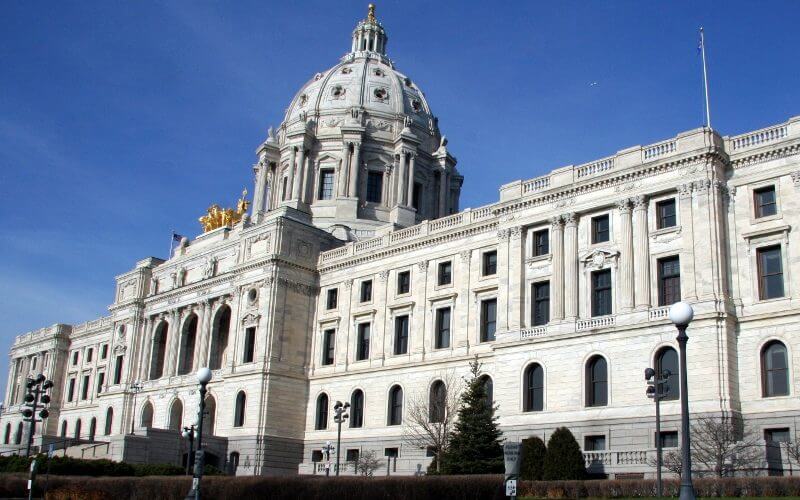
Minnesota legislators are back in St. Paul for the second week of a special session to wrap up negotiations on a new two-year state budget before June 30 to avoid a state government shutdown. The last update I wrote outlined the budget framework agreed to by legislative leaders and Governor Walz at the end of the regular session. This update will cover the current status of final budget agreements on policies that are relevant to Minnesota corn farmers.
Agriculture
During the regular session, the House and Senate approved a stand-alone agriculture policy bill, so the agriculture bill under consideration during the special session is purely a numbers-only budget bill. Last week we shared news that the final budget agreement for agriculture included $6 million for biofuel infrastructure grants to retailers to offer higher ethanol blends in the next two years, and another $6 million was included in the base budget for FY 2024 and 2025. Earlier this year, Minnesota Corn made a $1 million commitment to a future state biofuels infrastructure grant program.
The biofuels infrastructure funding in the agriculture budget bill is a significant investment and could result in an additional 100 retailer locations offering higher ethanol blends, depending on grant size and non-governmental resources for the grant program. Although Minnesota Corn Growers Association (MCGA) is disappointed that we were not able to advance the E15 standard across the legislative finish line this year, we know that the financial commitment to E15 and higher ethanol blends sets up the policy for future success. More Minnesota consumers will soon have the choice to fill up with cleaner-burning ethanol.
Another MCGA priority included in the final agriculture budget bill is ongoing funding for the Agricultural, Research, Education and Extension Tech Transfer program (AGGREET). This program supports agricultural research investments at the University of Minnesota and has resulted in the addition of 31 faculty and Extension educators working on clean water, crop and livestock productivity, microbial science, soil fertility, agricultural technology, pest resistance and climate change. An additional $200,000 in farm safety grants is also included in the final bill.
During the regular session, proposals were under consideration that would have increased the fee on gross sales for agricultural pesticides, added a new label to treated seed sold in Minnesota and added a provision to seed law that treated seed cannot be used to produce ethanol. MCGA opposed these proposals during the regular session, and none were included in the final agriculture budget or policy agreement.
Other funding in the agriculture bill includes $450,000 in additional funding for the noxious weed and invasive plant program, $1.65 million to upgrade equipment in the MDA analytical laboratory, $2.8 million for Agricultural Best Management Practice implementation, $1.5 million for livestock processing and $2.8 million for livestock investment grants, just to name a couple other provisions.
On Saturday, the House approved the agriculture bill on a vote of 111-20 and the Senate approved the bill on Tuesday but a vote of 63-3.
MCGA would like to thank the Agriculture Committee Chairs, Senator Torrey Westrom and Representative Mike Sundin, for their work and advocacy on several MCGA priorities in addition to other important investments and provisions for Minnesota agriculture. In addition, we would like to extend our thanks to MDA Commissioner Petersen and his team for their work on the bill. We look forward to working with MDA to implement a robust biofuels infrastructure grant program and expand ethanol blends across Minnesota.
Taxes
The final tax bill would provide over $900 million in one-time and ongoing relief for Minnesota business and citizens. The bill does include the state tax exclusion for federal Paycheck Protection Program (PPP) forgivable loans as agreed to by leadership at the end of the regular session. The bill also includes Section 179 fixes with language to eliminate the state addition for section 179 carryovers for property placed into service prior to tax year 2020.
A tax priority for MCGA for the last several years has been buffer property tax relief, but again this year, a buffer property tax proposal was not included in the final tax bill.
Leadership plans to adopt the final tax bill, but not until after the major budget bills are passed through each chamber.
Environment
When the regular session adjourned, one of the major issues facing environmental policy and budget negotiators was administrative rulemaking on adoption of California vehicle emission standards, also referred to as Clean Cars. The current agreement between the environment policy and finance chairs does not include any changes to, or a delay to the adoption of, a final rule for vehicle emission standards.
Overall, the environment budget bills provide funding for the Minnesota Pollution Control Agency (MPCA), the Department of Natural Resources, the Board of Water and Soil Resources and other smaller environmental related divisions and public institutions like the Minnesota Zoo.
On the policy front, earlier this year, proposals were making their way through the process that would have banned certain crop protection tools on state-owned lands, directed the MPCA to conduct rulemaking on treated seed disposal and enabled large metropolitan areas to adopt their own pesticide ordinances. None of those proposals were included in the final budget and policy agreement.
The environment bill does allocate some resources for soil health and water quality practice adoption in addition to funding for water storage projects in the Minnesota River and Lower Mississippi River basins.
A policy change supported by MCGA that was advanced by our livestock partners and included in the environment bill would make a common-sense change to recently updated MPCA rules for feedlot permits. The policy would prohibit the MPCA from requiring implementation of best management practices as a condition of allowing application of manure in October, unless expressly prohibited by the Environmental Protection Agency.
The environmental bill has not yet been scheduled for a floor vote in either body but is anticipated to pass before the June 30 deadline.
The Legislature has also approved a two-year Legacy bill, which includes Clean Water Fund projects.
It is anticipated the Legislature will be able to reach agreement and process the remaining budget bills before the June 30 deadline avoiding a government shutdown.
Be sure to follow the MCGA blog and its social channels (Facebook, Twitter) for updates. You can also follow me on Twitter (@AjBilek).