Telling the Minnesota farm story in London and Helsinki
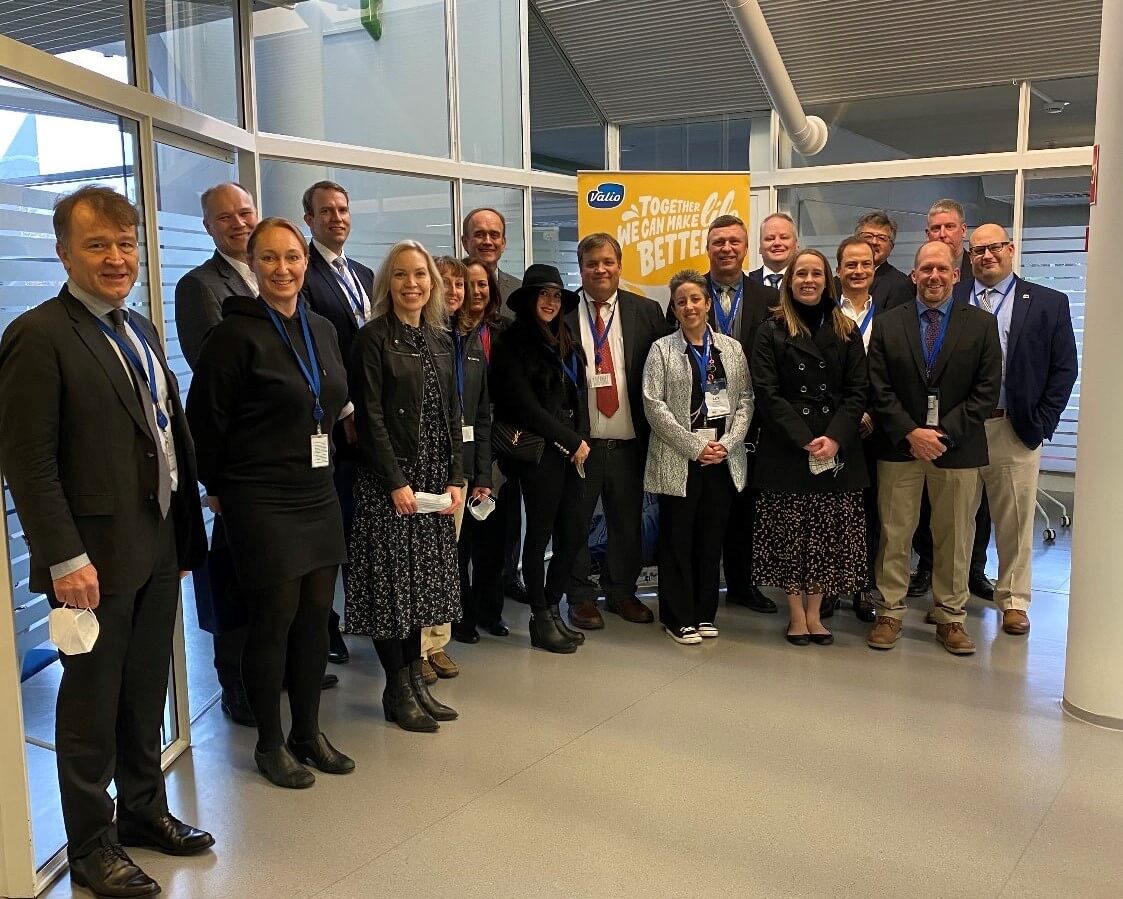
Gov. Walz trade mission includes local corn growers
By Jonathan Eisenthal
The United Kingdom and Finland do not produce all the food they need. This means trade opportunities for farmers in Minnesota.
On Nov. 13-19, a group of 70 people accompanied Gov. Tim Walz on a trade mission to London and Helsinki. Fourteen came from the food and ag sector, including two Minnesota Corn grower-leaders: Bryan Biegler, who farms in Lake Wilson, and Brian Thalmann, who farms in Plato. Biegler is president of the Minnesota Corn Growers Association (MCGA) and Thalmann is an MCGA board member and serves on the board of directors of the National Corn Growers Association.
In addition to food and agriculture representatives, the Minnesota delegation included people in the medical technology, environmental technology and education fields. The group met with representatives of trade, academia, food production and retailing. For those in the farm sector, it was an important opportunity to help share information and dispel myths surrounding American agriculture.

During their conversations, one of the potential obstacles related to how animal feed is grown and produced.
“I think there is an opportunity for Minnesota farm producers to backfill these markets, but we need to have a really good, defensible sustainability story to tell,” Thalmann said. “We keep getting better at what we are doing (thus more sustainable), but the essential thing is to get the word out with specific examples.”
Thalmann mentioned that grid soil sampling and planting and yield and fertilizer application maps were just some of the examples of the technology used on the farm that were of particular interest during one of his conversations.
“That seemed intriguing to the guy I was talking with,” he said. “I kept trying to make the point that we are much more sustainable and scientific in what we do than what they might’ve been led to believe.”
Another major trade opportunity is biofuels. The U.K. recently increased its standard to 10% ethanol, and Finland burns ethanol as well.
“They are buying it from the U.S. and Brazil — we talked to them about the benefits of ethanol, especially for reducing carbon, which is at the top of many people’s minds. And of course, we are hoping to convince them to buy a bit more of their ethanol from us,” Biegler said.
The agriculture group of the delegation was led by Minnesota Agriculture Commissioner Thom Petersen and included Bev Durgan, dean of University of Minnesota Extension, as well as representatives from the Minnesota Grain and Feed Association, the Minnesota Soybean Growers Association, the Minnesota Association of Wheat Growers, the Duluth Seaway Port Authority, and Northarvest Bean Growers Association, whose biggest export market is the U.K.
“Besides all the presentations where we learned about the U.K. and Finland, one of the great parts of the trip was getting to know the other members of our own team better,” Biegler said. “It’s great to sit down with them face-to-face. It seems like all of our farm groups have similar goals, and having a better understanding of what each group is trying to work toward is worthwhile.”