Legislative leaders reach high-level agreement
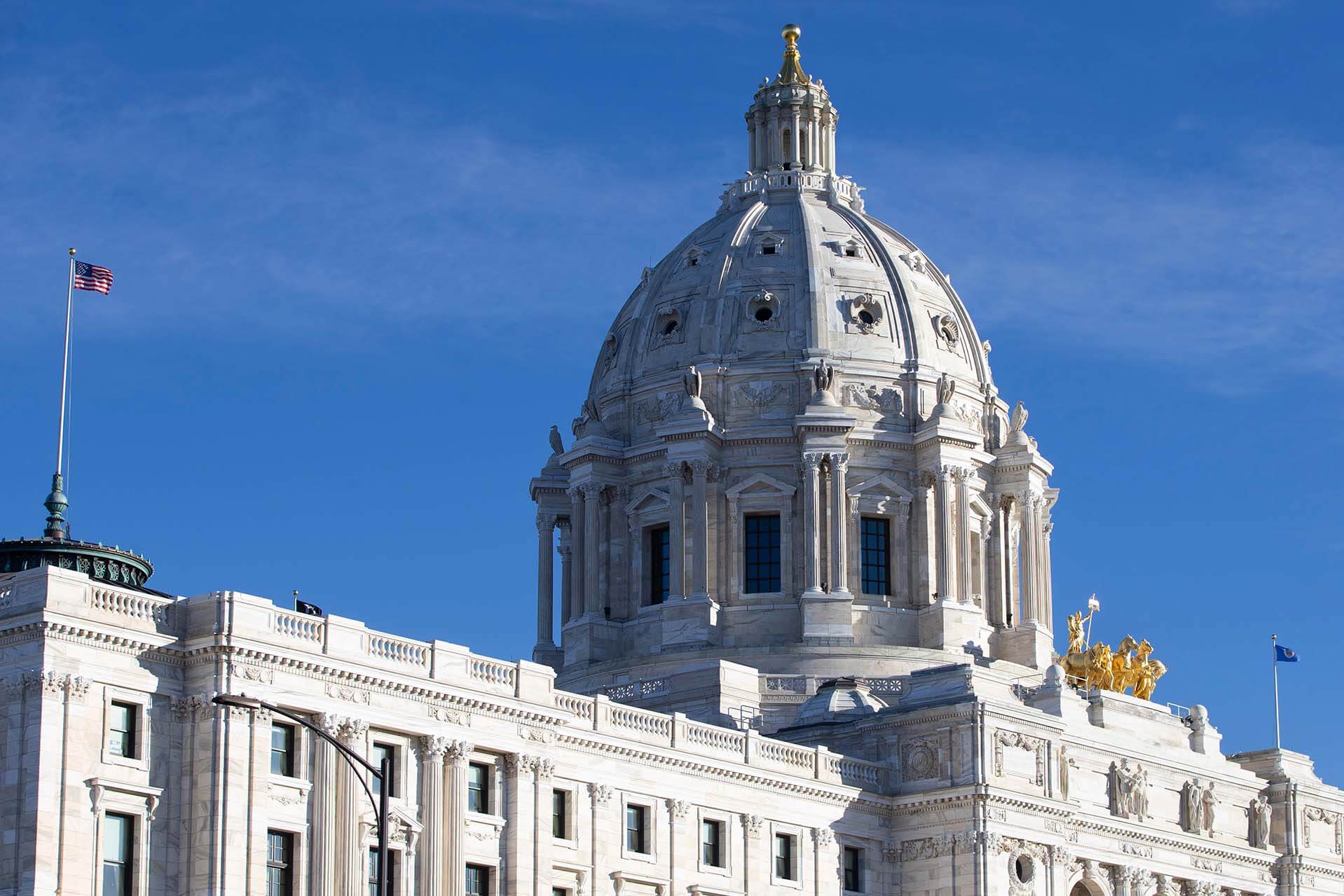
Photo courtesy House Public Information Services
Bills that would affect corn farmers could soon advance in the state Legislature, after Minnesota’s top elected officials announced a broad budget framework Monday.
The agreement, which came one week before the constitutionally mandated legislative adjournment date, was reached by DFL Gov. Tim Walz, leaders of the DFL-controlled state House and leaders of the GOP-controlled state Senate. For the current fiscal year, as well as the next two-year budget cycle, it calls for a $4 billion for a tax bill and $4 billion in new spending. Of the $4 billion in new spending, $1 billion is earmarked each for K-12 education and health and human services and $450 million for public safety. There was also agreement on a $1.5 billion bonding package.
The final details on specifics, which will include components of omnibus bills passed by both chambers in recent weeks, will be ironed out by conference committees in the coming days. As of Tuesday afternoon, budget agreements had been reached for agriculture, environment, drought relief as well as higher education and commerce but not all details were public at time of publication.
Below is a rundown of the omnibus bills that are most relevant to corn farmers and how the House and Senate versions of those bills compare. The Minnesota Corn Growers Association (MCGA) will continue to closely monitor the legislation, as part of its mission to advance policies that positively impact corn farmers and rural communities.
[More: Read additional policy stories on the Minnesota Corn blog]
Taxes
The Senate omnibus tax bill would establish estate tax portability, create a property tax credit for land in compliance with the state’s buffer law and increase the homestead first-tier valuation. None of those provisions are in the House omnibus bill.
The House omnibus bill, meanwhile, would increase the Ag2School credit and expand eligibility for the beginning farmer tax credit. Neither provision is in the Senate omnibus bill.
Both omnibus bills would add provisions allowing fencing to the list of farm equipment that qualifies for a tax exemption. Given that both the House and Senate tax bills have significant provisions that would provide property tax relief, we are hopeful that a final tax agreement will include some positive tax provisions for Minnesota farmers.
Agriculture
The Senate omnibus agriculture bill would create an agriculture best-management practices grant program proposing to provide financial resources to farmers to implement conservation practices that build soil health. Financial assistance under this grant program would not be limited to just traditional cost-share but could also include down payments on equipment, purchases or subscriptions of equipment technology for precision agriculture, low interest loans, the purchases of seed and soil amendments or technical assistance for conservation plans. MCGA is highly supportive of this provision, which was developed in conjunction with multiple agriculture organizations.
The House omnibus bill would ban plastic-coated fertilizers and require the Minnesota Pollution Control Agency (MPCA) to develop and maintain consumer guidance regarding the proper use and disposal of treated seed. It should be noted, the MPCA has already developed this guidance. MCGA raised concerns about this step in written testimony to the conference committee.
MCGA continues to oppose legislation that would prevent corn farmers from accessing critical crop-protection tools and will work hard to ensure the ill-conceived plastic-coated fertilizer ban does not make the final legislation.
Drought relief
The House omnibus bill would allocate $5.1 million for drought relief and allow individual farmers to receive up to $10,000. It would also allocate $13.3 million to the Department of Natural Resources (DNR) and transfer $5 million to the Rural Finance Authority (RFA) for disaster recovery loans.
The Senate bill would allocate $7 million for drought relief and allow individual farmers to receive up to $5,000. It would not allocate any funding to the DNR and would transfer $1.5 million to the RFA.
The conference committee working to resolve the differences has not met publicly in weeks. As of Tuesday afternoon, an agreement had been reached on top line numbers, which is a positive step towards finalizing this important issue for our livestock partners.
Environment
The Senate omnibus environment bill aims to increase certainty for an environmental assessment worksheet requirement specific to public waters that are only on the public waters inventory. This common-sense step would ensure that farmers have consistent regulatory processes that allow room for economic development.
In addition, the Senate bill would bar the DNR and the PCA from enforcing unadopted rules.
The House bill would set a statewide peat-soil-restoration goal, establish soil-health goals, and require feedlots to prove they can shoulder cleanup costs in the event of a closure. Unfortunately, it also would create a registry for all drainage projects.