Putting the farmer in the room sells grain and ethanol
Chad Willis looks back at his year as chair of the U.S. Grains Council
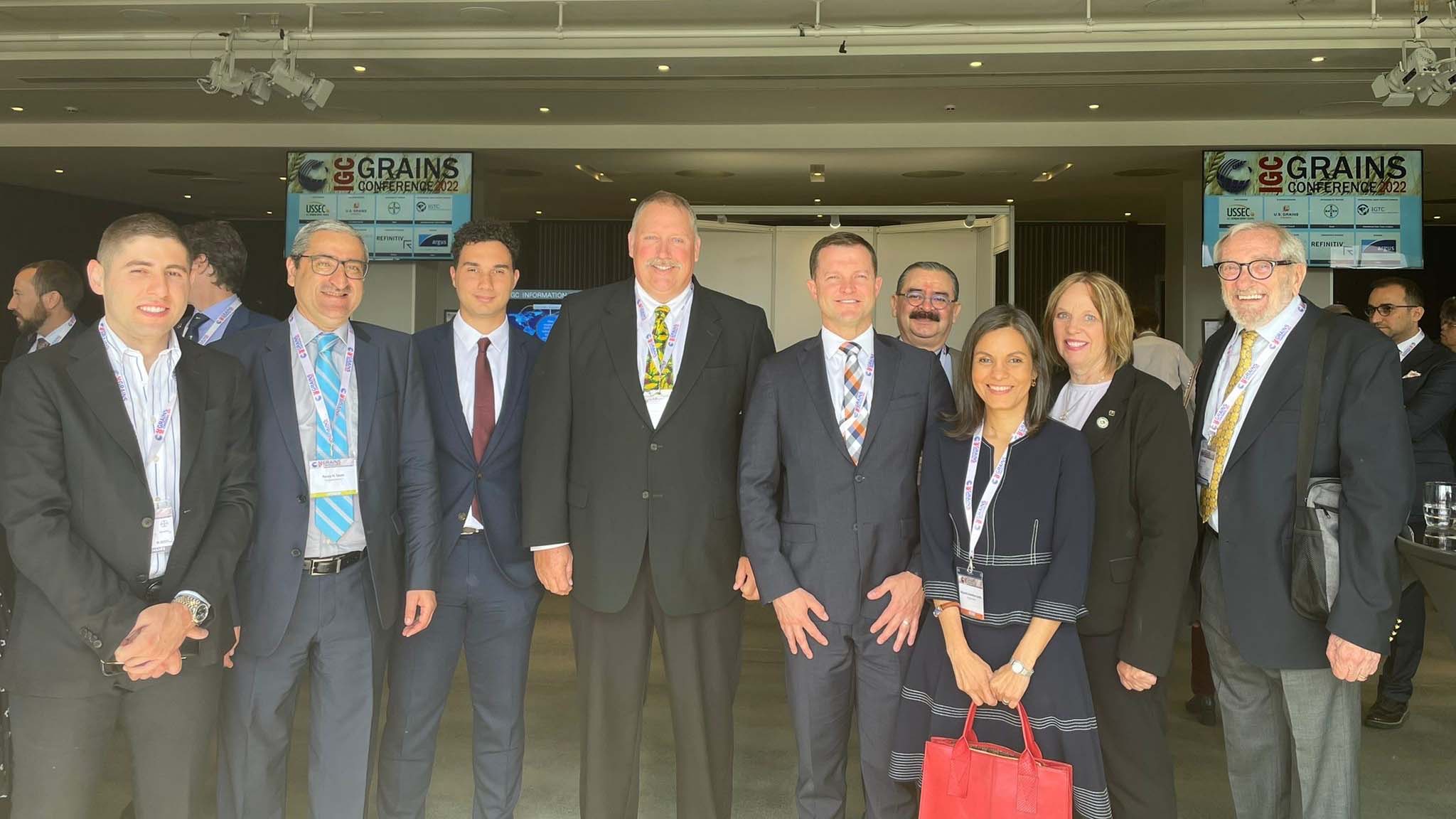
Above: In his capacity as chair of the U.S. Grains Council, Willmar farmer Chad Willis (fourth from the left) attended the International Grains Conference earlier this summer in London. Willis, who also serves on the Minnesota Corn Research & Promotion Council, recently wrapped up his term as USGC chair.
Written by Jonathan Eisenthal
Like Johnny Cash (or Hank Snow), Chad Willis has been everywhere. Almost.
During his year serving as chairman of the U.S. Grains Council, Willis, a member of the Minnesota Research & Promotion Council, traveled to Morocco, Tunisia, Dubai, Korea, Japan and London. He has an upcoming trip to India on his calendar.
Willis handed the chairman’s gavel to Vice Chair Josh Miller at the July 27th meeting of U.S. Grains Council in Sacramento, California.
“Each trip is a little bit different in what you try to accomplish,” Willis said. On his most recent trip, Willis decided to bring the officers of U.S. Grains Council and the National Corn Growers Association to Morocco and Tunisia, where U.S. Grains has been active for the past 25 years. Willis wanted these grower-leaders to see firsthand a very promising model: Morocco’s training centers create livestock feed mill and agriculture industry jobs for Moroccans, while developing a market for American farm production. “Lately folks from other African countries are being invited there for the training,” Willis said. “This model could be used in lots of countries and really has the potential to economically benefit the whole continent.”
Training centers for beef, poultry and dairy production make up a three-part campus where trainees live while learning. U.S. Grains helped a local cooperative called CopAg develop the enterprise, which includes miniature meat-processing and dairy-processing plants. Farmers delivering loads of livestock, eggs or milk can shop at an on-site exchange where they pay from credit for what they sold to the training center. The center also includes a daycare and a school, to make the training a good fit for all potential workers.
Providing the farmer perspective
Korea was Willis’ first trip of 2021-22, accomplished during fast-changing Covid restrictions on travel. The Korean feed industry was very anxious to know about the current state of plans for the 2022 crop, because of the 2021 drought and the very high cost of fertilizer. Much of the attention at presentations focused on Willis.
“They want to know how the crop is going to do, and they like to hear it straight from the farmer,” he said. “I noticed the same thing when I went to Dubai.”
Dubai is the most populous city in the United Arab Emirates, located on the Persian Gulf. The U.S. Grains Council came to Dubai to offer its Corn Quality Rollout report to feed industry representatives from around the globe. In addition to the farmer’s perspective from Willis, they heard reports from animal feed scientists and grain storage experts, in all presenting a thorough and reassuring picture of the state of U.S. grain supplies.
A focus on ethanol promotion
Each U.S. Grains chair decides on a particular emphasis for his year leading the organization. Willis chose to promote ethanol. That will be one of the main objects of the upcoming India tour. With much of India’s domestic farm product devoted exclusively to human food, this creates an opening for the U.S. ethanol industry, which can sell gallons to India to help it reduce its critical emissions pollution problems. Currently, India only imports U.S. ethanol for industrial uses.
Willis also attended the International Grains Conference in London with U.S. Grains Council President and CEO Ryan LeGrand. The most pressing issue in the European market is the impact of the Russian war against Ukraine, the largest grain producer in the Western Hemisphere. Willis toured a number of British ethanol plants, which have used wheat as a feedstock, but which may look to purchase American grain, because of the major drop in exports from Ukraine.
“American ethanol exports are picking up again,” Willis reported. The Council’s board of directors had set a goal of reaching 4 billion gallons, based on recommendations from the National Corn Growers Association ethanol team. However, the economic difficulties posed by Covid put a damper on that. “We’ll get there — it’s just going to take a couple more years,” Willis said. “I just think we should push ethanol exports higher because it’s so important to the U.S. farmer, and to our ethanol plants. If the U.S. government is not going to let us use higher volumes of ethanol, we’ve got to create a market, to keep our corn markets going.”
The importance of the U.S. Grains Council
Willis talks to farmers about the importance of U.S. Grains Council every chance he gets. Even in the midst of their meeting Dubai, Willis had Ryan LeGrand sit down with him, in front of his computer, at 10 p.m., to talk with the ag committee of the Willmar Area Chamber of Commerce about what U.S. Grains does. At the invitation of his pastor Dean Johnson (former state senator and regent of the University of Minnesota), Willis talks about the U.S. Grains Council between church services on Sunday mornings.
“A lot of people are unaware of the role of U.S. Grains,” Willis said. “If our export market weren’t so robust, our whole farm economy would not be as strong as it is. U.S. Grains staff is out there in our field offices in Asia, Africa, the Americas. They are bringing us out to meetings all around the world, to make sure the quality of our corn is known to grain buyers. To help people understand the value of ethanol. The result is a lot of happy customers, and more every year, lining up to buy our products.”