Farm-oriented weather station network gives time-critical info

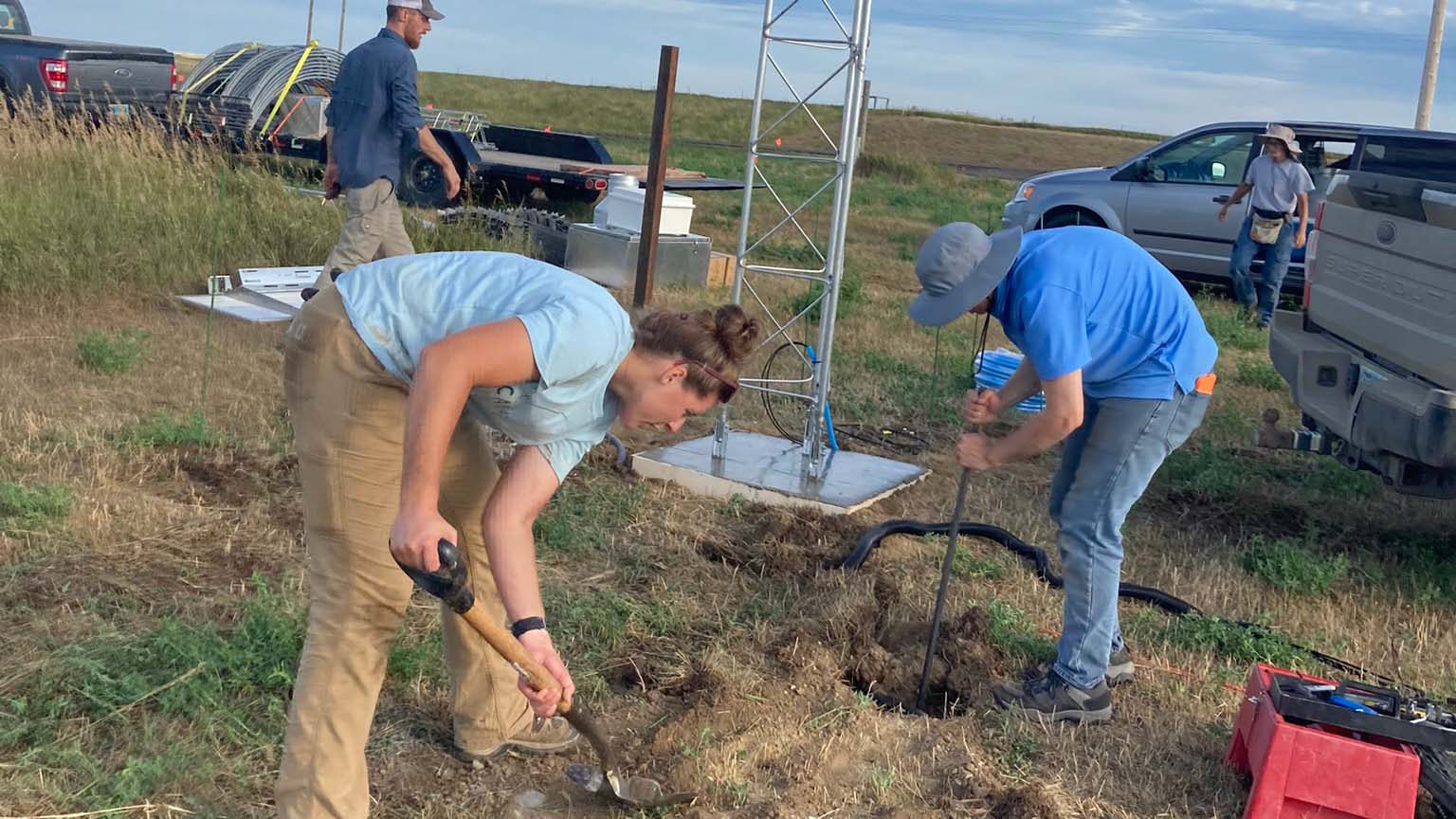
Above: An NDAWN weather station is installed. If you farm in western Minnesota, you could soon have free access to localized, real-time weather data, thanks to an effort by the Ottertail & Grant County Corn & Soybean Growers Association to install five NDAWN stations.
Written by Jonathan Eisenthal
The North Dakota Agricultural Weather Station Network, or NDAWN, is a network of 175 weather stations spaced approximately every 20 miles across eastern Montana, North Dakota, and western Minnesota, its fastest-growing region. Each station is packed with state-of-the-art scientific equipment measuring air temperature, wind speed, rainfall, humidity, solar radiation, dew point, soil temperature, and soil moisture across a range of depths.
All data is posted on the NDAWN website in real time, and offers extremely accurate, state-of-the-art forecasting within a radius of 20 miles of any given station.
Over the past couple years, the Otter Tail & Grant County Corn & Soybean Growers Association raised $90,000 to build five new NDAWN weather stations in western Minnesota. The stations were installed this past summer.
Meanwhile, the Minnesota Corn Growers Association (MCGA) is supporting a proposed $3 million allocation of Clean Water Funds to add NDAWN stations across the state. The Clean Water Council, which advises the state legislature on Clean Water Fund allocations, recommended the proposal this fall. It will still need approval from the legislature.
“By providing this information, we can give our farmers and commercial applicators the tools they need to make well-informed decisions,” said Minnesota Agriculture Commissioner Thom Petersen, whose department supports the Clean Water Fund proposal. “We can decrease the potential loss of nitrogen and increase farm productivity by saving nutrients on the land. It is a win-win situation based on an easy-to-use tool.”
Below is a rundown of how NDAWN stations can help corn farmers during planting and the growing season.
Planting
For proper germination, soil temperatures should be a uniform 50 degrees to a depth of four inches. Planting at this temperature assures even emergence and helps the plant attain its maximum yield.
Planting in colder soils can mean a yield reduction of up to 40 bushels per acre, according to agronomist Rick Swenson, a member of the Otter Tail & Grant County Corn & Soybean Growers Association Board of Directors. As Agronomy Lead with Peterson Farms Seed, Swenson works with many area farmers to help them achieve their production goals, and he believes NDAWN’s expansion in Minnesota will provide an essential service.
The seed damage caused when planting in cool soils can have effects later in the season, too. For example, it could lead to using more fertilizer than necessary, increasing runoff.
NDAWN stations measure soil temperatures along a whole range of depths, from 2 inches to 4 feet. That gives growers a sense of when seeds will germinate, and how quickly roots can grow all the way down through the soil profile.
“The temperature at 2-inch depth might be 52 (degrees), but if your 4-inch reading is still 34 degrees, just knowing that is some incredible information to have in your hands before you plant,” Swenson said. “It can be as little as a day or two of waiting that can mean the difference (between low and optimal yields). Especially if you have 80-degree weather on the way.”
In season spraying
For growers to help their crops reach their maximum yield, they need to fend off a changing array of insect pests, fungal diseases, and weeds, all of which can sap the energy the plant needs to produce its grain.
These chemical controls are among the biggest investments a farmer makes, and highly detailed weather data helps the farmer use these controls effectively. Temperature and wind conditions can make spray applications ineffective. High evaporation potential dissipates spray before it can do its job. Also, the weather conditions under which insects and blights emerge are predictable, so accurate forecasting can save the farmer from wasting controls when those insects or diseases are not apt to arise. The forecast can also help predict the right moment to make the most effective application.
NDAWN helps alleviate these risks in multiple ways:
- Measuring wind temperature, so stations can help growers know when not to spray.
- Measuring air temperature, so stations can help growers know when fungal diseases and insects are likely to be a problem.
- Tracking Delta T values, so stations help growers know if a pesticide would evaporate before hitting the ground.
- Measuring temperature at 20 inches and 10 feet above ground, so NDAWN stations can tell if there’s an inversion in an area.
The NDAWN system also can send real-time text alerts to farmers about temperature inversions. NDAWN Director Daryl Ritchison said the network has the only real-time temperature inversion alert system available to his knowledge.
Applications beyond farming
As stations are added to the network, there is an option to add a high-tech sensor to measure the amount of moisture in each snowfall, as well as other factors that can predict spring flooding. The sensor has been added to 40 stations, but NDAWN hopes that eventually all the stations on the network will have this capability.
These monitors also track the amount of snow deposited in each locale and the relative moisture level in the snowpack. This lets municipalities and regional governments know when it’s time to deploy sandbags and/or close roads.
MCGA board member John Swanson, who farms in Polk County, said this feature could have saved the Fargo-Moorhead area money a few years ago, when it spent a lot of money on flood protection. The measures ended up being unnecessary, he said.