Field Day focuses on women in agriculture

Written by Jonathan Eisenthal
More than one in every three American farmers is a woman, and that proportion is likely growing. That’s 1.2 million women farmers, as of the latest U.S. Census of Agriculture (data collected in 2017).
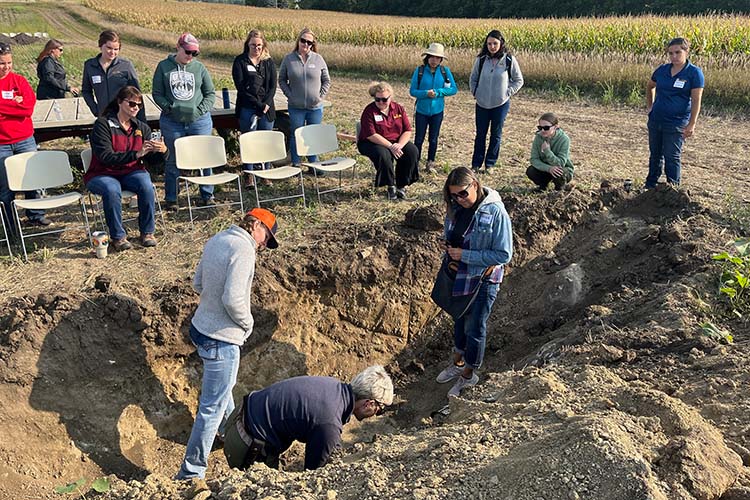
The Thriving Roots Field Day held in Morris, Minnesota, on Sept. 8, celebrated the importance of women in agriculture, attracting 25 women representing farm operators, agronomists, researchers, scientists, and students. They learned about topics such as tillage and its relationship to soil health and how cover crops affect cropland’s water-holding capacity. A soils expert from the Manitoba Province extension service ‘read’ the layers in two soil pits. Attendees were keenly interested in Finpack/Finbin — the University of Minnesota’s farm financial software and database, which helps farmers determine how various choices impact farm profitability. The latest datapoint collected by Finpack/Finbin is how cover crop seed and inputs impact the bottom line of a farm’s finances.
Samantha Nelson and Dana Engstrom attended the talks. They are part of the growing demographic of young women farmers, both operating farms in Minnesota’s top corn-producing location, Renville County.
Engstrom, 26, started farming with her dad, Dan Elliot, when she was in high school, working at their home farm in Sacred Heart, and also at their fields in Hector and Buffalo Lake. She would get home from school and take over driving the grain cart from her grandfather. She began renting her own land when she was 21.
“I’m the youngest of three daughters, and I’m the one who wants to farm,” Engstrom said. Many participants in the field day expressed the feeling that there can be uncomfortable situations — a certain resistance — regarding women who farm, but Engstrom expressed gratitude for all those who have helped her in a field that is still dominated by men.
She also said she has a lot of good teachers and mentors in her community — including her dad — who appreciate that she has become a farmer.
Nelson came to farming after working in both education and healthcare. She has imported what she has learned about planning from both of those professions into her farming practice.
“I have been a project manager, doing innovation projects,” Nelson said. “I love research. I think it’s really interesting, but especially in agriculture. How do you even begin to pull apart all the variables that are influencing what is going on — in that soybean plot, or in that other one — how do you compare them?”
During the field day, both Nelson and Engstrom were fascinated by the information gained by carving a one meter by three meter trench in a farm field and examining what is happening in each layer of the soil. Two pits were excavated about fifty yards apart on different points of a slope. The upslope trench showed a distinct lack of topsoil, while the downslope trench showed an overabundance.

Over time, cultivation and erosion had moved the topsoil down the hill. Engstrom became fascinated with an innovative approach advocated by Manitoba soils expert Marla Riekman known as “soil landscape restoration,” where 6 inches of topsoil is scraped from the lowland and carted up the hill. In combination with no-till cultivation, this engineered solution can offer a measurable yield gain for 20 to 30 years before a new restoration is needed, Riekman said.
“That really interested me,” Engstrom said. “We do have quite a bit of the high ground that has gotten worn down, and it’s drier up there, and the crops don’t always produce up there. It interests me that this is something people have done, and I would be curious to see how that works and how people go about doing it and what the reward is. What that outcome looks like.”
“The pits are totally different,” Nelson added. “It’s almost like you can’t ever have one answer (regarding the fertility of a whole field), but instead you have to know the profile of every farm that you are farming, and even the different parts of each field. So, I have a notebook that I keep in the top of my lunchbox, and I have a ‘personality’ for every farm that we farm. During planting season, I take notes on that farm — there are different areas of the field that have different personality traits. It’s just my way of getting to know each piece of land. At the end of the day, you want to get a good yield, so you want a good seed to put in the ground. When I talk about our farms with my dad or my husband, we talk about how the soil is the ultimate beginning point. If you don’t know your soil, you can’t know if it’s healthy or not.”
Featuring tillage equipment
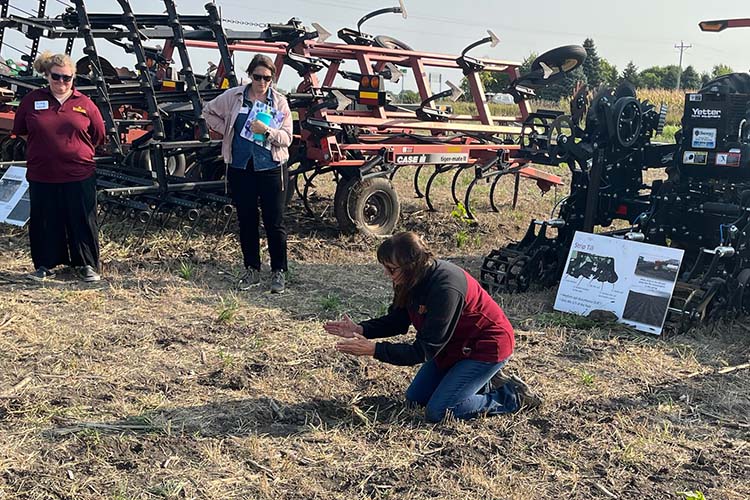
Also during the event, University of Minnesota Regional Extension Educators Jenn Hahn and Jodi DeJong-Hughes set out a row of tillage equipment, ranging from the most aggressive tillage, moldboard plow, down to strip tillage machines that disturb only a third of a field, and in those strips limit tillage to the zone needed to establish the seedling — the top three-to-four inches of the soil.
In addition to being the most fuel- and time-intensive method of cultivation, moldboard plowing also destroys the structure of the topsoil that was created in a very slow process by the biological activity in the soil. The result is soil that is prone to compaction, runoff, and erosion. Moldboard made sense when mechanical methods were the only ones available for making a new seed bed or controlling the weed seeds, according to these experts. An argument can be made for using the moldboard in very limited areas when immediate need arises in the short planting season window for a dry seed bed. The fact that John Deere no longer manufactures moldboard plow attachments speaks to all this accumulated understanding of their impact.
University of Minnesota Prof. Anna Cates, a soil health specialist, and her graduate student Bailey Tangen showed a plot with various plantings of species of cover crops, and then had participants run tests of the intake rate of water in different plantings. They talked about the choices farmers make for cover crops, dictated by when these species can be planted, how deep their roots delve, and how much biomass they produce. They talked about the benefits to soil health, to reducing erosion and increasing water infiltration, as well as moderating the surface temperature of the soil. But they also spoke about the challenges in dry years when cover crops can compete with cash crops for limited moisture.
The Thriving Roots Field Day was sponsored by Minnesota Corn and took place at the University of Minnesota West Central Research and Outreach Center in Morris. DeJong-Hughes and Susanne Hinrichs with the University of Minnesota Women in Ag Network organized the event.