Legislators, staff visit UMN mesocosm facility
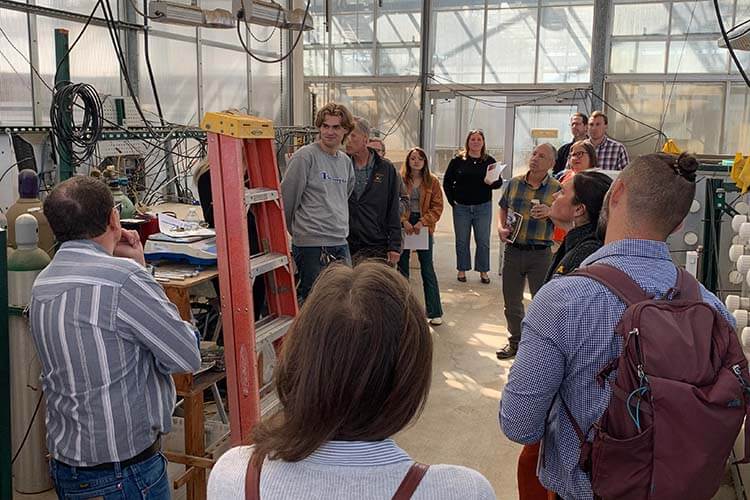
Last week, a group of state legislators and state government staffers visited the University of Minnesota mesocosm facility in St. Paul. The visit was coordinated by Minnesota Corn in partnership with University of Minnesota Professor Tim Griffis, who is conducting a series of corn check-off-funded studies into nitrous oxide emissions at the facility.
The tour group included Rep. Patty Acomb (DFL-Minnetonka), who chairs the House climate and energy committee, and Rep. Robert Bierman (DFL-Apply Valley), a member of the committee. It also included staff from the office of Sen. Aric Putnam (DFL-St. Cloud), who chairs the Senate agriculture committee, and the office of Sen. Heather Gustafson (DFL-Vadnais Heights), a member of the committee.
Other tour participants included Gov. Tim Walz’s agriculture policy advisory, a House GOP research consultant, and staff from the Minnesota Department of Agriculture.
During the event, Griffis explained how nitrous oxide emissions, which result from bacterial respiration in waterlogged soils, are particularly acute in the spring and early summer. He said his group has studied several potential methods for reducing nitrous oxide emissions, including the nitrogen-fixing microbial product Pivot Bio ProveN, cover crops, and enhanced efficiency fertilizers.
Additionally, Griffis explained how he and his team are studying whether compounds found in grape seeds called procyanidins can limit the microbial process that leads to nitrous oxide emissions. Griffis and his team are studying procyanidins thanks to funding from the Minnesota Corn Innovation Grant program.
[More: Read about Griffis’ latest corn check-off-funded research project]
In addition to learning about the studies, the group toured the mesocosm facility, which includes multiple growing chambers. Graduate student Michelle Bohnen and researcher Sam Strack explained how the facility allows the research team to carefully control growing conditions and plant multiple corn crops in a single year.
The group also learned about Minnesota Corn’s research program from the organization’s executive director and CEO, Dr. Adam Birr. Birr noted how Minnesota corn farmers invest more than $2 million of their own dollars annually through the Minnesota corn check-off into projects aimed at improving the productivity, profitability, and sustainability of corn production. That has included over $22 million in research projects at the University of Minnesota since 1985.
The Minnesota Corn Growers Association thanks Acomb, Bierman, and the state staffers for taking the time to learn more about the nitrous oxide research projects. Learn more about the projects at mncorn.org/research.