MN Corn sustainability journey detailed
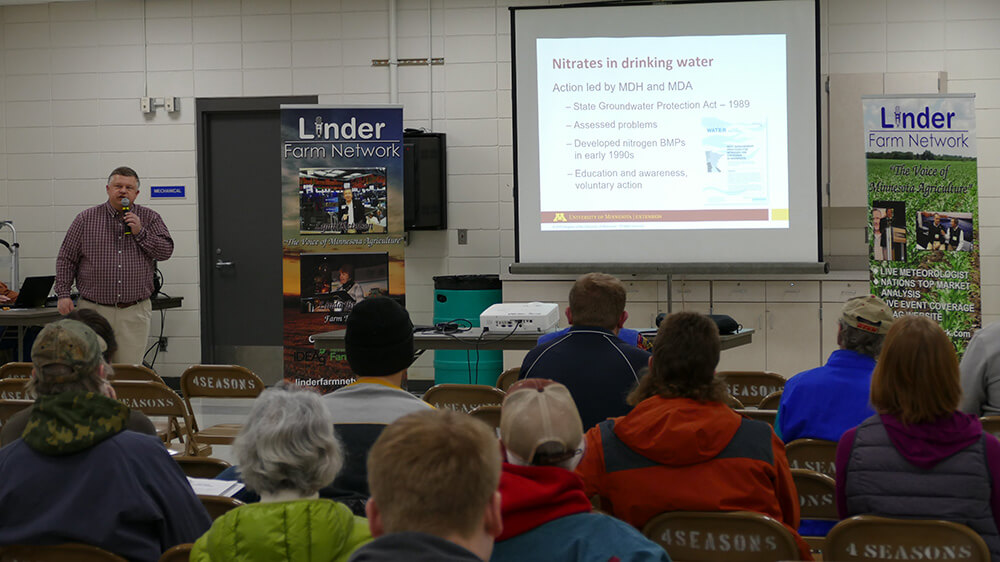
CEO Adam Birr, Senior Public Policy Director Amanda Bilek present the organization’s sustainability work
Minnesota corn farmers are committed to maintaining sustainability in their farming operations while ensuring financial viability. To support them in that journey, Minnesota Corn works to ensure producers have the resources, information, flexibility and support necessary to implement the practices that work best for their respective operations.
In a presentation last Wednesday to the Minnesota Board of Water & Soil Resources (BWSR), Minnesota Corn Executive Director and CEO Adam Birr and Senior Public Policy Director Amanda Bilek outlined this sustainability journey.
Over time, corn farmers have become more productive and efficient, Birr and Bilek said, increasing yields while maintaining the same number of acres in production and using less inputs. They’ve also engaged in conversations around conservation practices, Birr and Bilek said, with many already taking steps toward implementation in their own operations.

Birr and Bilek said economics can get overlooked in sustainability discussions, with challenging years like this one requiring tough choices. For example, as they prepare for the 2025 growing season, farmers face slumping grain prices, elevated input costs, and middling yields, all of which will create difficult conversations with lenders as producers seek operating loans.
Still, even with the challenging outlook, Birr and Bilek said corn farmers are committed to sustainability. For example, they noted that corn farmers invest nearly $2 million of their own funds each year through the Minnesota corn check-off into university-level research projects focused on nitrogen management. That includes research at the University of Minnesota focused on nitrous oxide emissions associated with farming and the University of Minnesota Extension Nitrogen Smart Program.

Led by Extension Educator Brad Carlson, Nitrogen Smart includes workshops and webinars that help farmers understand the nitrogen cycle and nitrate leaching potential. Over 1,200 farmers managing nearly 1 million acres have participated in the program to date.
Birr and Bilek also noted how the Minnesota Corn Growers Association (MCGA) supports public policies and programs that allow for increased adoption of voluntary conservation practices. For example, Bilek highlighted MCGA’s leading role in the State Legislature creating the Soil Health Financial Assistance Program, which provides farmers with grants for the purchase and retrofit of soil health equipment. To date, in two rounds of soil health grant funding, the Minnesota Department of Agriculture (MDA) has awarded 97 grants totaling over $2.8 million to farmers, producer groups, and local government units across the state.
Bilek also noted MCGA’s support of the Minnesota Ag Weather Station Network, the AgBMP Loan Program, and Agricultural Water Quality Certification Program, which allows farmers and ag landowners to take the lead in implementing conservation practices. Additionally, she highlighted MCGA’s letter of support for BWSR’s Advancing Soil Health in Minnesota Agriculture project through the USDA’s Regional Conservation Partnership Program. The project will offer financial incentives to producers for implementing soil health best management practices and systems such as no-till, strip-till, rotational grazing, and cover crops.
Leading the way on the farm level
At the organizational level, Minnesota Corn farmer-leaders know it’s important to have a baseline accounting of the progress farmers have made in practice implementation while understanding the opportunities that lay ahead, Birr and Bilek said. That’s why many Minnesota Corn farmer-leaders have undergone third-party sustainability assessments of their own operations over the past couple of years. Conducted by Eocene Environmental Group, which utilizes the latest USDA-approved modeling, the assessments provide a snapshot of on-farm soil health, water quality, and greenhouse gas emissions on nearly 40,000 acres farmed by Minnesota Corn farmer-leaders.
The assessments show that Minnesota’s corn farmers are walking the talk on sustainability, Birr and Bilek said. For example, approximately 22% of the assessed acres were planted with a cover crop, Birr and Bilek said, noting the statewide average from the latest Census of Agriculture is approximately 5%. They also noted that a majority of the nitrogen was applied pre-plant and in-season, optimizing its availability when the corn plant needs it. The assessments also show strides in farming practices while providing a roadmap for improvement.
Birr said farmers are interested in implementing best management practices but need flexibility noting that some practices won’t make sense on all fields. He and Bilek said farmers see significant opportunity in the many streams of funding available for on-farm conservation and that farmers are committed to continuous improvement.
Learn more about Minnesota Corn’s approach to sustainability and how the organization supports rural communities, stewards natural resources, and ensures the prosperity of family corn farmers here.