Seeing (and meeting) is believing
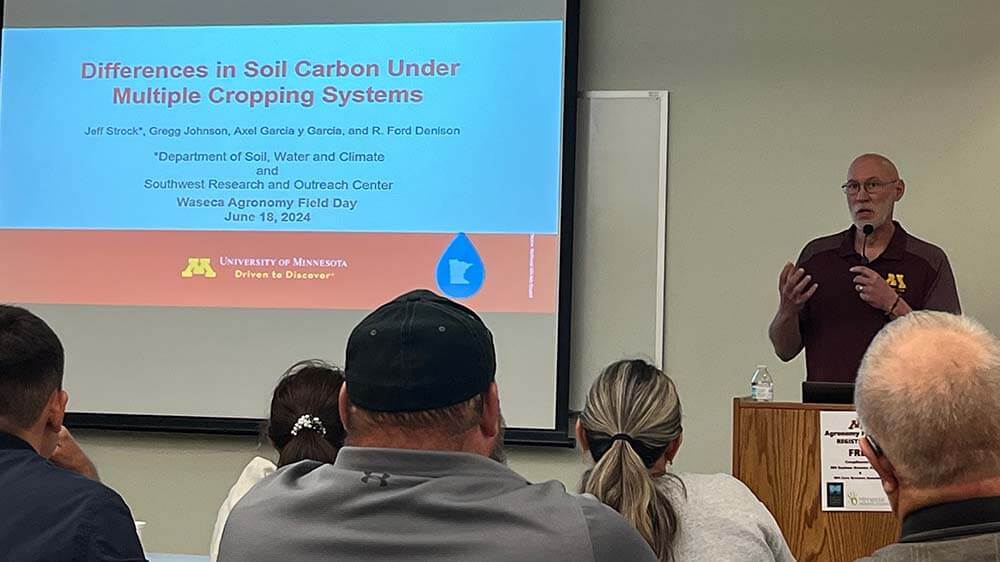
Agronomy Field Day at UMN research center connects farmers to researchers
Written by Jonathan Eisenthal
Science guides farmers’ choices in everything from planting date to fertilizer rates to which combination of herbicides to use to combat water hemp.
But seeing plots and comparing the results visually really helps ground-truth the results for farmers, ag professionals, and even other ag scientists. Meeting together with the broad range of practitioners gives events like the Agronomy Field Day, something you can’t get anywhere else.
“At the Agronomy Field Day, you get into conversations with neighbors or people you haven’t seen for a while, and with the researchers—Jeff Vetsch and Tom Hoverstad and the other great scientists,” said Peter Anthony, who farms near Mankato. “A lot of new thoughts and ideas come up that would not have if I was sitting at home watching a recording.”
Stephan Melson, an independent crop consultant with United AgTech in Trimont, agreed that the event offers a lot of opportunities one doesn’t find everywhere. He said, “It’s a way to brush up on what you have seen, or what you know, or what you have experienced in the past, and then it gives you a chance to ask the professionals, the experts in their field, specifically the people who are doing the research. It gives you a chance to talk to these people. You can read an Extension article, but it’s easier just chatting with them, sometimes.”
Just as valuable to Melson: the presence of a large contingent of farmers in the audience:
“I do find it valuable to get a sense for farmers’ train of thought. It gets us out of our bubble, out of our confirmation bias, so we can just hear what they are thinking, how they are seeing things.”
Melson is a dedicated attendee of these events, but he notices a positive difference in the last year:
“There were more people in the room, and I think that has a direct correlation with the Minnesota Corn Growers and Soybean Growers sponsoring it.” (Note: Minnesota Corn sponsored the event through farmers’ support of the Minnesota corn check-off.)
With the support of the farm organizations, admission has gone from $30 to free, including lunch and mailed materials.
Attendance in 2024 stood at 110—the largest it has been in 10-15 years, according to organizer Jeff Vetsch, a researcher who has been with the Southern Research & Outreach Center since 1993.
“Tom Hoverstad and I have done this Agronomy Field Day and plot tour in June for our whole careers here,” Vetsch said. “One of the things that Tom always says, which I think is a really valuable way to look at it is that (farmers and ag professionals) value the research information we provide at the meeting, but they also value those two-to-five-minute opportunities to talk to a specific researcher about a specific topic or question they have. They know who they want to ask. And sometimes they put their question to more than one researcher. It’s the ability to get all those people in the same room at the same time that really makes Agronomy Field Day special.”
“The other key feature is that it happens during the growing season, so it’s very much about ‘what’s happening now,’” Vetsch added. “In the case of this year, it was all about the excessive moisture in so many fields, and had it led to leaching and nitrogen loss? That was the focus of that discussion—that if we got another week of this kind of rain, those fields would lose possibly as much as half their nitrogen. … We have had some data since then that have confirmed that, on how our nitrogen system trials performed after that.”
Agronomist Jeff Coulter pointed to a silver lining. Cooler weather had come along with all the rains, which meant the corn crop was slightly delayed in its development, and so there was a longer window when farmers could apply rescue treatments of fertilizer.
“There were opportunities in late June and early July for farmers to apply supplemental nitrogen to corn,” Vetsch said. “And some had to use aerial applicators to get around field conditions too wet for heavy equipment. Here at the Research and Outreach Center, we started two supplemental N studies the first week of July. That corn was at V12, just the time when it is getting pretty late for those types of applications, but it was an interesting opportunity. We don’t get those conditions every year. So, we did that sidebar research to investigate the benefits of applications closer to the start of the reproductive phase. When we made those applications, we knew it was only about two weeks until tasseling would begin. The greatest demand for N happens between V6 and R1 stages.”
Agronomy Field Day helps train the next generation
Melson said United AgTech always makes a point of bringing the agronomy students who are with them as summer interns to the event. “It’s a chance for them to see what we are seeing, to talk with the experts,” he said. “At the Agronomy Field Day presentations, they may be hearing the same information they are getting in their classes, but to hear it from another person, in another context, may be really helpful to them. In this other setting, suddenly, it’s not just us telling them what we think—it’s a direct window on the research, and it’s a really valuable learning resource.”
Anthony, the Mankato area farmer, is no stranger to on-farm research. He and his wife, Katey, both studied soil science at the University of Alaska, and the scientific approach they bring to farming, along with many of their neighbors, has really come home to their boys, age 9 and 12, who accompanied Peter to Agronomy Field Day.
“The boys were keyed into the presentations the whole time,” Peter said. “As part of their homeschool curriculum, we have them do some plots and experiments and presentations. The biggest impact on them of Agronomy Field Day was seeing how interested all the other farmers and agronomists and the ag community was, in showing up and listening to Jeff and Tom and everyone else talking about what their findings and observations were. It showed the boys how much the research matters, and in turn it is really motivating to them—suddenly their plots are not just something mom and dad tell them to do, but this kind of research work makes a difference to everyone.”
Minnesota Corn has supported the Agronomy Field Day and the Southern Research and Outreach Station’s winter meeting as well to assure that both events are free to all. This coming January, all attendees can get the results from the research plots, including the supplemental nitrogen trials the Waseca researchers were able to add this year. The twice-yearly meetings provide a kind of balance to each other and an interactivity that benefits the entire agricultural community.