Speaking the language of bacteria
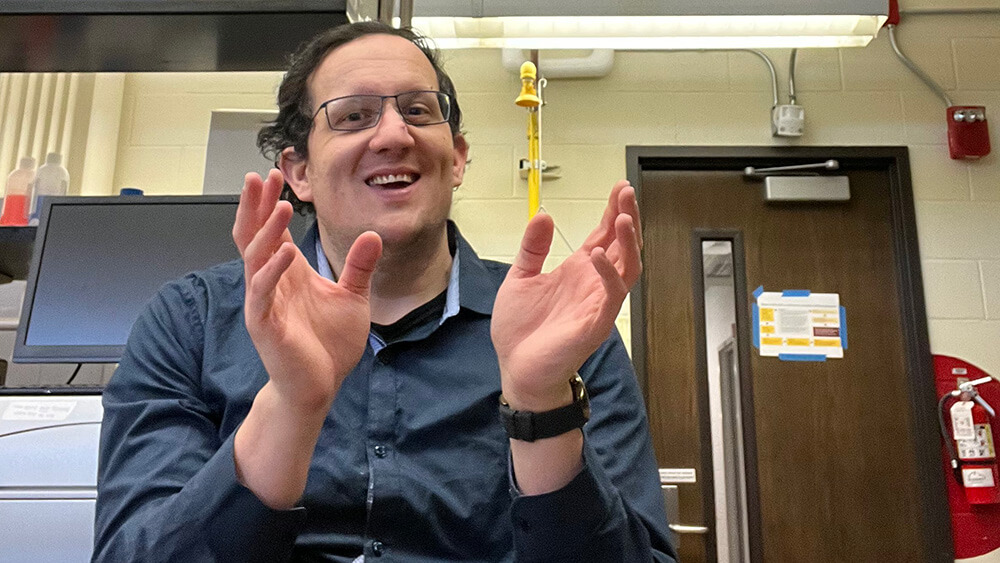
Researcher treats plant disease with biological control
Written by Jonathan Eisenthal
American farmers lose nearly 13 million bushels of corn every year to Goss’ Wilt, a bacterial infection. Currently, there’s no satisfactory treatment for the disease. Often, farmers are forced to destroy part or all of a field’s crop in order to prevent the spread of the infection.
In research funded by the Minnesota Corn Research & Promotion Council, University of Minnesota Scientist Mikael Elias has found a means to blur/interfere with the “the language” of bacteria in a way that disrupts their behavior without the need for chemical controls. This will allow the bacteria to continue to live normally in the environment but prevent them from becoming pathogenic.
“Our solution involves a protein called lactonase,” Elias said. “This name comes from its ability to degrade lactones, which are molecules bacteria use to communicate. Lactonase will bind those lactones and break them down into a product that is now chemically different. And this product is now not recognized by bacteria as a signaling molecule.”
Lactones and lactonase are both completely natural.
“This technology does not kill the bacteria,” Elias said. “It’s a very important aspect—the bacteria are still there and they’re still growing normally. The only thing that is being altered by this enzyme is their ability to communicate. So, their behavior changes… bacteria become pathogenic because they need to survive. And as part of the survival response, they will produce those virulence factors that are in general nothing less than scavengers of resources.”
Thinking ahead to the application, Elias believes this protein could be used as an additive, complementary to existing operations and plant treatments.
“Talking with farmers, we know that there is typically treatment for other things applied to corn plants at around V4, V5 stage,” Elias said. We hope that this compound can be used at that time—so that it’s user friendly and requires no specific training to use.”
Farmers who attend the MN Ag Expo in Mankato on January 22 and 23 will be able to hear reports from Elias and other researchers whose projects are being funded by the Minnesota Corn Research & Promotion Council. Learn more about Expo and register here.