Helping decision-makers understand farm issues
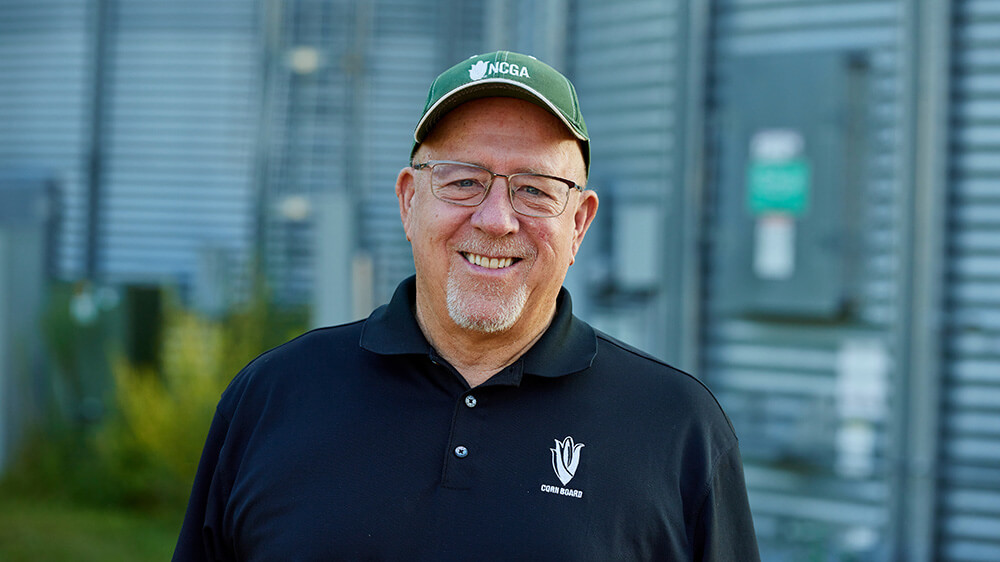
Harold Wolle, Jr. reflects on his year as NCGA president
Written by Jonathan Eisenthal
Editor’s note: Since October 2022, Harold Wolle, Jr., of Madelia has been a member of the executive leadership team on the National Corn Growers Association (NCGA) Board of Directors, serving as First Vice President (2022-23), President (2023-24), and Chairman (2024-25). As Wolle prepares to retire from the NCGA board next month, he reflected on the experience with freelance writer Jonathan Eisenthal. You can read more about Holle’s experience as an NCGA leader in the next issue of Minnesota Corn’s print publication, Corn Talk.
Harold Wolle, Jr., knew it was a precious opportunity, and he had to make the most of it. He had a U.S. Senator in his combine. He had a chance for one-on-one conversation with one of the nation’s most influential lawmakers.
It’s an experience Wolle has had twice, hosting both Sen. Amy Klobuchar and Sen. Tina Smith on his St. James, Minnesota, farm during his term as president of National Corn Growers Association, from fall 2023 to fall 2024.
“Building relationships with our politicians; that’s the key. It really might be the most important way that we can be a voice for agriculture,” Wolle said. “Talking to the politicians who shape policy, just the two of you talking in your combine, that is a wonderful opportunity. I made the case for how we do things on the farm and how that forms the basis for our views on farm policy.”
Wolle used the time to present farmer priorities like E15 and strong overseas trade. If he had more time, he would have included another element, and he believes farmer-leaders should emphasize another reality in American farming practice—the growing emphasis on conservation.
“I would have liked more time with each of them to talk about the different aspects of our farm, and our approach to sustainability and conservation,” Wolle said. “Those are best understood when you can actually see an example, for instance, a grassed waterway, a terrace, no-till crops, or cover crops.”
Another pillar of NCGA leadership is communication with the public. Wolle believes farmers can affect how people feel about farming. In the national conversation about food and farming, NCGA has taken an active role to help farmers continue to farm the way they want to farm. Wolle says farmers can show what they do and why they do it, and convince the public that everyone benefits when farmers are profitable and productive, when laws ensure the future of the family-owned-and-operated farms and that the public benefits from supporting farmers’ efforts to preserve the natural resources used in the making of food, fiber and energy.
There is a lot of “noise” and factually incorrect messaging, and it is a constant effort to counteract that, according to Wolle.
Science and data won’t win the argument by themselves, according to Wolle, but the ability of an actual farm producer to speak while standing on a foundation of facts is a very effective combination, Wolle feels.
Current leaders face the challenge of pushing back against statements critical of crop protection tools in the initial “Make America Healthy Again” report released this past spring.
“The MAHA commission made statements in its initially released report that were critical of some of the crop protection tools that we employ,” Wolle reported. “It’s imperative that we as NCGA leaders make sure MAHA uses actual rigorous science when they issue their final report. The crop protection tools we use on our farms have been thoroughly reviewed by EPA. We are not out here using unproven products. They’ve all been thoroughly tested and found to be safe before the Environmental Protection Agency grants these companies permission to manufacture and sell these products.”
With farmers facing the least profitable season in two decades, due to the rising costs of inputs, and the low prices in the commodity markets, Wolle feels farmers need to convey this reality to both lawmakers and the public. The need for strong markets for farm goods becomes the basis for the work that NCGA and the state corn organizations do to innovate new uses and increase the demand for corn. NCGA represents more than 36,000 dues-paying members and interests of more than 500,000 farmers who contribute through corn checkoff programs in their states.
“The cost of our inputs, from seed to fertilizer to chemicals, just keeps rising and we are paying higher interest rates as well—this combination is causing economic stress in the countryside,” Wolle said.
One solution for strengthening commodity markets is close at hand—to increase the amount of ethanol used in America’s vehicles. Wolle is optimistic that the country can move in that direction. The other essential element of commodity markets is trade, and learning to navigate the new reality of America’s tariff-driven trade policy will make a major difference for the ability of farm producers to maintain and grow our share of global markets.
“Currently, around 36% of the nation’s corn goes to a biorefinery and is made into ethanol and dry distiller grains,” Wolle said. “That’s a result of farm organizations pushing for that policy. It’s a great success. It’s a significant market for corn. But there is still room for growth that makes sense. If we could go to year-round E15 nationwide, that would increase the blend rates in the liquid fuels market. Minnesota is very fortunate because of a variety of factors. Our blend rate currently is 12.7%. So that means, for every gallon of gasoline we’re marketing, 12.7% of it is ethanol. Nationwide, the blend rate is just barely above 10%. Each percentage point we can increase the national blend rate equates to 400 million bushels of corn. A 15% national blend rate would substantially help reduce the carryover, the mountain of grain that we carry over at the end of each growing season.”
The continuing resolution passed by Congress this past December initially contained a provision allowing for nationwide, year-round E15, but it was removed from the final version of the legislation. Wolle believes another suitable, must-pass bill can be found, where E15 can be included. He believes Congress has enough votes, and that the executive branch will come around to the farmers’ point of view on the issue.
Wolle still serves as chairman of NCGA until the turnover of the officer’s slate in October, and so he will take part in an upcoming push to pass E15 legislation.
“We have a fly-in to Washington in September, so we can get it fresh again in the legislators’ minds. I believe we can convince them we need to get this done and checked off. Once year-round E15 becomes national policy, then we want to move on to an octane standard. That would pave the way for the standard gasoline blend to include even higher blends of ethanol in our nation’s fuel supply. Ethanol is the best octane enhancer on the market now. Higher octane via ethanol is a pathway to greater engine efficiency and reducing carbon and pollution emissions at the lowest cost to consumers.”
Wolle says that electric vehicles will be a part of the future of transportation, but he believes that higher octane via ethanol is a commonsense approach that will win a place in America’s energy policy.
At Corn Congress in July, Wolle gave his final address as chairman to the national delegates. America’s farm organizations and grower leaders work toward long-term goals that often take years or decades to achieve. Wolle said:
“I want to thank all of you for giving me the opportunity to serve as a National Corn Growers Association Officer. It has been the highlight of my career of Board service. Someone asked me what was accomplished during my Presidency. Well, we did not pass the Farm Bill, the Next Generation Fuels Act, or year-round nationwide E15. I guess my message is “don’t give up.” Throughout my Corn Board service, I have been consistent and persistent. We achieved many of our Farm Bill priorities and Tax priorities in the Reconciliation Bill that just passed. We continue to push for year-round nationwide E15. It will happen. And we are laying the groundwork for a high-octane standard. As I ride off to my deer stand this fall, you, the nation’s ag leaders, will be left to carry on the work of the National Corn Growers. Thank you for your persistence.”