Raising the next generation of ag-literate students in Minnesota
Written by Jonathan Eisenthal
Meeting minds in the classroom and winning hearts.
Minnesota Agriculture In The Classroom does that every day.
Its recent 39th Annual meeting was a celebration of increasing impact in endeavors ranging from creating ag-centered lesson plans to bringing students to farms.
Through these activities, MAITC aims to help kids become educated consumers, and to see the potential for themselves in agribusiness careers.
To see how Minnesota Ag In The Classroom does it means seeing the resources MAITC puts into the hands of teachers. Its latest effort is Read and Grow, a web page that offers links to the best books about agriculture for school-age children, broken down by topics.
“Curiosity sparked, connections made, and minds opened,” Ann Marie Ward summed up the year 2025 for Minnesota Agriculture in The Classroom (MAITC). Ward serves as executive director for the MAITC Foundation. She has cultivated a network of 107 active foundation investors—10 of which, including Minnesota Corn, have supported MAITC’s work for more than 35 years. A quarter of all MAITC investors have been funders for over 20 years.
By the numbers, MAITC saw student engagement increase to 158,728 over the year, reaching 88 percent of all school districts in the state of Minnesota. The centerpiece of MAITC outreach is a handsome full-color booklet known as “AgMag,” with different editions aimed at a multitude of educational standards for grades K-12. It’s packed with factual information about Minnesota agriculture and conservation, presented in an engaging style, with lots of photographs and graphics, to ensure that it reaches students with different learning styles and abilities. Distribution rose 21 percent to an all-time high of 107,772 issues in the Fall and Spring. Educators must request classroom issues each year, further proving how much they value this resource.
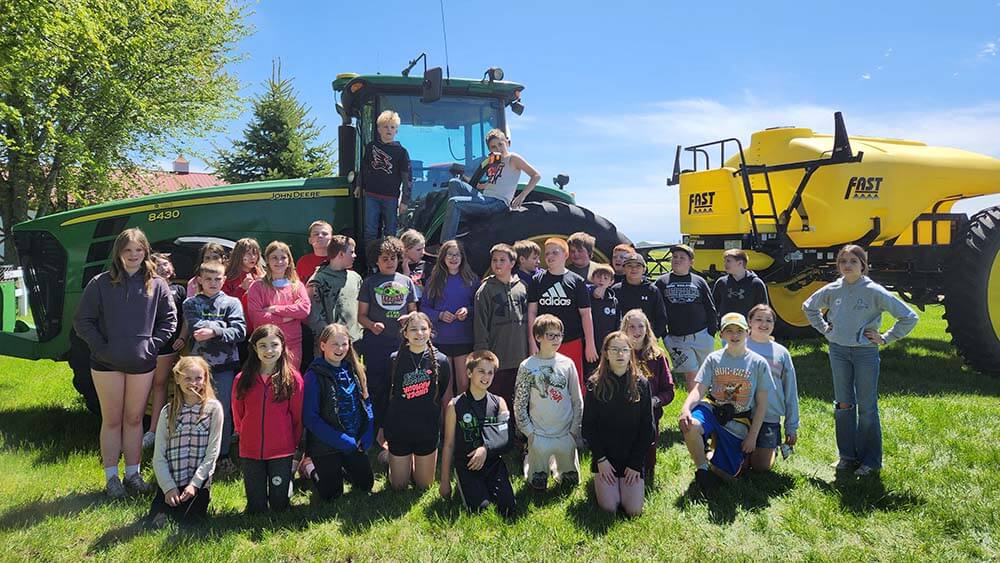
Another fast-growing segment of the MAITC program is Farm Camp Minnesota, which saw a 15 percent increase in student experiences over the last fiscal year, bringing a total of 1,032 students to farms where they met producers and heard the story of agriculture directly from them.
“We have no doubt that Minnesota Corn’s investment in Minnesota Agriculture In The Classroom is money well-spent,” Angela Guentzel said. Guentzel is a sixth-generation farmer near Mankato who serves on the Minnesota Corn Growers Association Board of Directors. “Our mission at Minnesota Corn is to promote the farmers themselves, but to also promote the story of agriculture. Minnesota Ag in the Classroom is always a top choice because they’re making the difference.”
The experienced educators and communicators who make up the MAITC team are the heart of the organization. Minnesota Department of Agriculture has devoted two education specialists to the effort, Sue Knott and Keri Sidle. Sarah Kuschel and Jessica Petroske are MAITC resource specialists who work with teachers across the state to connect them to the wealth of materials and opportunities generated by MAITC.
Year by year, MAITC creates more content and resources for the Web. In addition to Read and Grow, MAITC is part of the Curriculum Matrix, an online searchable database hosted by the National Agriculture In The Classroom organization and featuring ag-oriented lesson plans in every subject area, for every grade level and designed to meet state curriculum standards.
Farm Camp Minnesota is a customized three-part experience for 5th-12th graders that efficiently meets several goals, according to Brandi Wulkan, its director.
“We impacted 1,032 students and across 21 counties,” Wulkan said. “We had 13 farm camps, which included 23 schools, 55 educators, and 31 agricultural host locations with many more hosts involved. Farm Camp is a three-part experience. (It begins with) in-class lessons that meet academic standards to give students some background knowledge before they visit the farm or agricultural business. Part two is the actual experience on the farm or within the agribusiness, and then the final part offers career lessons after they return to school. Our agricultural hosts shared repeatedly this year their impressions were that students were asking informed questions when they come to the farm. The third part, these career lessons are such a crucial aspect of Farm Camp because they give students the opportunity to see that you can be involved in agriculture even if you don’t see yourself as a farmer. Our agricultural hosts talk about the careers that they had before getting to where they are now and the careers of people that they interact with regularly. When students get back to school, they dive into conversations about careers. They utilize the career wheel from AgCentric! (also known as the Center for Agricultural Excellence). The students can also watch the Careers Beyond the Farm video seriesto learn from industry professionals.”
Careers Beyond The Farm video series was developed by Ward, in partnership with Lakeland Television, Bemidji’s PBS affiliate.
As impactful as in-person farm visits can be, MAITC’s Virtual Field Trips program offers a practical alternative. Classroom teachers can offer their students a 30-minute virtual field trip without leaving school or rearranging the entire schedule. MAITC hosted seven virtual field trips in 2025, impacting 7,332 students, in 370 classrooms. These experiences typically target elementary students.
Increasingly, MAITC is investing in teachers as a foundation for reaching students. For a number of years, MAITC has offered Summer Teacher Tours that have become a very popular professional development opportunity. But this year, while hosting the National Agriculture In The Classroom Conference, MAITC launched its “25 for 2025 Cohort.” They were able to offer scholarships for 25 teachers to attend the conference, not only to experience all the rich and varied workshops (60 workshops were offered), but then to get to know one another and unite as a peer network who can serve as resources for one another, learning and sharpening their skills in bringing agricultural content to their classrooms. The Cohort will meet three times during this academic year (2025-26), each time having a new experience with a particular focus. Their meeting this fall will take place at the University of Minnesota Carlson School of Management and includes a seminar with Prof. C. Ford Runge, examining the impact of tariffs and other economic issues on Minnesota farmers.
The NAITC Conference, which took place this summer in Minneapolis was the organization’s best attended gathering, ever, with 543 registered attendees. Not only did it offer 60 in-place workshops, but through the work of 95 volunteers, MAITC staff and specialists organized 12 traveling workshops that brought these teachers from across the nation out to Minnesota farms and agribusinesses, in a memorable showcase of Minnesota’s ag and food sector.
MAITC’s 40th year promises to continue this trajectory of building connections for a new generation of learners. Making use of technology, ingenuity and the desire to keep American agriculture vibrant, productive and prosperous, The Minnesota Agriculture in The Classroom’s team have become indispensable to the state’s farm and food sector.