Fertilizer Prices Put Economic Squeeze On Farmers
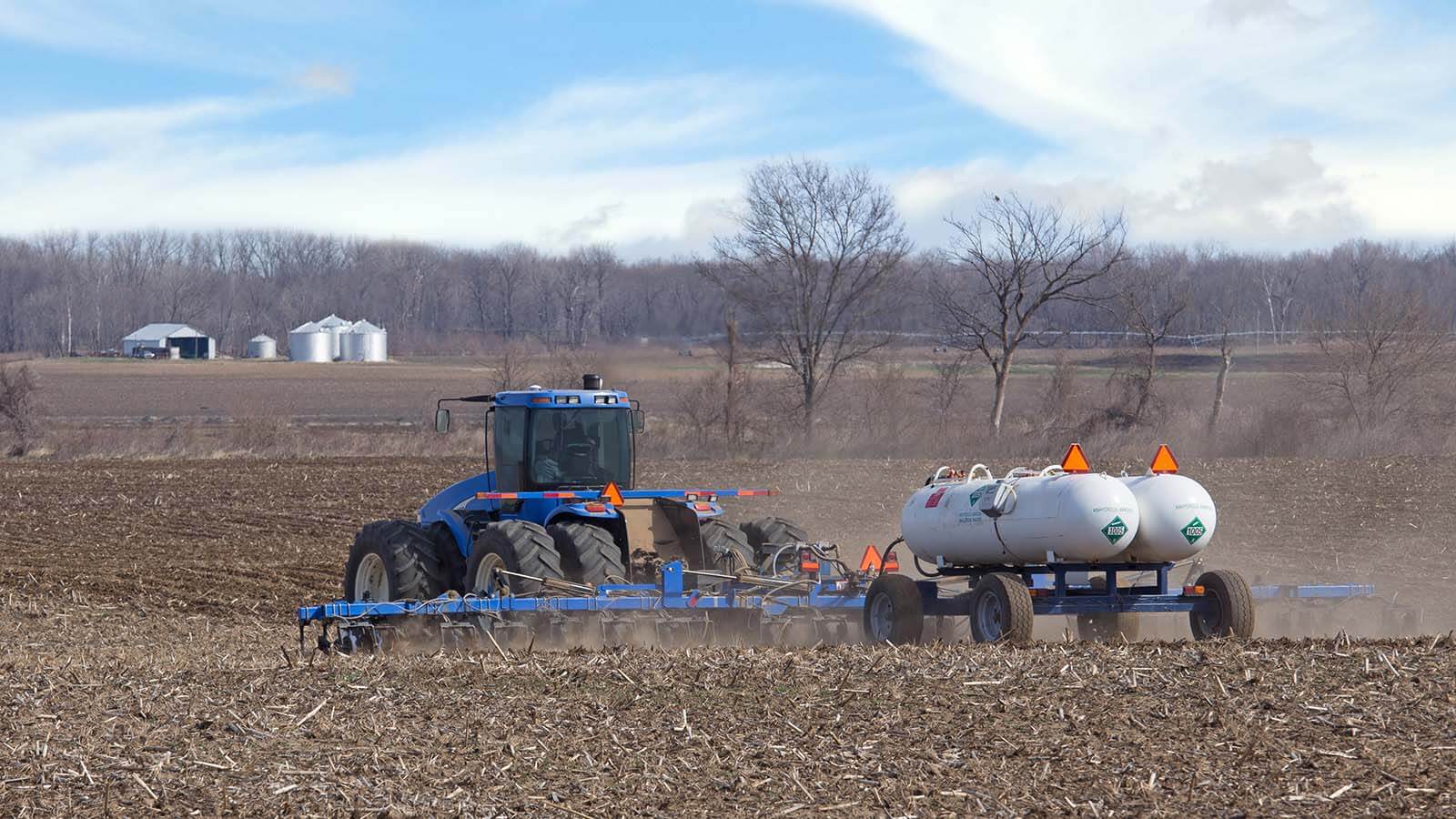
With fertilizer up 55% since 2020, farmers face shrinking margins and are rethinking nutrient plans for the 2026 crop.
Written by Jonathan Eisenthal
In the coming year, it is estimated that it will cost an average of $220 to fertilize an acre of corn in Minnesota, based on projected 2026 crop input and overhead costs and historical data from the University of Minnesota’s Center for Farm Financial Management/FINBIN. It’s the single largest expense for many farmers, and it represents a 55% increase over the average cost of fertilizer five years ago. The price farmers receive for a bushel of corn remains what it was five years ago.
In recent written testimony submitted to Congress, Mark Mueller, president of Iowa Corn Growers Association, offered a grim assessment:
“The massive increase in the cost of fertilizer is crushing corn growers in Iowa, and they aren’t alone. Growers across the country are facing an impossible decision: buy fertilizer or stay solvent,” Mueller wrote.
Looking for causes to the extreme price rises, Mueller pointed to the concentration of the fertilizer supply into the hands of relatively few companies. The lion’s share of the three main macro nutrients needed to grow corn and many other crops—nitrogen, phosphorus, and potassium—are sold by only a handful of companies.
One of those companies, Mosaic, recently saw a 23% increase in year-over-year revenue in the third quarter of 2025, Jim Wiesemeyer reported. Nutrien, the world’s top potash producer, saw its third quarter sales jump 12% year over year, Reuters reported.
Mueller urged the Department of Justice, Congress, and the USDA to work together to vigorously enforce anti-trust laws to bring more competition and better prices into the fertilizer market.
“From a cash flow standpoint, as we head into 2026, economic conditions for farmers are probably a little tighter and a little more dire, not for all farmers, but certainly for some farmers,” said Kent Thiesse, a farm management consultant in Lake Crystal. “The farmers that get hit the hardest are obviously those younger farmers that probably don’t have the asset base to build on. They don’t own as much land. They rely on rented land. And so, they probably have a little higher input cost.”
He noted that farmers carrying a large amount of debt—in some cases from buying additional land to farm—may be hard-pressed by high fertilizer costs.
Projected losses for 2026
According to Thiesse, farmers often calculate input costs according to how many bushels of corn it will take to pay for those costs. The 2026 farm management estimates show that, on average, when corn is $4 per bushel, it will take 157 bushels of corn to pay the projected cost of inputs in 2026, which total $630. Should the price of corn fall to $3.75 per bushel, it would take 168 bushels just to break even on those input costs. Current estimates place the average yield in 2026 at 210 bushels per acre. Take out the $140 per acre overhead cost, and that leaves $28.75 net per acre. For farmers who need to rent their land, or service debt on it, the margin shrinks below the cost of production. The projected profit on an acre of rented land planted to corn next year is minus $205 per acre.
In Mueller’s testimony he noted the role that tariffs, in the form of countervailing duties (CVDs), play in the price rise of fertilizer.
Mueller wrote: “For example, the CVDs increased the price of diammonium phosphate (DAP), a common phosphorus fertilizer, by 28.6% during the period when the CVD was imposed at its full initial level of 19.97%…This increased the cost of phosphorus fertilizers for U.S. producers of various row crops, including corn, by an estimated $6.9 billion for the 2021 through 2025 growing seasons.”
In April, the Trump administration imposed across-the-board tariffs on nearly all imported goods, including fertilizers, as part of its trade strategy. Last week, the administration partially reversed course, rescinding tariffs on nitrogen and phosphate fertilizers, among other products—a move that could help ease pressure on farmers ahead of the 2026 planting season.
Farmers change approach to nutrients
Nick Peterson, 33, farms with his older brother in Clear Lake, Minnesota, in the Central Sands region. He said the prices have changed their approach to nutrients.

“Where we’ve seen the biggest increase in cost per ton of fertilizer is phosphorus in the last year or two…we saw easily 50%-plus increase in the cost of phosphorus sources,” Peterson said.
Instead of replacing what the crop removes from the soil, they plan to “get by” with a lower rate, and “mine the phosphorus,” in the hopes that prices will moderate in the next few years and then they can afford to build the levels in their soils back up.
“I’m a seed dealer, too,” Peterson said. “Getting around and talking to some folks here, everyone was kind of hoping that prices would fall a little bit on phosphorus and potassium, and nitrogen, too.”
But prices remain static, at very elevated levels.
“That’s tough stuff,” Peterson said.
Mueller’s testimony urged the federal government to act:
“Don’t kick the can down the road. The one-time economic assistance payments will hit our checking accounts and then go straight to the dominant fertilizer manufacturers. That aid is a band aid to allow farmers to pay their bills for a season, but it only incentivizes the monopolists to continue squeezing and raising prices more next year in hopes of another buyout. Even with this essential aid—the goal of which we deeply appreciate, we will be back here again next year, one year older and facing even worse competitive dynamics than we are now. Competition issues can’t be solved with cash. Keep up vigorous antitrust enforcement. We need enforcers who are aware of the issues facing American farmers and are committed to being the cop on the beat against monopolists who wield their market power unchecked. Empower DOJ Antitrust Assistant Attorney General Gail Slater and FTC Chair Andrew Ferguson to make our markets competitive. Give them the tools and hold their feet to the fire. Same with Sec. Rollins who should be fully supporting their efforts. At the end of the day, farmers are capitalists—they want to compete on the merits in the economy. Finally, take action before it’s too late. Family farm bankruptcies increased by 55% last year. The numbers will be higher this year.”