Reflecting on the 2025 harvest season in south-central Minnesota
Written by Jonathan Eisenthal
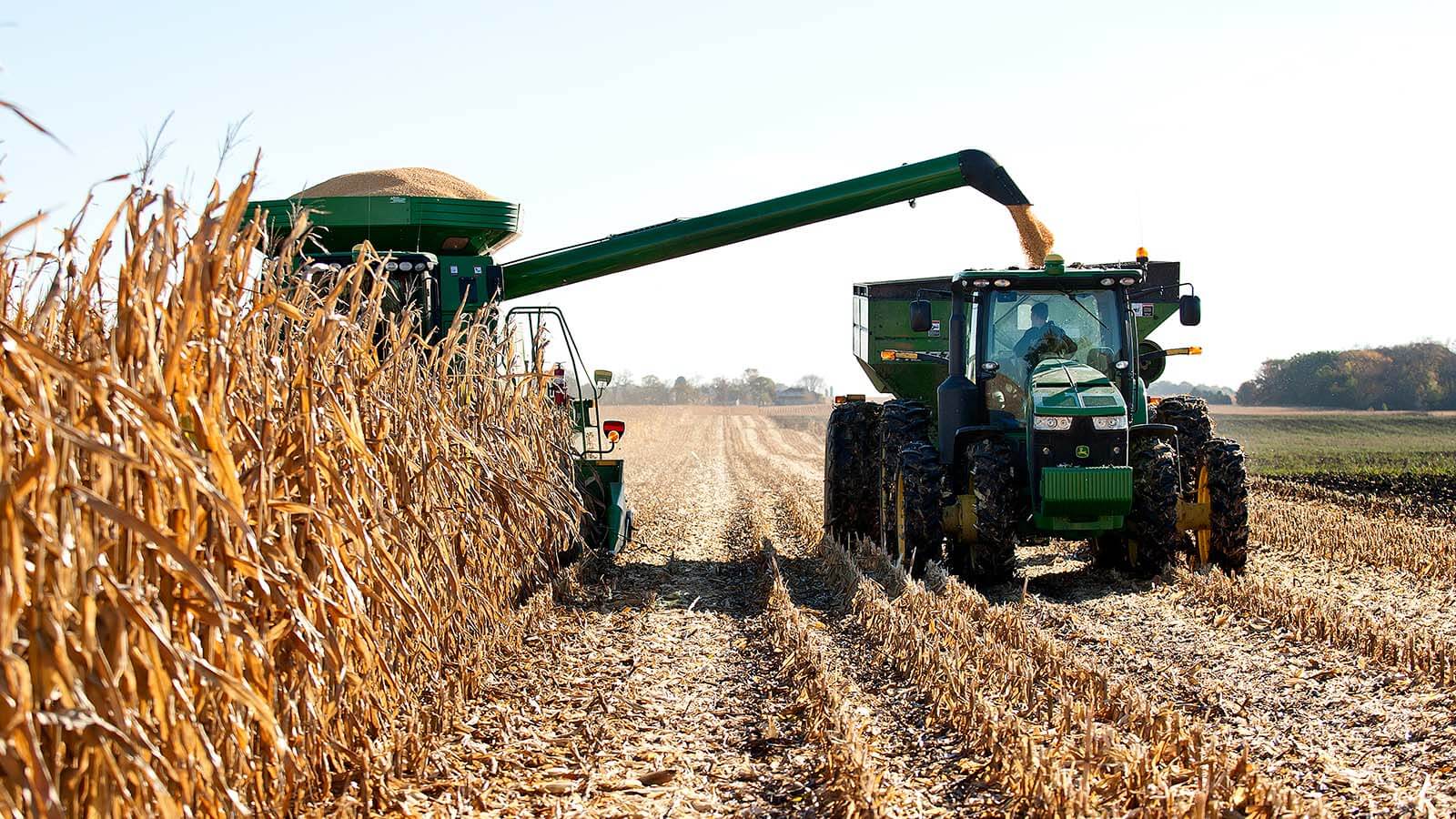
2025 marked Brian Thalmann’s 34th harvest season and Nathan Serbus’ seventh. Looking back, the two farmers say the year delivered a few lessons, and they feel grateful to have seen fairly high yields.
Thalmann, who farms with his son Adam in Plato, said well-timed rains through much of the summer set them up for what eventually was a crop 10 percent above their average production history. What he didn’t count on was that the continually wet conditions also set the stage for higher disease pressure, including white mold.
“We may not get another year with these conditions, but when we have this kind of consistent moisture in the future, we want to be a little more proactive, trying to manage disease a little earlier,” Thalmann said. “If you catch it already in June, you can put something in your soybeans then to help prevent white mold and other diseases.”
More generally, Thalmann takes this year as a reminder of the importance of taking great care with the chemical controls that farmers have in their toolkit, to judiciously use different modes of action in combination, so that no weeds or pests develop resistance to any of these essential chemical controls. It takes a long time and a large investment for an input manufacturer to bring a new control to market, so preserving the utility of the current tools is critical, Thalmann said.

“Some herbicides work on the roots, some work on the growing leaf tissue, whatever the case may be. We are always making sure we use a combination of products,” Thalmann said. He estimated there are several dozen different classifications of herbicides. “When we’re spraying, we make sure our program includes three to five different groups…Because of the challenge of getting new products, we had better take really good care of what we have, and not diminish their effectiveness.”
Serbus, 26, who farms with his dad in Renville, said this year’s bumper crop reinforced his belief in the importance of good on-farm storage facilities. USDA programs can help keep a farmer’s operation in the black and assure their ability to keep infrastructure up to date, so keeping abreast of available programs is a necessity, he thinks.
The Serbuses were awarded a Rural Energy For America Program (REAP) grant—offered to help farmers invest in renewable energy and energy-efficient systems. In their case, they will install a new energy-efficient grain dryer in spring 2026. USDA’s Farm Service Agency (FSA) offers a variety of grant and loan programs that help farmers improve their operations.
Serbus and his father each independently own a farm operation but do all the farm labor and management together. One of the most important elements of their operation is patterned tiling to assure well-drained fields, according to Serbus.
This year, farm fields in Renville, seven miles from the Serbus farms, received more than 7 inches of rain from a single storm, while the Serbuses had the fortune to only receive 0.8 inches. Even so, the tile drainage system was essential to this year’s excellent crop, he said. Working with a family-owned tile plow, they continually repair and extend their tile system, to keep it working well.
Serbus began farming in his senior year of high school and every year since then he feels that he has gotten a deeper knowledge of the fields that they work. He tries not to overlook any tool that can help increase that knowledge. Maps generated from the data collected by onboard computers in their planters and combines offer many essential points of information.
At a glance: Estimated 2025 corn harvest
| Minnesota | Nationwide | |
| Acres Harvested | 8.4 million | 90 million |
| Yield | 193 bushels per acre | 186 bushels per acre |
| Total production | 1.6 billion bushels | 16.8 billion bushels |
Source: USDA NASS, Nov. 14 Crop Production Report