Growing Ag Skills and Knowledge
UMN Extension 12-part weekly seminar series begins January 7
Compaction is a phenomenon that every farmer worries about, but no one really knows what to do about it. (Or, if you think you know, say the experts, you may have it wrong. Ouch.)
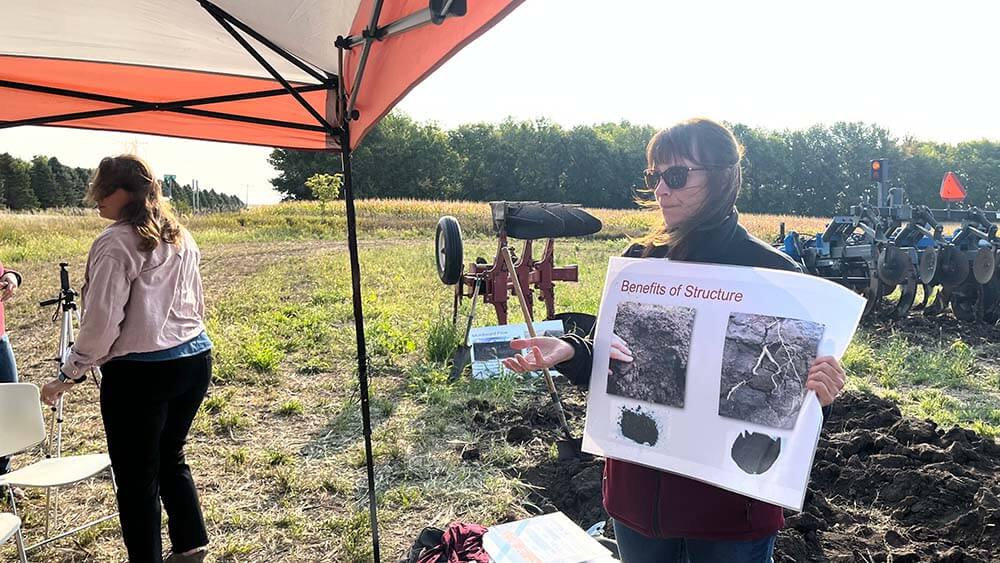
University of Minnesota Extension begins its 2026 Strategic Farming seminar series with this issue because the yield losses due to compaction hit nearly every farmer. The good news: there are lots of researchers working on the issue. Regional Educator Jodi DeJong-Hughes, who specializes in soil health, took a sabbatical to focus deeper learning on compaction, visiting with scientists and farmers across the region who have dug into compaction and learned methods to alleviate it. Among the key finding she will share: it pays to keep to a limited number of wheel tracks (rather than taking heavy equipment across different parts of fields); the more axles the better; double and triple wheel arrays spread the weight, as does tire deflation (when the type of tire allows it); and leave the grain cart at the edge of the field—especially as it gets full it can compact the soil as much as three feet deep.
“Compaction has been a growing problem,” DeJong-Hughes reported. “It’s partly to do with the equipment size getting bigger, but it also has to do with raising a limited number of crops. Adding perennials to rotations, or using cover crops, or employing a number of soil health techniques, can build the soil structure that can better support heavy equipment.”
On the widely held notion that driving in different parts of the field can reduce compaction, DeJong-Hughes warns that 80% of compaction happens in the first pass, so it makes more sense to follow a limited number of tire tracks, when possible.
The Strategic Farming series convenes as a weekly video conference, offered every Wednesday, from 9 to 10 a.m., January through March. Registration will include a link good for all sessions. Other topics that will be covered include farm finance; new this year, creating pollinator-friendly areas in your operation (Feb. 12); how to forecast for the particular pest and weed pressures in your operation this year; cover crops; and more. According to Stahl, topics have been selected based on farm operator feedback, as well as the current projects of U of MN researchers and extension educators. If readers don’t see a topic of interest in the 2026 series, University of Minnesota Extension encourages people to offer suggestions for other seminar topics here.
Dan Cariveau, with the University of Minnesota Bee Lab, will present ways to help pollinators, including research being done in Iowa with planting pollinator-friendly strips in the landscape, which also enhance habitat and population of bird species.
“It’s great when people can join live because then they can ask questions—we try to address them all in the session,” said Liz Stahl, regional extension educator in Worthington, and a key organizer of the series.
She noted that one weekly session will focus on waterhemp.
“Waterhemp continues to be the major weed problem for many people across the state,” Stahl said. “Herbicide resistance in waterhemp keeps increasing….Can we really solve a problem created by herbicides with just herbicides alone? Probably not…so we’ve got to do other things too. Cover crops may be part of the solution, along with other agronomic practices like reducing row spacing in soybean when feasible.”
Some of the latest techniques, still in beta-testing, like laser- and electrocution-based weed eradication will be discussed, as well as a bolt-on piece that works on the back of the combine that shatters waterhemp seeds, and has proven 90-percent effective in making the weed seeds non-viable. Using this over the course of multiple years—waterhemp seeds are typically only viable in the soil for up to four years—could eradicate the problem. But issues like speed of the combine and increased power and fuel consumption still need fine-tuning, according to Stahl.
Extension began video conferencing the sessions in the past decade to not only reduce the cost of in-person events, but also to reach more people in the most convenient fashion. For those who cannot attend live, the sessions will be recorded and posted on the Strategic Farming web site (z.umn.edu/strategicfarming) for those who want to listen later.
“There is fantastic research going on out there all the time and we want to assure it gets the widest possible audience, so it can get put to use by the people who can benefit,” said Stahl. “Though it saves some time and money to video conference, instead of traveling around, there are still costs, and we are so appreciative of the Minnesota Corn Research and Promotion Council and the Minnesota Soybean Research & Promotion Council, for making it possible to offer this series at no cost to participants. It helps us maximize the outreach. For those in need of continuing education credits, we are applying for those to make them available for those who attend the sessions live.”