The quest for a plastic that comes from nature and returns to it
by Jonathan Eisenthal
Mother Nature and plastic. These are not words one usually finds together. Imagine plastic made from plant-derived sugar instead of petroleum. Imagine that plastic could fully degrade, leaving nothing behind but the water and carbon dioxide that the plants used the season before to make that sugar. A cycle that leaves no additional greenhouse gases in the atmosphere, and may even become a carbon sink.
Research at the University of Minnesota’s Center for Sustainable Polymers, funded by the Minnesota Corn Research & Promotion Council, may bring this hoped-for innovation.
U of M Chemistry Professors Tom Hoye and Ian Tonks have worked for a decade on fundamental science that focuses on the use of corn as a feedstock that can be substituted for fossil materials. In 2024 they began a four-year project investigating the combination of “designer monomers” derived from corn that could hold the key to rapid degradation of bio-based plastic.
Hoye and Tonks are hopeful.
“Wouldn’t it be great if people were conscious of what happens to plastic after they use it?” Hoye said. “If they chose to purchase items because the manufacturer uses this (earth-friendly) packaging, because they know they can put this packaging right into their backyard compost? That’s a holy grail kind of goal. But there are microbes all around us. They are responsible for degradation of things that will take a month, a year, a millennium to decompose. Too much of (petroleum-based) plastics are with us forever, for all intents and purposes.”
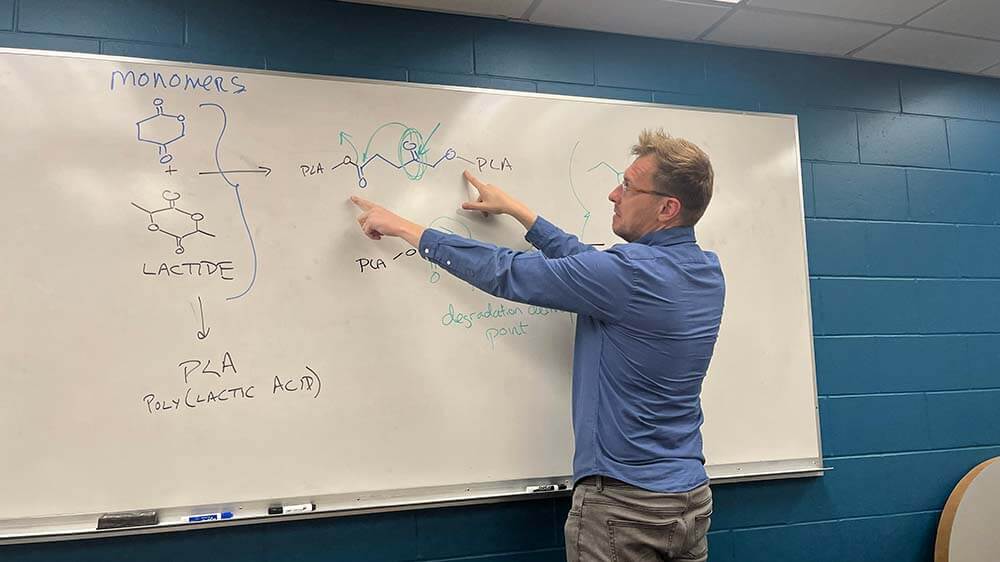
Using a chemistry process they call side-chain ester backbone scrambling, Hoye and Tonks are using ‘designer monomers’—simple plastic molecules derived from corn—and building them into the bioplastic material, so that, after use, the plastic breaks apart into much smaller, ‘bite-sized’ pieces—a feast for soil microbes like Pseudomonas Aeruginosa—microbes that exists in the millions in every teaspoon of soil. If this new process fulfills its promise, it could mean an eventual end to the swirling islands of plastic in the mid-Pacific. But these are early days, and Hoye and Tonks don’t like to over-promise.
“PLA’s Ingeo, a corn-derived plastic, already has the advantage of not being forever,” Hoye said. “It’s’ just that the decomposition is not quite fast enough, as it stands. We don’t know yet how much our process will speed this up. That’s part of the research. But if we can cut the time of the composting from 90 days to 15 days, even if it still requires industrial composting, that’s still an advantage.”
“Single-use plastics are a good place to start with this new material,” Tonks said. “Cutlery, plastic films on food packaging, cups, and bottles–those are the ones that should degrade quickly. If you have plastic parts in your car, you probably don’t want that degrading in sunlight over time.”
The virtue of these innovative monomers is that they would allow manufacturers to build different chemistries into plastics, which can use chemical different triggers to decomposition, based on use. Different pH levels could slow down or speed up decay, or the presence of moisture—like that found in a backyard compost pile. Or even sunlight could be the trigger, Hoye said. Minerals present in the ocean, like fluoride anions, are “very good at attacking specific types of chemical bonds. So, if you can incorporate those bonds, and the plastic ends up in an environment that’s heavy in fluoride, like the ocean, it can chop it apart there and give the microbes something to eat,” Tonks said.
Seeing how the world recycles, and training future chemists—all part of the job at Center for Sustainable Polymers
“As part of the CSP, I got to lead a study-abroad trip with some of our PhD students, to Australia,” Tonks said. “Since it’s a continent-nation or an island nation, they have a very circumscribed view of what circularity means, and how plastic waste impacts their environment. So, it was a good place for us to go and study, to see what’s working for them, and what isn’t. One of the things that really struck me, in terms of the packaging industry, is that they were really kind of nervous about PLA. It impacts their recycling streams of other plastics. If PLA is mixed in with other plastics, it can be difficult to recycle effectively. For instance, if you are trying to reblow a bag from recycled plastic material, and you have an amount of PLA in the mixture, it can affect the structure of the material. You have to make sure you have a pure stream of plastic to work with. So, if we can get the PLA out of that stream and get it to be fully degradable, instead of just degradable in an industrial composter, I think that will change the game a lot and get people really excited about using it.”
The grant from Minnesota Corn has supported one graduate student in the two research groups led by the professors.
“These graduate students will get trained on the work, this process,” Tonks said. “This is what we do (as University-based research chemistry professors) We train people. That is our output, first and foremost—trained scientists. I have always considered the science that comes out of that to be a kind of bonus. Luckily, the good stuff comes along pretty frequently. We are picking interesting problems. But the students are the most important part. Tom and I have already had a number of students that have been supported by these MCR&PC grants over the years, that are now out in the world doing things related to sustainable chemistry. Working for large companies like Dow Chemical.”
Hoye and Tonks point to a highly beneficial “spillover effect.”
“Each of us has a group of approximately ten graduate students and there are one or two in my group that are working on a sustainable funding stream and sustainable ideas, and the others will hear them report on their work at a group meeting once every couple of months,” Hoye said. “Hearing about this sustainable work opens the eyes of the others to realize, ‘hey, maybe this is something I should be thinking about.’ If they get a job offer from H.B. Fuller, where they want a more sustainable adhesive material, that job offer is more attractive than it might otherwise be, to the rest of the students in our groups, because of what they have been hearing about CSP research. So, the benefit is broader than just the student who gets the stipend from Minnesota Corn.”
Minnesota Corn has supported the Center for Sustainable Polymers for the entire decade of its existence. The training of future sustainable chemistry scientists benefits everyone in Minnesota, and it is something Minnesota Corn believes to be central to its mission to help shape a more prosperous and sustainable future for all Minnesotans.