After Planting: The field work continues for farmers
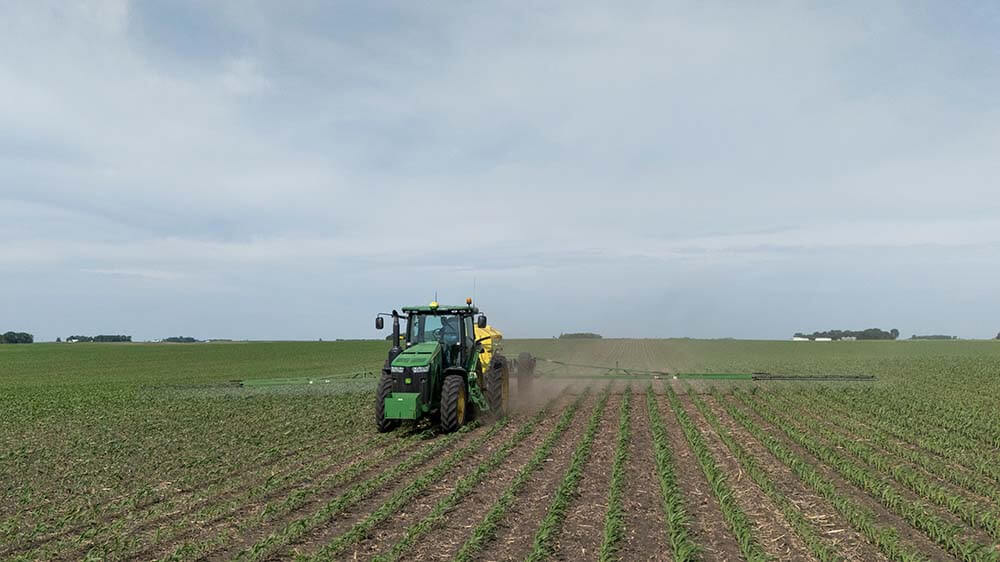
It’s Side-Dressing, Spraying, Scouting…and Rock Picking Season
Written by Jonathan Eisenthal
You might think once farmers get their crops planted, they can just kick back and watch ‘em grow. Or go fishing.
Most farmers might get a week or two off later in the summer, but right now it’s go-time: a series of unglamorous but essential chores must get done now. Fertilizing, spraying for weeds, (and a little later) scouting for diseases and then making one or two applications of fungicide. And of course, after planting is Rock Picking Season, according to Jeff Coulter, an Extension corn agronomist with the University of Minnesota.
June is also split fertilizer application season, Coulter said. “They’re going to do that in June. Right now is prime time for that.”
For farmers like Nick Peterson in Clear Lake, near St. Cloud, who farm in the Central Sands region of Minnesota, they must take a whole different approach to fertilizing because the coarse-textured soils are “only one or two heavy rain storms” away from losing any nutrients placed in the soil ahead of time. Instead, Peterson splits the application of his fertilizer. A good portion goes on in spring around planting time, but then he “spoon feeds” the rest over the course of weeks, using either a Y-applicator that dribbles fertilizer along the row, applying ammonia underground between the rows, or pumping it on with irrigation water. Peterson also applies ATS, a form of nitrogen fertilizer that includes sulfur, which helps the nitrogen uptake in the plants, stabilizes the nitrogen to prevent leaching and is itself an important nutrient. The ATS is delivered through the irrigation system they will use to keep the crop watered in the hot summer weeks. Applying fertilizer through the irrigation system is called “fertigation,” and is diluted down to less than 1/10,0000th of the irrigation water. Irrigation makes Petersons a member of a minority of farmers in Minnesota. Most farmers across the state depend on rain alone to water their crops.
So, for the Petersons, the period right after planting is irrigation system maintenance season, too. Replacing worn-out parts and making sure it all runs well.
And of course, summer will mean meetings for Minnesota Corn Growers Association—Peterson serves as Secretary on the board of directors.
But why does late spring mean rock picking in the farm fields?
Fields that are cultivated freeze to a greater depth, and stones present in the upper levels of the soil conduct heat faster than soil, which means that ice around those stones melts and refreezes underneath causing frost heaving, which over time, and continuously brings rocks up to the surface of the farm field.
“Rock picking is a continuous thing, every year.” Coulter observed. “Most farmers are picking rocks, getting rid of those because they can damage the machinery. Certain areas of the state have more rocks than others. It comes down to how the soil was formed. Basically, in a lot of areas of Minnesota, they have good black topsoil, but then they have rocks down there, and the rocks range anywhere from pebbles up to the size of the back of a pickup. The smaller ones, they can get by hand, loading them into a four-wheeler trailer or side-by-side, and some of the big rocks require a skid steer. It’s work you don’t get a pat on the back for, but you do it anyway, because the rocks can ding up the cutting disc openers on the planter. It can damage tillage equipment. If you hit a rock with a soybean cutter bar, that’s going to can cause all kinds of problems.”
Peterson notes that now is the phase for post emergence herbicide application, trying to get the weeds before they reach a height of four inches because that’s when the chemical controls are most effective.
“This spring, we had maybe four nights or more nights with freezing or near freezing temps after planting, when we had just applied the pre-emergence herbicide,” Peterson said. “When you have this situation where the temperature rises and falls, the weeds will stop growing in the cool temperatures and then start right up when it warms up again, and that seems to make the chemistry less effective.”
Waterhemp, giant ragweed, lambsquarters, and grass are weeds that will again exert pressure on yields, Coulter said. “In fields where the pre-emergence herbicide didn’t work very well, farmers are really going to have to get after the weeds right now.”
So much for heading out to the lake for a little fishing.