U of MN and MCR&PC celebrate a 40-year-plus partnership in scientific research
Written by Jonathan Eisenthal
Since 1985, Minnesota Corn has invested $29.6 million in funding for the University of Minnesota, including $27 million directed to scientific research. Investigations have spanned topics from fertilizer rates to increasing the yield of ethanol per bushel of corn, to next generation biodegradable plastics made from corn starch.
Investment in scientific research surged with the formation of the Minnesota Corn Research & Promotion Council (MCR&PC) in 1990, which organized the half-cent corn checkoff fund. Investment surged again when MCR&PC doubled the checkoff rate to one cent collected on each bushel of corn sold in the state.

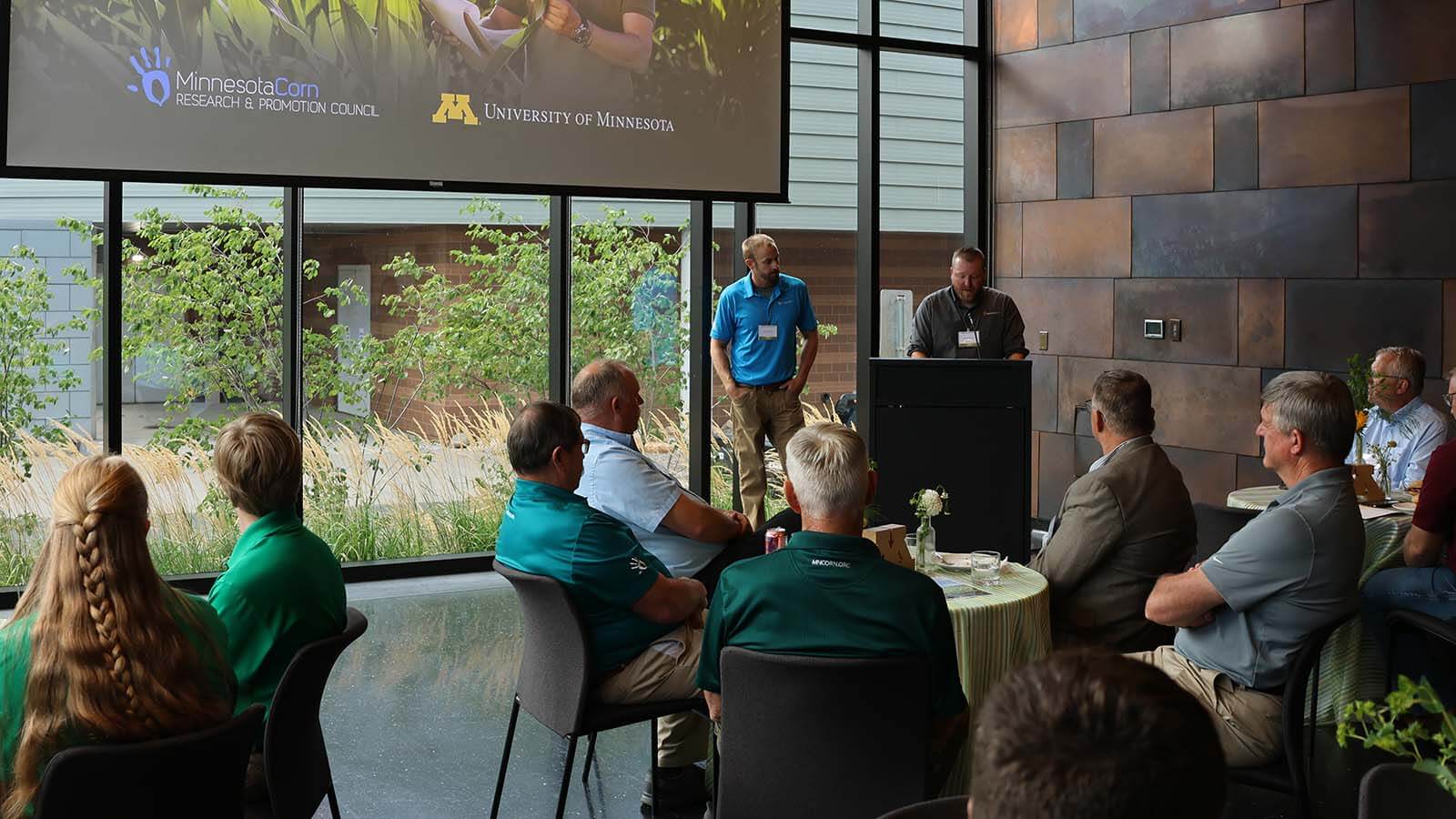
“Research isn’t about knowing the answer before you start,” Jordan Goblish said. Golblish, a farmer in Vesta, Minnesota, serves as chairman of MCR&PC. He spoke at a reception September 9th, celebrating the relationship of Minnesota Corn with the University of Minnesota. Goblish said, “We need researchers willing to test these ideas, tell us that they work, and most importantly, tell us that they don’t work. Agriculture continues to change. The challenges we face on the farm change, technology changes, markets change. We need to continue looking for ways to produce corn more efficiently and profitably. While also asking new things we can do with the corn we produce. I think the research presented in this room does a great job in addressing both sides of that equation.”
The reception was held at the McNamara Alumni Center at the U of M campus in Minneapolis, and dozens of leaders from Minnesota Corn attended, along with the leaders of U of M College of Food, Agricultural and Natural Resource Sciences (CFANS), the College of Science and Engineering, and the College of Biological Sciences, as well as university groups like Center for Sustainable Polymers and the BioTechnology Institute. A highlight of the reception: Graduate students who represent the next generation of scientists and engineers presented posters on their work, including a high yielding method to produce corn methanol—a potential source of Sustainable Aviation Fuel (SAF).
“I want to especially thank Minnesota Corn for your partnership with the University of Minnesota,” Linda Nagel said. She is Interim Dean of CFANS. “We are incredibly grateful for the depth of this partnership. Over the last five fiscal years, Minnesota Corn has awarded the University of Minnesota ninety-five sponsored awards totaling $7.6 million, with about $4.1 million of that coming to the College of Food, Agricultural, and Natural Resource Sciences through fifty-seven awards.”
“What makes this partnership so special is that it truly is collaborative,” Nagel said. “So you all bring the perspective of the grower and the questions that you’re seeing in the field, and our researchers bring the scientific expertise. And together, we can focus on solving problems and creating opportunities that really impact Minnesota growers.”
The incredible productivity of American corn farmers presents both an opportunity and a challenge, according to Nick Peterson, who helms the Discovery and Development focus group for Minnesota Corn. He’s a farmer in Clear Lake.
“We’re really excited about both sustainable aviation fuel and renewable marine fuel,” Peterson said. “These are areas, especially marine, where electrification doesn’t appear to be close to happening, and corn-based fuels are an immediate answer. Corn oil to SAF is something that can be done now. If we can capture between five to ten percent of these markets, it would be a market for a billion bushels of corn. When we are looking at a total national crop of 16 billion bushels, this kind of market development is essential.”
One of the key selling points of these renewable fuels is their lower carbon intensity compared to fossil fuel. While corn oil-based SAF and marine ethanol fuel score much greener, Minnesota Corn is also funding a project that represents an even greater leap, but which will still take some years to develop and commercialize: Conversion of corn-based ethylene glycol directly into methanol using metal catalysts.
Valentina Camelo, a fourth-year doctoral student in the University of Minnesota’s Chemical Engineering Department, is working for Dr. Paul Dauenhauer’s research group, studying this new approach. She presented a poster on the work during the Minnesota Corn reception.
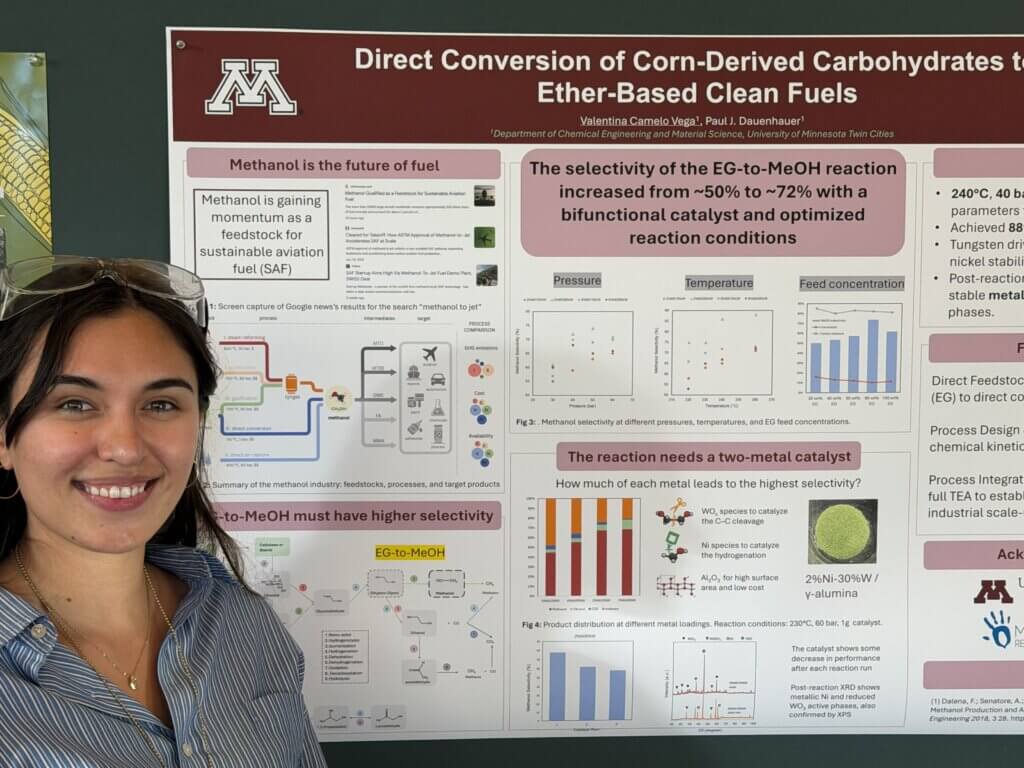
“The ethylene glycol to methanol conversion, (would) hopefully bridge the gap of glucose to methanol and get the highest yield possible,” Camelo said. “Traditional glucose fermentation to ethanol yields around 66% (fuel). But with this process, we could theoretically yield 100%.”
In the first decades of the dry grind ethanol industry, the push for great efficiency led to yield increasing from 2.5 gallons to 2.8 gallons of ethanol per bushel of corn. Just as increased ethanol yield put more money in the pockets of farmers, this novel methanol production technique promises to strengthen commodity corn prices tremendously.
“The money we’re investing in research comes directly from Minnesota corn farmers through the checkoff,” Peterson said. “We take seriously the responsibility of investing those dollars in work that can provide value back to farmers and create opportunities for our industry. When you look at the history of our partnership with the university, those investments really add up.”