MN farmers get back on schedule for harvest
Written by Jonathan Eisenthal
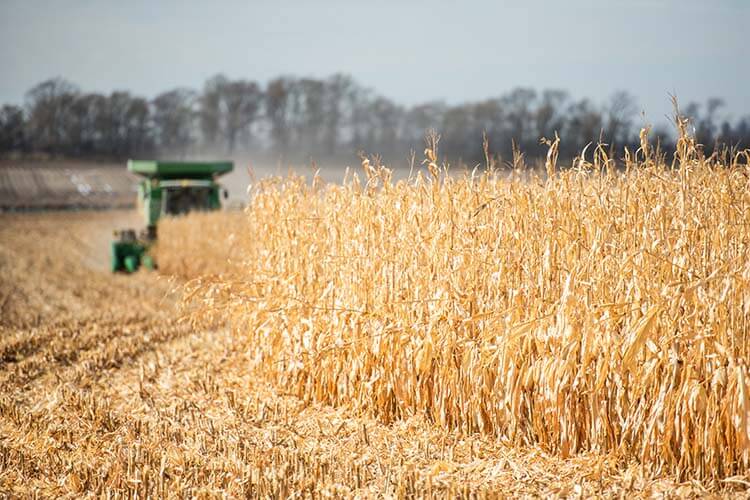
With the prospect of sunny skies for the next few days, following two weeks of rain off and on, Minnesota farmers are getting back up to speed with harvest.
USDA estimates that, as of Sunday, 12 percent of the corn crop has been brought in. On average, farmers in Minnesota have picked 16 percent by this date.
Looking at the quality of the crop, the USDA reports that 60 percent of the Minnesota corn crop is in good-to-excellent condition, while 27 percent is considered fair. Drought conditions throughout the growing season impacted much of the crop. A number of hard-hit areas mean that 13 percent has been rated poor or very poor condition by the USDA.
Still, most farmers hope to be see average or above average yields and grain quality for their operations.
“We had some periods of dryness (this growing season), but right in our local area, we’ve received decent rains and recently, more rain than we probably needed,” Todd Wentzel said. He serves as president of the Minnesota Corn Growers Association. His operation is in Murdock, Minnesota, near Benson, near the western border of Minnesota. He said, “The fields are pretty moist right now, so we’re letting them dry out a little bit. Still, here in Minnesota, we’re always concerned about getting into that corn crop as soon as is reasonable, so we don’t have issues with plant health late in the season. One big windstorm can really change things for people. But it looks like a good crop out there.”
Rain delays occurred across the southern tier of the state.
“There’s been a lot of rain (at the beginning of harvest season),” Rob Tate said. He farms in Cannon Falls, south and east of the Twin Cities. Usually, Tate harvests soybeans first, but he shifted to picking corn first, focusing on fields where drought stress had left weakened corn stalks.
“Yield-wise, we’re a little under APH (Actual Production History) on the corn,” Tate said. “The soybeans we’ve harvested are probably going to run about APH or maybe just a bushel under. Last year was an exceptionally good year, so it’s hard to compete with that. Still, with the drought we had, I’m pleasantly surprised. The yields are better than I expected.”
Jordan Goblish farms in Vesta, west of Redwood Falls, and the family operation includes fields in four counties in southwest Minnesota: Lincoln, Lyon, and Yellow Medicine, as well as Redwood.
“We’re right on schedule now,” Goblish said. “Usually, we like to knock out some soybeans in September and in the first part of October. The corn takes about a month for us, after we finish with soybeans. We try to get done by Halloween, or deer hunting season, at least. My west fields are more affected by the drought, to the south and west of Marshall. But a little north and west of Marshall, that one was a little droughty, but not terrible. Around home, I think we got adequate rainfall, though we could have used a couple more rainfalls in July. It should be above APH, hopefully. It looks that way right now,
Aside from weather concerns, the chief worry for Minnesota farmers this year has been economics. In particular, the high price of fertilizer and fuel, and the uncertainty introduced into ag export markets by federal tariff policies.
Attempting to both reduce fuel consumption and improve the retention of top soil, Wentzel said he and his brother increased the acreage of cover crops. They plant oats after their soybeans and black beans, where practical. They also leave lots of residue on the corn fields.
“We’re doing a little less tillage, trying to save some fuel,” Wentzel said. “But no, we’re not changing a whole lot right now, when margins are tight. We’re just watching what we do.”
Goblish focuses on the efficiency of keeping to the University guidelines for fertilizer application rates.
“I didn’t over-fertilize anything, and I bought the cheapest seed available to me,” Goblish said. “I tried to contract fuel ahead of time, but that didn’t seem to save me much.”
Tate notes that they have been strict about not letting equipment idle, to save fuel costs.
“As far as trucking goes, we’re trying to go to (grain delivery) destinations that are the shortest distance from us,” Tate said. “Fertility-wise, it’s hard to change things a lot. I think we’ll probably look at tweaking our phosphorus levels a little bit, because that’s probably one of the more expensive nutrients. All fertilizer is expensive, but phosphorus by far and away is the most expensive. We’ll look at soil tests, and if it’s not absolutely needed, we’re probably not going to put more on than what we need to replace what was removed, just to ensure we get a satisfactory crop the next year.”