Discovery Farm adds cover crops to conservation-minded operation
Written by Jonathan Eisenthal
Curt Trost’s farm in Redwood Falls offers a unique opportunity to Discovery Farms Minnesota—the program created and led by farmers to investigate the actual impact of conservation methods on real farms.
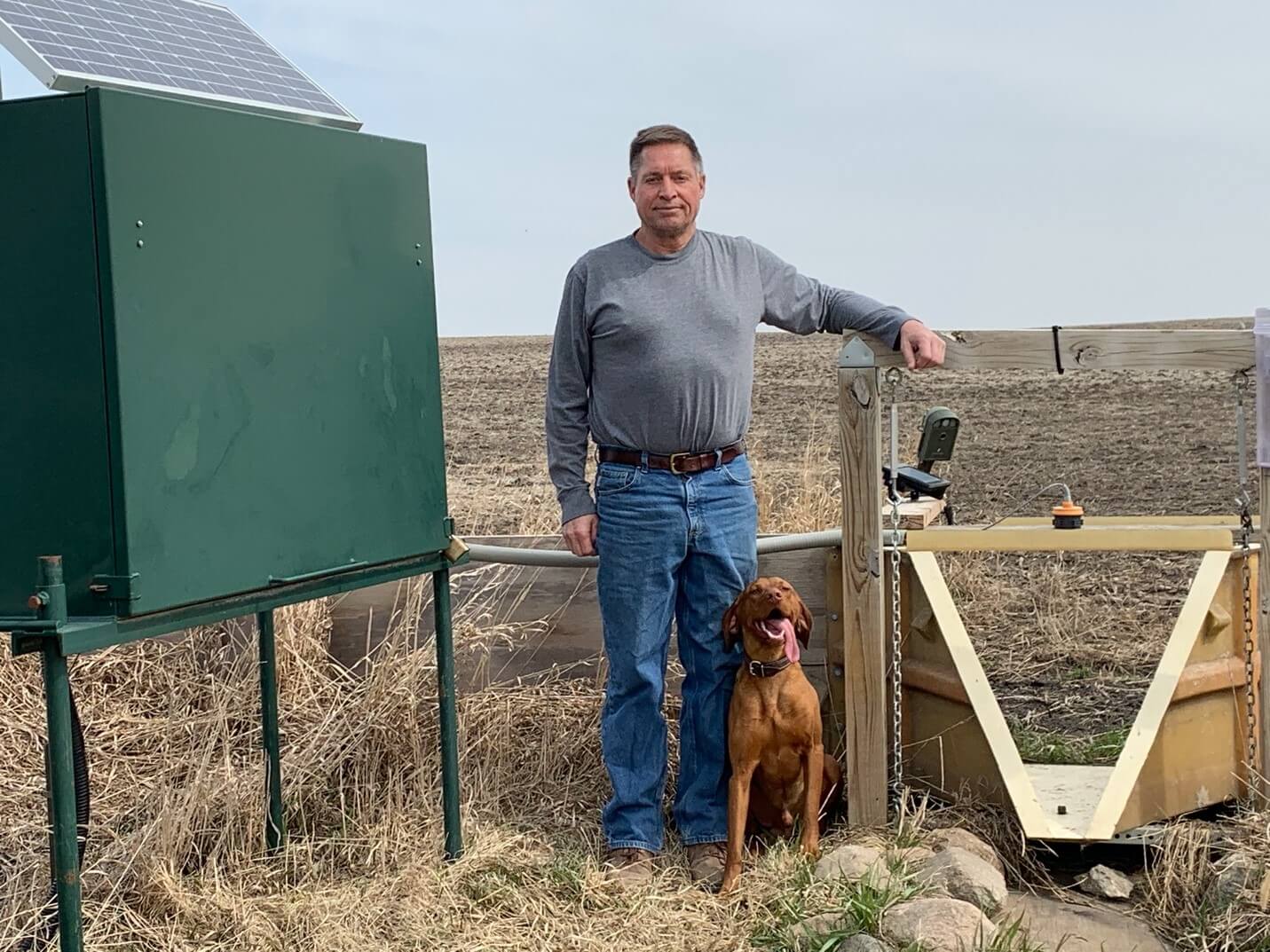
The Trost farm is the only one of Discovery Farms’ ten core farms with a single field that has two separate drainage systems: one side of the field slopes northeast, while the other descends towards the southwest. This has allowed Discovery Farms to set up side-by-side monitoring to compare soil erosion and nutrient loss with and without the use of cover crops.
As a Discovery Farm, the Trost operation is no stranger to conservation-minded solutions, according to Tim Radatz, coordinator for Discovery Farms Minnesota, and that includes reduced tillage. Trost said he has used as little tillage as possible since a particularly hard spring rain years ago left three-feet-wide trenches across his field.
“When I saw that I said that’s it. We have to change, or we are going to lose all of our topsoil. We can’t farm like this for much longer, or we will have a farm that is not worth very much,” said Trost.
Radatz said Discovery Farms will now take advantage of Trost’s field with two drainage systems to pinpoint the impact of cover crops in addition to reduced tillage. Last year, Trost switched his cover crop variety to cereal rye, which successfully overwintered, stayed in place and sprung back to life when the weather warmed.
“Are the cover crops taking up nitrogen during the season when the primary crop is not growing? Does that reduce the concentrations in the tile lines as well? There is evidence to that effect in other studies, but we haven’t gotten to that point with the project at Curt’s farm, yet. We’re hoping that’s what we will show there,” Radatz said.
With precipitation nearly five inches above normal last season, the field with cover crops performed much better. The monitoring stations measured soil losses of 15 pounds per acre on the north side where the cover crops were used and 26 pounds per acre on the south.
“Discovery Farms’ long-term average across all our sites is a soil loss of 135 lbs. per acre. This equates to about 3 five-gallon pails of soil across an area the size of a football field,” said Radatz. “So Trost’s 2019 results were exceptional, and show what minimum tillage and a well-established cover crop can accomplish.”