Watershed-scale bioreactor, management practices push limits on nitrate removal
Michele Stindtman
Stindtman’s research takes place on two side-by-side sections used exclusively for growing corn and soybeans. Both are watersheds that are hilly, and runoff moves quickly and discharges directly into the Blue Earth River. This makes the pair of sections an ideal ‘outdoor laboratory’ to compare and contrast farming techniques aimed at improving water quality.
Stindtman is working with USDA-ARS Scientist Gary Feyereisen to engage farmers in watershed districts CD30 and CD62 to determine the best plan of action for nitrate removal and reduction in the water that runs off these fields. Potential test treatments include:
- Management in the field: the careful application of fertilizer in terms of form, rate, timing.
- The vegetative aspect: cover crops, rotations that add additional cash crops.
- Structural practices like bioreactors or installed wetlands. Something where the water is treated after it leaves the field.
CD62 has a head start on point three—A three-chamber woodchip bioreactor was installed in the district in 2016. When the first chamber fills to capacity, the overflow begins to fill the second chamber, and when that is full, the third chamber comes into play.
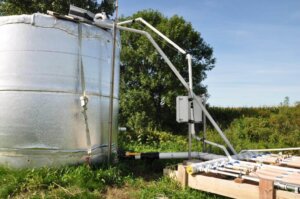
A sophisticated flow-weighted nitrate measuring system, installed at the same time as the bioreactor, takes samples automatically, increasing the frequency of collection when more water is flowing through. This project will add the same kind of monitor in CD30.
The plan is to measure the two watersheds simultaneously for one or two years, without management changes, to establish a baseline relationship in flow and water quality. Once that is established, they will be able to show the impact of any new conservation practices that are added to one or the other of the watersheds.
With measuring systems in place, the project will produce the statistics that show a specific method aimed at nitrate removal and reduction in run-on is effective or not.