Teachers get front-row seat to the world of raising food
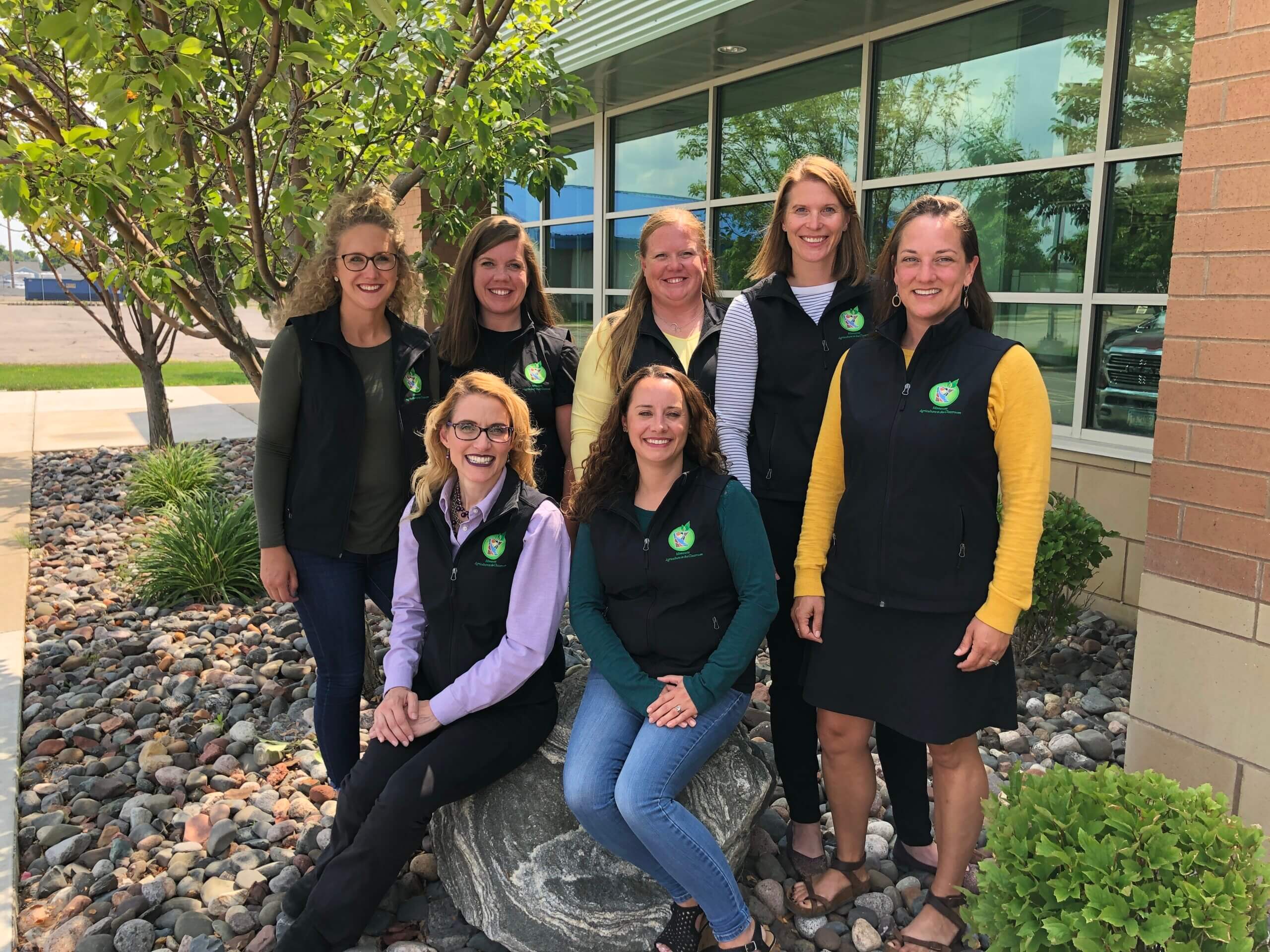
Above: The Minnesota Ag in the Classroom (MAITC) staff, pictured here, has wrapped up its second year of virtual farm visits for educators. Minnesota Corn has been a proud sponsor of MAITC for over 30 years.
Written by Jonathan Eisenthal
It’s a virtual ‘magic carpet ride.’
This summer, 83 teachers connected by livestream with farmers and food makers from around the state, courtesy of Minnesota Agriculture in the Classroom (MAITC) and its Summer Teacher Tours program. The teachers went places that few people have the chance to visit. The experience offered inspiration, insight, facts and impressions that these educators can turn around and teach their students this fall, utilizing MAITC’s standards-based curriculum.
On July 13, for instance, dozens of teachers were able to virtually ‘step into’ ‘Sota Grown, an indoor agriculture research facility at Central Lakes College. It’s an 8-by-40 shipping container outfitted with state-of-the-art lighting, watering and vertical grow panels that produces the equivalent of a one-acre crop of kale, the superfood packed with vitamin A, vitamin C, folic acid and other important nutrients.
A lack of locally-raised fresh produce makes many rural areas across America ‘food deserts.’ But here, thanks to the food pod, they harvest the kale weekly, producing an ample supply of fresh vegetables for the Lakewood Health System, which feeds seniors, school children and people in need. This fresh produce doesn’t replace outdoor farming, which is the cornerstone of protein-foods production. Instead, indoor agriculture promises to make the whole food system more complete, according to the site’s operators. Some experts believe indoor agriculture will become a $6.4 billion industry within the next few years.
“What the virtual world has brought us is the opportunity to take students and educators to places we couldn’t take them — by the bus load,” MAITC Executive Director Ann Marie Ward said. “One of my favorite parts of the virtual experiences is that everyone has a front-row seat. Everyone gets to have their voice heard, to have their questions heard and answered.”
[More: Read about other organizations supported by Minnesota Corn]
The Minnesota Corn Growers Association has supported MAITC for more than three decades because of its ability to reach young people with a positive message about farming and food. MAITC works to engage and support K-12 educators by encouraging them to embed agriculture into their classroom and curriculum.
Sue Knott hosted the Summer Teacher Tour virtual farm visits, helping assure that in the 90 minutes or so together, farmers and educators made a personal connection. Knott and Keri Sidle are the two specialists at the Minnesota Department of Agriculture who have assembled many of the moving parts of the MAITC program. Sidle, who has technological expertise, worked to design the online experience for the teachers.
On July 20, teachers got a field-edge seat to watch Emily and Ryan Ponwith talk about their corn and soybean farm in Cleveland, Minnesota. The emphasis of the tour was the key role of soil health in crop production. The Ponwiths explained how the strip-tillage method is the best option for their farm, because it maintains organic matter, while allowing a clear strip of soil to get the full benefit of solar warming to help seeds germinate in the spring.
Emily, who is one of three regional curriculum specialists working for the Minnesota Agriculture in the Classroom Foundation, explained the benefits for them of the strip-till cultivation method: “With the strip-till machine, we can put the fertilizer exactly where the plant needs it. … This approach helps with costs across the board, and it helps with the soil to produce a healthier plant.”
[More: Read about other Minnesota Corn-supported educational initiatives]
In addition to Ponwith Farms and the food pod, teachers also virtually toured wheat and soybean fields, the Northern Crops Institute and the pasta research facility lab in Crookston. They also toured Baker’s Field Flour & Bread, a mill and bakery in Minneapolis. The teachers learned that soybeans raised in southern Minnesota, by-and-large, go to domestic animal operations, while northern Minnesota beans travel by rail to the West Coast and from there to China, Japan and other major markets around the Pacific Rim.
“What we’re able to do through the Summer Teacher Tours is to grow a community of engagement,” Ward said. “Everyone who participated better understands the value of connecting with the MAITC team, utilizing the standards-based lessons and further connecting to a community of educators through social media where they can continue the conversation and learning about food, fiber and natural resources. Now you have a core group of people with a shared experience, who are interested and ready to learn even more and to get more specific on those topics. We also know that those 83 people are excited to be engaged with MN Agriculture in the Classroom and bring agriculture into their classrooms. In addition to schools, these tours draw in people working with community organizations like museums and historical societies, and we love that. Learning about the past of agriculture is how we understand and learn about where the future of agriculture is headed.”