Farmers learn about check-off-funded research
Written by Jonathan Eisenthal
To boost profitability and sustainability among corn farmers, Minnesota Corn invests corn check-off funds in research to improve on-farm practices and identify new markets. At MN Ag EXPO, check-off-funded researchers, including those featured below, were on hand to give the latest updates on their projects. To learn more about Minnesota Corn-funded research projects, visit mncorn.org/research.
Sustainable polymers from corn as tomorrow’s plastics

A readily available toughening agent can make corn-derived plastic film just as tough as its conventional plastic competitors. Food packaging is just one of the large markets that could use corn-based plastics.
“There is no barrier to doing this commercially tomorrow. [Commercial food manufacturers] just have to implement this additive into their process,” said Dr. Chris Ellison, a University of Minnesota professor of chemical engineering and materials science.
Polylactide, or PLA, has been produced since 2002, and is compostable in industrial facilities. Meanwhile, conventional plastic, which is made from petroleum, is a growing source of pollution.
Ellison’s research project focused on films because they are a fast-growing segment of the plastics market. Single-use food packaging employs transparent plastic films to keep food fresh and safe. While providing the flexibility and strength of conventional plastic film, this PLA corn-based plastic is not only bio-derived, but it is also biodegradable.
“In an industrial composter, PLA degrades within about 60 days,” post-doctoral student Boran Zhao said. “People talk about reusing and repurposing, but all plastic ends up in the landfill at some point, and much of it simply ends up in the environment. But PLA can be turned into fertilizer, CO2 and water.”
Integrating cover crops and liquid-injected manure
About one-third of Minnesota’s farm acres benefit from the use of manure as a nutrient source. University of Minnesota Assistant Professor Dr. Melissa Wilson wants to make sure farmers get the best crop yield results, while preventing this useful resource from escaping the field. Her check-off-funded research looked at whether a vegetative cover crop during the cold season can help achieve this goal.
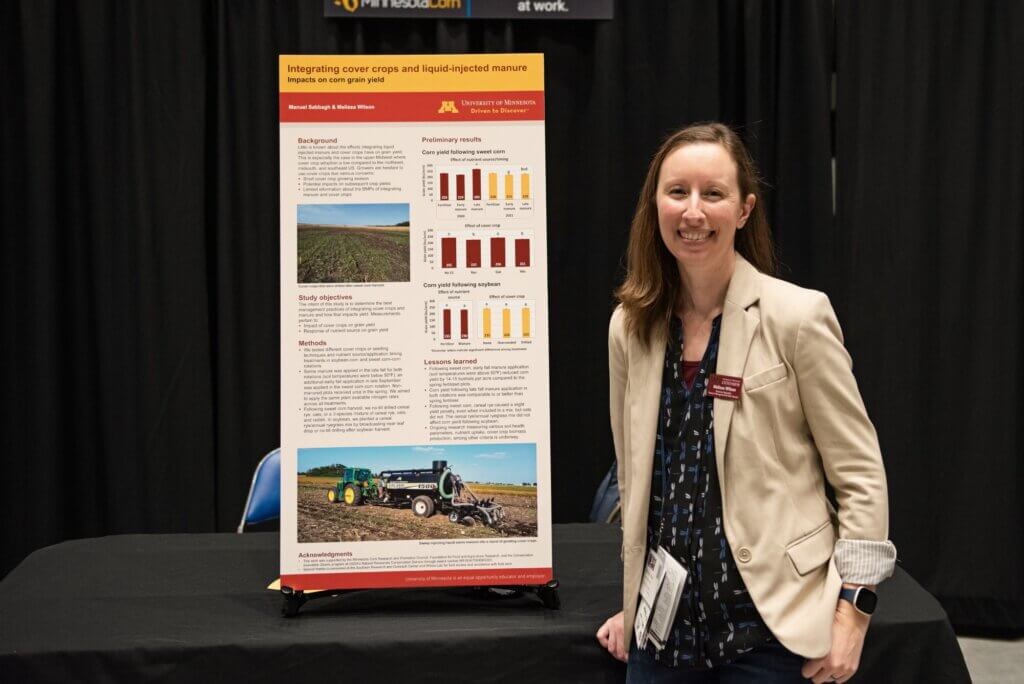
“Corn yield following late manure applications (into cover crops) was comparable or better in both rotations compared with spring fertilizer,” said Manuel Sabbagh, a graduate student on the project.
The research took place at the University of Minnesota Southern Research and Outreach Center in Waseca. It looked at two different crop rotations (field corn following soybeans, and field corn following sweet corn), several different mixes of cover crops (as well as control plots with no cover crops), and three different nutrient treatments. Those were: injecting manure in September, injecting manure in late fall (after soil temperatures fall below 50 degrees) and using no manure, but rather broadcasting commercial urea fertilizer in the spring, before planting the cash crop.
Wilson anticipates gaining valuable insights from the full analysis of soil testing on these plots, to assess the uptake of nutrients, organic matter levels and other measures of soil health.
[Learn more: Wilson explains her research on the Minnesota Corn Podcast.]