Graduating from FFA to farmer
Written by Jonathan Eisenthal
As part of their shared mission to support future generations of farmers, Minnesota’s corn organizations proudly sponsor a variety of youth-development organizations, including FFA. As students across the state prepared for the Minnesota FFA Convention in April, we checked in with a student-leader about her experience with the program.
Nicole Koziolek grew up in Northfield wanting to be a competitive dancer.
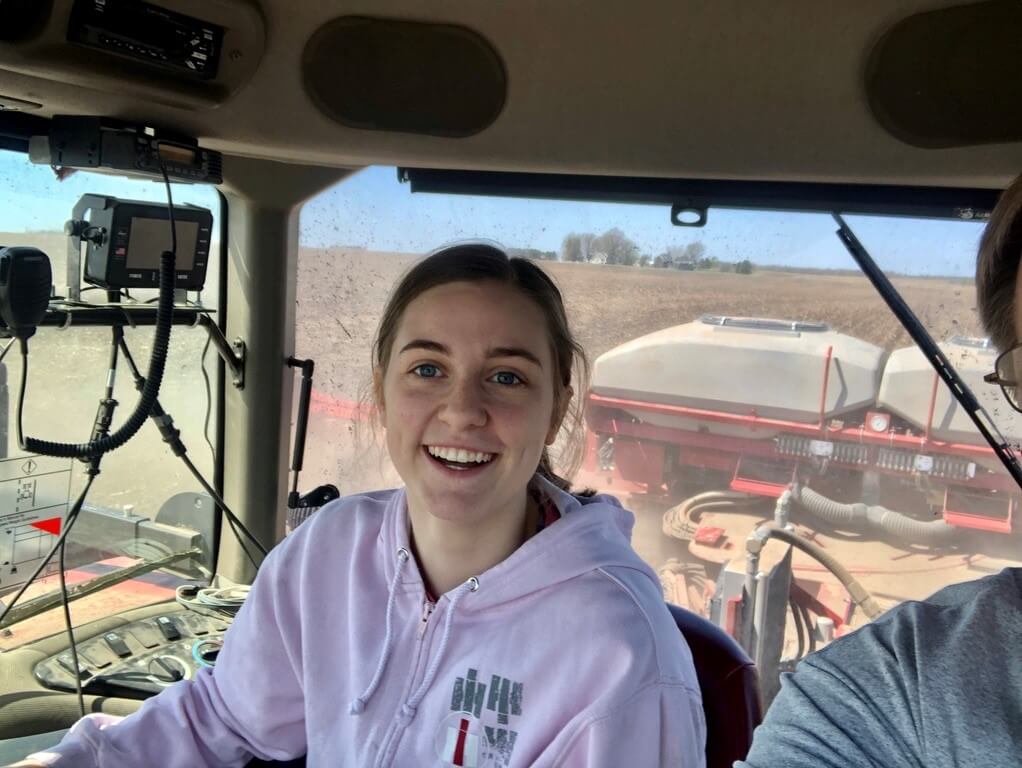
Now, at age 20, she owns part of her family’s farm, and she’ll return home from university finals to help her family plant corn and soybeans. She is set on a dual career of farming and working at an ag company on its marketing and branding efforts.
How did she end up back at the farm?
She credits the trips to her maternal grandparents’ dairy farm in Goodhue throughout her childhood. Seeing how her grandpa showed up every day, twice a day, to milk their 75 cows —and not only that, but how happy it made him — made a significant impression on her.
In eighth grade, she decided to try the ag class at Randolph High School. The class did not produce a eureka moment. No sudden epiphany. But somehow, teacher Ed Terry, and the world of FFA, won Koziolek over.
That’s no surprise. In his storied 51-year teaching career, Terry has helped thousands of young people acquire the tools to succeed as farmers, or to take other vital roles in the world of agriculture. Terry, who retires at the end of this year, oversaw Koziolek’s “supervised agricultural experience.” From ninth grade through 12th grade, Koziolek rented 20 acres from her parents and planted and harvested corn and soybeans in alternating years.
“Learning the basics of farming was a gradual process, which is a great way to learn. At first, dad was sitting right next to me in the tractor, but by the end, I could and I do plant and combine corn and soybeans all on my own,” Koziolek said. “Through this whole series of experiences, I learned that farming really feeds my curiosity. I don’t feel like I know it all — in fact the opposite — but I feel like I know enough to ask the right questions.”
Invasion of the blue jackets
Koziolek was so happy to see Terry accompanying 30 students from her home FFA chapter to the 2022 Minnesota FFA convention, which took place at the end of April. It was a chance to connect with her teacher and, maybe not in so many words, show appreciation in the best way possible. To show him that she knows what he has devoted his life to is worthwhile. That he has influenced her path in life.
The 2022 Minnesota FFA convention, otherwise known as the invasion of the ‘blue jackets,’ was the culmination of Koziolek’s FFA career, where she “retired” from her yearlong position as State Secretary. She and the other five members of the state leadership team were like the crazy conductors at the whirling center of three days packed with activities: Leadership seminars, award ceremonies, talent contests, games of every description, and a career fair to connect kids to companies who are eager to encourage their talent and interest in agriculture.
[More: FFA award spotlights deeper knowledge of crop production]
A sophomore at the University of Minnesota, Koziolek is studying agricultural marketing and communications, with an emphasis on crops and soils. She already has a summer internship in her pocket — she’ll be traveling everywhere from St. Paul to Hawley for Corteva’s Pioneer Seed division, helping seed dealers and learning the business. Another key figure in Koziolek’s education is Leah Addington. A volunteer with the Randolph FFA, Addington, who works for Pioneer, helped Koziolek land her internship, but her role is far more extensive than that: through Addington, Koziolek found the inspiration and assistance she needed to pursue and win election to state FFA office and to succeed in the nearly full-time occupation of FFA chapter visits, workshops, regional conferences — all the mechanics that make FFA go.
Speaking to the convention
With her career direction well set, Koziolek spent her time during the career fair taking photos of students with prospective employers and thanking sponsors who make all this possible.
On the stage at Mariucci Arena, she took part in quiz games to grab the attention of the conventioneers, and then presented awards to the many hard-working FFA students who spent the year developing competitive science and agronomy projects.
Perhaps the biggest highlight for Koziolek was delivering her “retiring address.” Her best friends from college and many friends and family members from home attended the proceedings at Mariucci and watched Nicole share words of inspiration to thousands of agriculture students.
She revealed something about herself that even some of her closest friends and family members didn’t know. She has an eye condition that isn’t treatable through surgery or medicine, called convergence excess. In fact, she didn’t herself understand why reading had been such a challenge until her junior year, when she got the diagnosis. The result of this condition was that whenever she tried to focus on anything at close range, especially reading, her eyes overcorrected, and she had double vision.
Koziolek made her struggle with convergence excess the jumping off point for her speech, in which she encouraged FFA members, whatever their interests or pursuits, whatever challenges they face, to bring their whole selves to what they aim to do, and “to show up every day and put in the work.” Her vision condition wasn’t fun, but vision therapy and daily eye exercises granted her enough muscular eye control, so she can now focus properly. The result of the hard work is that she has been able to succeed at school and accomplish her goals. She told her audience that this kind of commitment pays off, and she labels it “having grit.”
[More: Read Koziolek’s retiring address from the FFA convention]
Positive reception
She received lots of comments from students and teacher-advisers alike, saying how they really needed to hear this message about “showing up every day,” particularly in this moment. The transition back to working and studying and volunteering in person is going to be an adjustment that requires perseverance. “Grit.”
Nicole believes “grit” is a characteristic that will serve her well in the time to come. She recalls her family dealing with a major change to their operation. Suddenly, the seed company that had contracted with them to grow soybeans for seed was pulling out and not contracting with any farmers in the three-county region surrounding Goodhue. They had to figure out how to move on.
“I was a part of the process of evaluating what we should do next, and putting that plan into action,” Koziolek said. “We decided to grow food-grade soybeans to sell to the Japanese market, where it would be made into tofu. That is super interesting. And I had to learn all about pest management chemistry, what you can and can’t use when raising food-grade crops, and how to maximize yield while operating under those constraints. There are also very ordinary kinds of jobs that become super important, like making sure that you clean out the equipment. There can’t be a single kernel of corn in a hopper when you are going to work on the soybeans. I have done a lot of cleaning of bins and hoppers, because it affects how much you make on the crop. You have to keep any possible source of contamination out.”
[More: Read about Minnesota Corn’s partnerships with other agriculture and outreach organizations]
In the end, one of the most enduring parts of the FFA experience for Koziolek is the feeling of being connected.
“As a state team, we talked about that a lot — the importance of feeling connected to others,” Nicole said. “Since we were the team that took things from virtual space and turned it, by the end of our year, into face to face with more students than the last in-person conference we had, we were really putting that value into action. Firsthand, we got to see how students feel more important when they are connected to other students, advisers and peers. It’s a very special experience when the older students connect with the younger ones — both sides get so much out of it. When you truly get to interact with someone, you really grow.”
Koziolek knows she and the other five state officers she served with will be best friends forever. Connected. And she looks forward to her future in the agriculture industry, where she knows “grit” and connectedness will make all of her efforts in farming and the other parts of her life worthwhile.