Dassel-Cokato’s FFA Food Science team wins nationals
written by Jonathan Eisenthal
It was a taste of the real world of ultra-competitive name-brand food marketing. Dassel-Cokato High School’s FFA Food Science Team had an hour to come up with the most appealing wholegrain, low-sugar breakfast cereal possible at the 87th annual National FFA convention in Louisville, KY.
They beat out more than three dozen competing teams, winning the minds and discerning tastebuds of food industry professionals.
The team came up with “Hunger Grahams”—a sweet graham cracker biscuit cereal, its name a play on the popular book and film series, Hunger Games.
Asked how they outwitted the competition, Sophomore Lydia Meredith said, “We were able to flow with everything. We had a scenario written. Things we knew we wanted to say. And then we could vary it according to whatever food product we were talking about.”
They had to present to judges what the product was and talk about every aspect of producing the food — from receiving the raw ingredients to shipping the packaged cereal. They discussed the relevant food safety practices. They also had to show the nutritional calculations they used to arrive at the information in the nutrition label.
In addition to the team win, Meredith won first place individual honors in the competition. The Dassel-Cokato Food Science team this year also included Christina Babb (ranked 12th overall in the competition), Alyssa Torola (ranked 18th), Mistin Petersen (ranked 39th) and Kaitlyn Uldrych (who served as the team alternate). Each student of the winning team receives a $1,000 prize. Coach Danita Piepenburg accompanied the team and provided moral support, though, during the competition, she could not have any contact with the students or even be in the competition space.
The Food Science Team’s four starters and one alternate arrived at the competition knowing only that they were going to create a ready-to-eat breakfast food. They received the ingredient list one day before the competition.
“We didn’t know if it was going to be a yogurt drink or a sandwich, a breakfast bar, we had no clue,” said Danita Piepenburg, a science teacher at Dassel-Cokato who has coached the FFA Food Science Teams for a decade.
Before becoming an educator, Piepenburg went to cooking school and spent 20 years in the restaurant business. “In getting ready for the scenario the team got together and made all of these things. Then we talked about all the other possible scenarios. Then in practice we had them make products according to requirements I gave them. Nutrients, cost, where it’s marketed, how it’s marketed,” she said.
At the competition, all this took place in one hour.
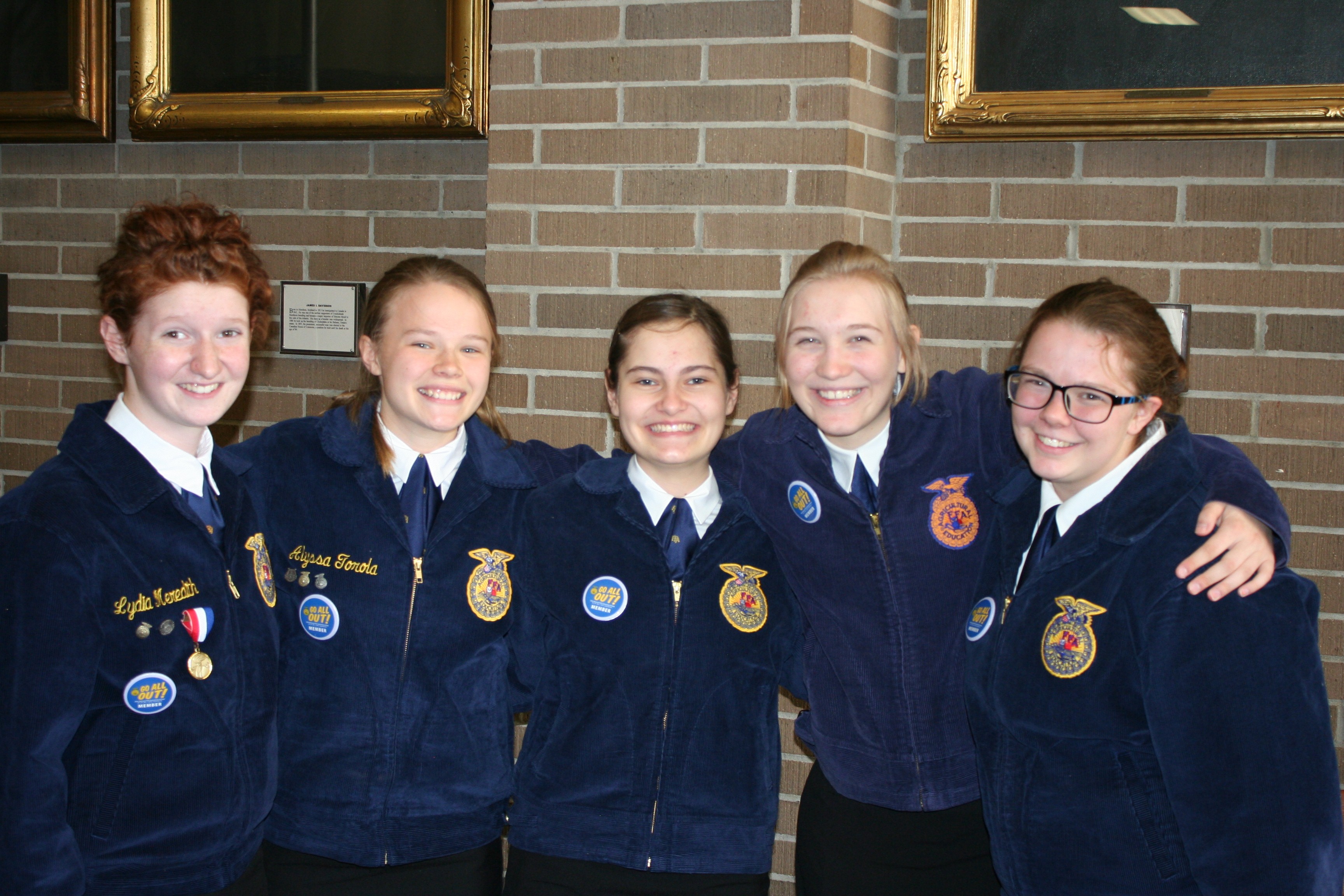
“For me, there was a moment, right after we finished our ‘Hunger Grahams’ presentation,” said Meredith. “The judges were laughing and smiling and overjoyed with us. Once we got out, we said ‘Yes! We did it. We won! There’s no way we can’t be in the top 10!” We had testing Wednesday and Thursday and then we didn’t find out until Friday night. So it was really stressful. We were in a big meeting room that seated a few hundred people. Every food science team that competed was there for our banquet and then they announced the results while we were eating.”
But the creation and presentation of a food product was just an hour of the competition. Team members took part in testing of their food science knowledge over the course of three days.
There was a 50-question test that deals with food safety, food quality, food-borne illness, food production, and chemical makeup of food. The students have to know how food is processed — at home, in factories and restaurants. They have to know how food is preserved. They have to know food industry abbreviations, being able to sort out “CPI,” the Consumer Price Index, from, “CIP,” ‘Clean-In-Place,’ a term for the automated cleaning systems used in dairy and other food processing industries that allows the cleansing of the internal parts of complex machines without disassembly.
“Food Science is a growing field,” Piepenburg noted. “Getting kids interested in (the FFA Food Science competition) can be hard because of the chemistry background required. They have to know what carbohydrates, lipids and proteins are. They have to understand how scientists test for those in the lab. Even understanding the role of micro-organisms in food safety has a foundation in biology.”
Food processing is Minnesota’s second-largest manufacturing sector with 44,700 jobs. Looking at the full spectrum of agribusiness and food production, the sector supports a fifth of Minnesota’s jobs and economic activity. The concentration of companies like Land O Lakes, Hormel and General Mills in Minnesota is no accident. Forbes rates General Mills as one of the best companies in the nation for women seeking corporate employment. Likewise it rates General Mills ideal for college graduates. Cargill, the largest privately held company in North America, is based in Wayzata.
“When it comes to food science, it’s a very broad field, and it includes marketing and planning careers,” said Piepenburg. “There are analytical jobs, like the chemist that tests a food to determine the components that make up a particular product, in order to develop its nutrition label.”
Dassel-Cokato won the state championship, held in Marshall last January, and sponsored by one of Marshall’s major food companies, Totino’s Pizza. The team, asked to create a gourmet pizza variety, came up with Chicken Alfredo with Spinach. The prize for the winners was a year of free pizza and pizza rolls.
As is often the case at nationals, high school graduates compete because they won at states in January of their senior year. Two of Dassel-Cokato’s teammates at nationals graduated last spring. Though they didn’t pursue food science careers, both have science in their sights. One of the graduates works as an EMT, the other, a freshman in college, intends to pursue an engineering degree.
“I love watching these students broaden their horizons and learn where their food comes from,” Piepenburg sketches out the value in this competition that’s not strictly career preparation. “When they eat a steak, knowing how this food came to be, from farm-to-table, the food safety aspect of producing that steak, the regulations the farmers and the processors have to go through to make it safe for us.”