Research: Grape seed extracts could reduce emissions, keep nitrogen in the soil

Written by Jonathan Eisenthal
Grape seeds contain the compound procyanidin, which has a curious property. It can limit the conversion of nitrate, a plant-available form of nitrogen, to nitrogen gases, a process called denitrification that generally happens in saturated soils, such as during heavy spring rains and freeze-thaw cycles in winter. One of those gases is the potent greenhouse gas nitrous oxide.
Because they contain procyanidin, grape seed extracts could be a valuable soil amendment for farmers who grow crops that require nitrogen fertilizer.
CheJen Hsiao, a post-doctoral scientist at the University of Minnesota, working with Prof. Tim Griffis in the Department of Soil, Water, and Climate, received a grant to study the phenomenon from Minnesota Corn through its Innovation Grant program.
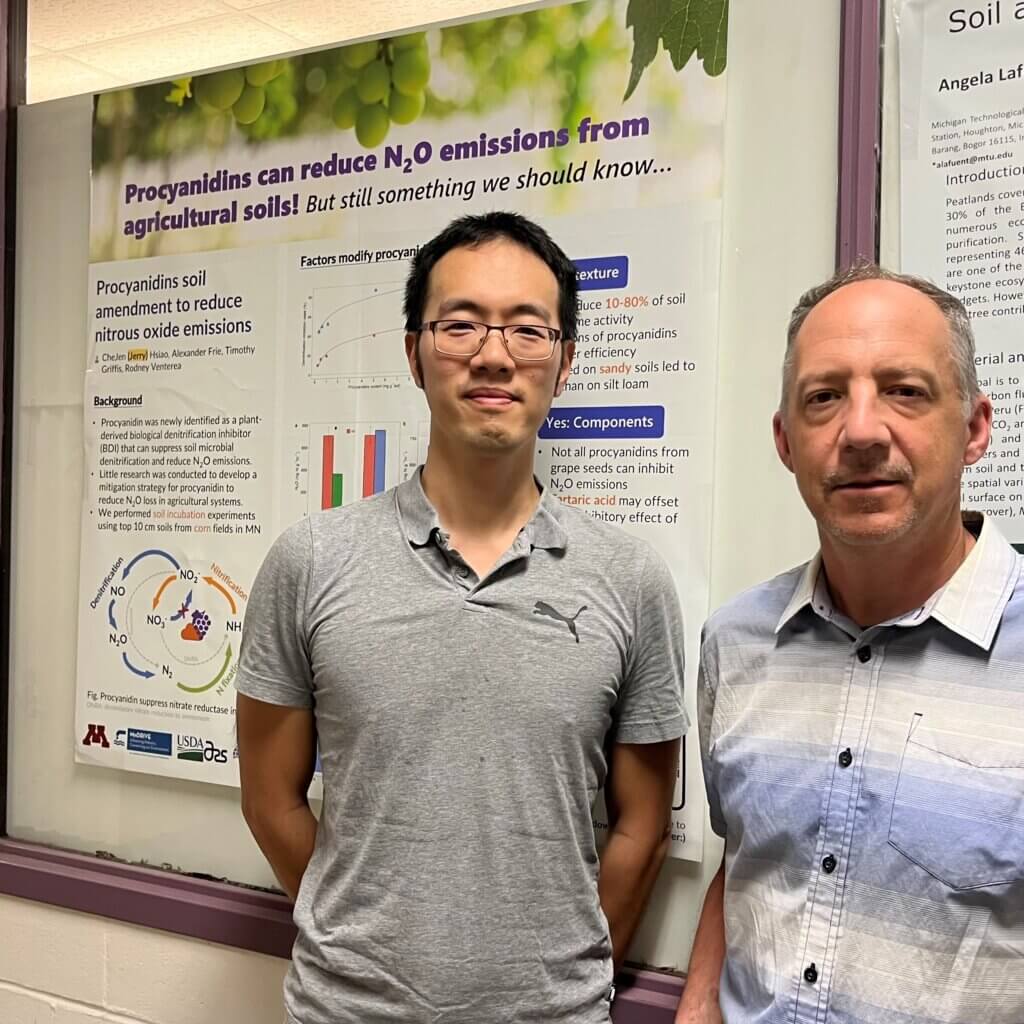
This year, Hsiao is working to remove compounds from grape seed extracts that limit the ability of procyanidins to inhibit denitrification. He’s also exploring ways to increase the procyanidin content of the extracts.
He’ll apply the refined extracts to soil potted inside indoor growing chambers. Eventually, he could begin conducting the experiment on a field scale.
“If we can reduce denitrification this is a real benefit,” Hsiao said. He added that preventing atmospheric nitrogen losses means soil can have more nitrogen for plant growth.
Roots in Asian knotweed research
Hsiao’s project has its roots in research by European scientists into an invasive plant, Asian knotweed.
In 2010, the researchers discovered that the plant limits denitrification, ensuring it has an abundant nitrogen supply and helping it spread. A few years later, other scientists discovered that procyanidin was the compound in the plant that inhibited denitrification.
Griffis, whose lab focuses in part on nitrous oxide emissions from cropland, put the finding to use in his own lab. Last year, he successfully applied for a grant to apply procyanidins — which are found in a variety of fruits and other plants — to soil from corn fields.
He and his team chose grape seeds extracts as their source of procyanidins because grape seed extracts are widely available.
The team found that grape seeds extracts can reduce nitrous oxide emissions from cropland by 10% to 80%, depending on soil type, application rate, crops, and the type of grape seed extract. This year, they’re hoping to make the extracts even more effective by removing impurities that limit their ability to inhibit denitrification.
Minnesota Corn will provide more information on this project throughout the year. Visit mncorn.org to learn more.