Broad survey points corn oil research in a new direction

Written by Jonathan Eisenthal
There is wisdom in looking first for the low-hanging fruit.
Without doing a thing more to them, do any of the most vigorous corn seed lines grown in the Midwest offer a bounty of particular oils, for instance palmitic acid, or omega 3, or some other highly valued human food or industrial feedstock?
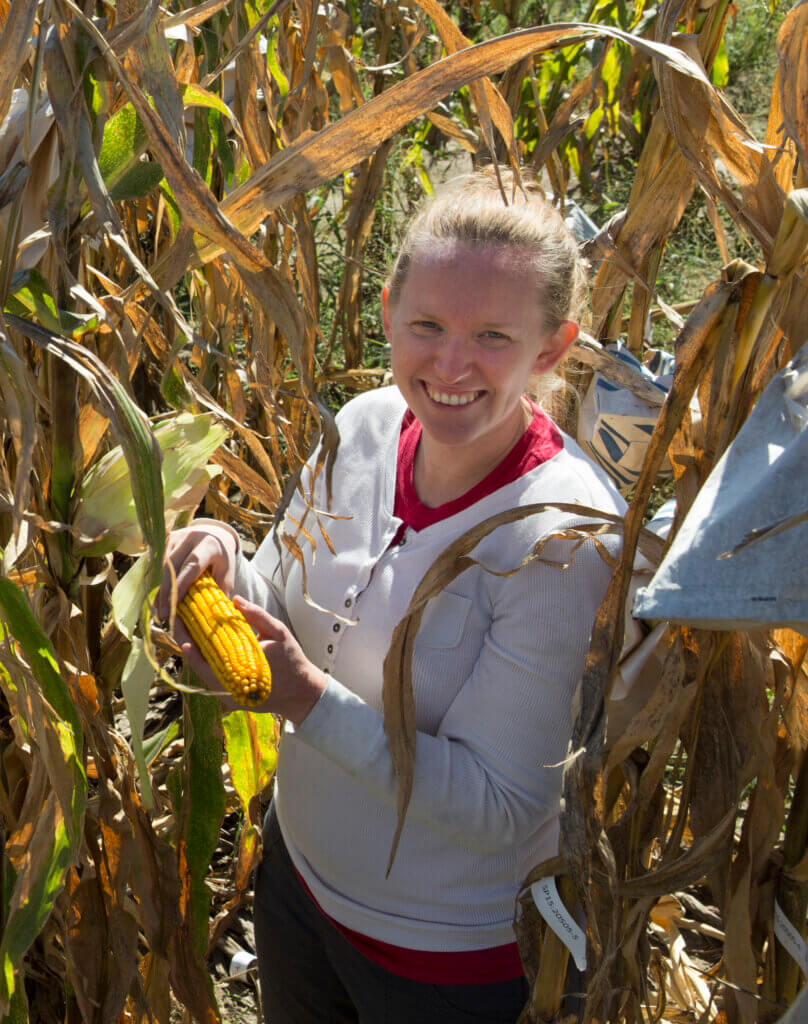
That was the question posed by Candy Hirsch, an associate professor in the Agronomy and Plant Genetics Department at the University of Minnesota. With support from Minnesota Corn, Hirsch and her team used near-infrared spectroscopy to select 100 corn seed genotypes and tested them to get a deeper look at the chemical composition of the corn oil in all these plants.
Hirsch reported, “We looked at a lot of parameters, because we wanted to see what was out there, in terms of natural variation. … What we found is that there is not a lot of variation for specific types of oil. The implication for that is, if you want to develop corn for very specific oil uses, and you need a specific type of oil — that variation is not readily abundant.”
Though no plans are in the works, this is not the end of the line in the quest to produce particularly valuable oils from corn plants, Hirsch believes.
“The next step (if sticking with an investigation of natural variation), instead of looking at all 66 parameters as we did here — that’s an expensive undertaking — could be to narrow our scope and determine what we are really looking for, and then to look for that in a broader set of lines,” Hirsch said. Such research could examine hundreds or even thousands of lines, if just looking for a few specific oil components.
But seeking an existing corn line to exploit is merely the most direct approach, Hirsch said. Beyond seeking natural variation, the corn industry could decide to support research into biotech approaches. The desired oil traits could be brought out using techniques of mutagenesis or genome engineering. Mutagenesis takes any of an array of substances and exposes an organism’s genes to it, causing a change in its DNA. Gene engineering imports a gene from another organism or makes targeted changes to existing DNA.
The oil is found primarily in the embryo part of the corn seed, and corn plants can be bred to have larger embryos to offer a higher oil content. But that doesn’t address the desire to yield a particular kind of oil.
Hirsch continues other investigations on behalf of the corn industry. This growing season, she begins work on a project supported by both National Corn and Minnesota Corn to investigate the conditions and genetics that affect the durability of corn kernels when they are stored and transported. She will be seeking farmers across Minnesota who are willing to submit samples of their corn production to assay. She wants to look at all the factors that may affect the quality of the kernel, from genetics to climate and weather, soils, and topography.