What to know about corn tar spot
Written by Jonathan Eisenthal
Ongoing research at the University of Minnesota will help corn farmers fight back against a fungal infection that can cause yield losses between 50 to 70 bushels per acre, called corn tar spot.
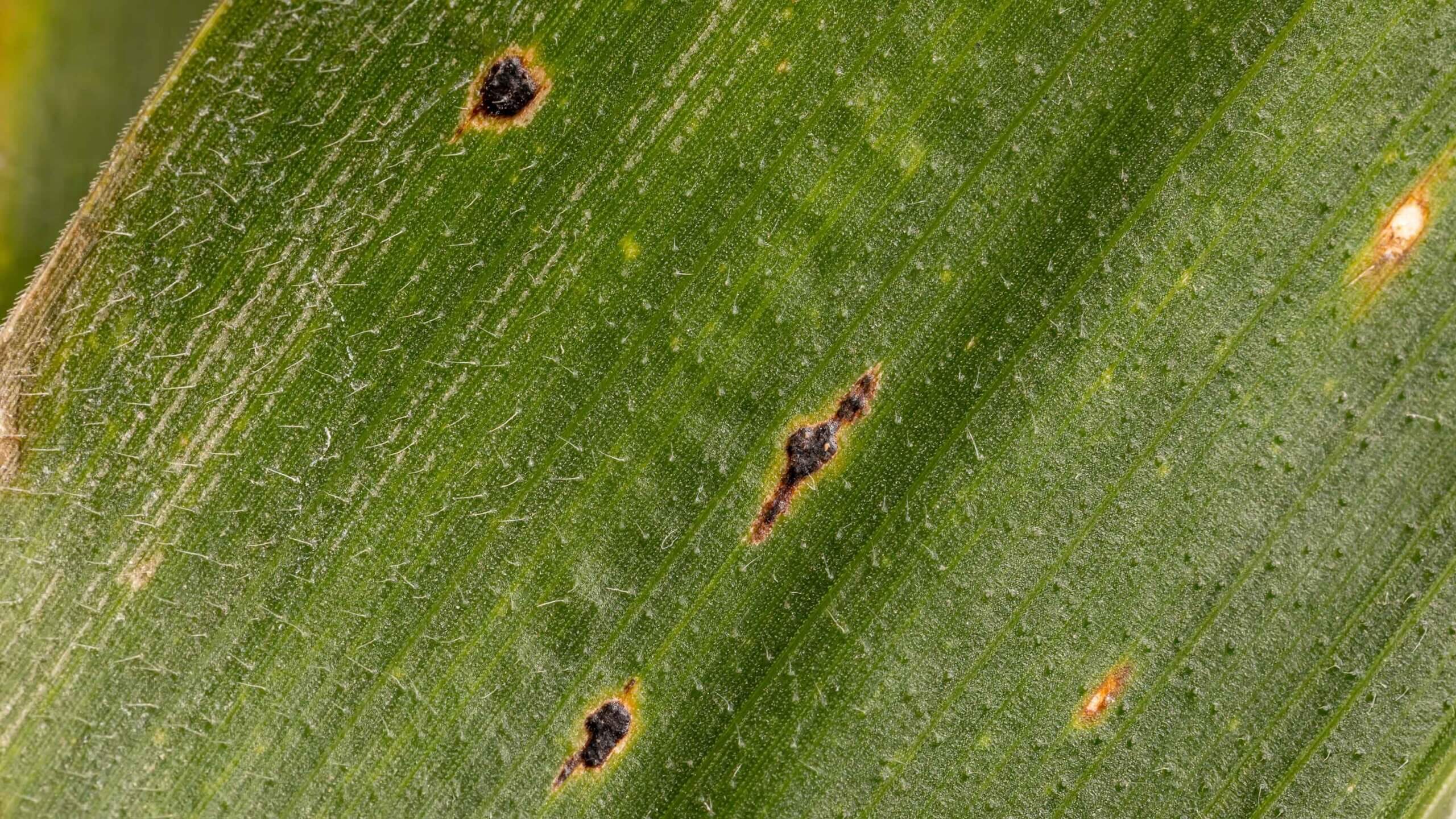
Distinguishable by raised black spots known as tar spots on the plant leaves, husks, and stalks that cannot be removed by rubbing, this fungal infection is being tracked by Prof. Dean Malvick and graduate student José Solórzano in the University of Minnesota Department of Plant Pathology.
“The tar spot fungus has been found in 18 states in the U.S. and has spread to more than 30 counties here in Minnesota,” Solórzano said. “It was first found in Minnesota in the southeast corner of the state in 2019 and has been found as far northwest as Stearns County in central Minnesota. It was first found in the U.S. in Indiana and Illinois in 2015, but it’s been known for over a century in Mexico, in Central and South America.”
From its emergence in 2015, corn tar spot has spread to Pennsylvania in the east, Florida and Georgia in the south, and as far west as Nebraska.
The good news is that research is showing that some fungal controls farmers employ will work to manage the infection. Agronomists and seed companies are spreading the word to assist farmers in making the right selections. Seed companies are also making headway in identifying and producing hybrids that have greater resistance to the tar spot fungus, according to Malvick.
“An ongoing question is the optimal timing of spraying fungicides for tar spot,” Malvick said. “When should we make the first application? If we put it on too early, it loses efficacy over time and the plants become vulnerable again to infection. So, if we postpone that first application as long as possible, we can minimize the number of applications, and make just one, or maybe two applications. The most common time for fungicide application for corn is at tasseling. That’s the time for most target uses. But for corn tar spot, it may be later, it may be at R1 or R2 of the reproductive phase.”
The disease appears to make its most devastating inroads in late August and into September. Spores that remain among residue on the field can cause infection the following growing season. While spores may be present in a field, it really takes optimal weather conditions, namely moisture and adequate warmth at the same time, for infection to take off.
“We are developing methods to study the disease in the greenhouse and in the field,” Solórzano said. “We have a method that works, and we are now using it to test different aspects of the disease. We have found that once viable spores are present on the plant, if the weather is conducive, then the tar spots can appear in 11 or 12 days after that.”
Corn tar spot scouting advice from Malvick and Solórzano:
Begin scouting in late summer. Key aspects for diagnosis:
- Tar spot symptoms appear initially as flecking and mild chlorosis (yellowing) on leaves, stalks, and husks.
- The black tar spots form after the flecking or yellowing. These spots are the fungal structures called stromata, which are embedded in the plant tissue. They are elongated, raised, and cannot be removed by rubbing them.
- The symptoms and signs can develop at any corn growth stage throughout the summer but typically develop most severely in the late summer.
For those seeking more in-depth information, Malvick and Solórzano have published Tar spot of Corn: A Diagnostic and Methods Guide.