New MCR&PC chair excited by check-off investments
Written by Jonathan Eisenthal
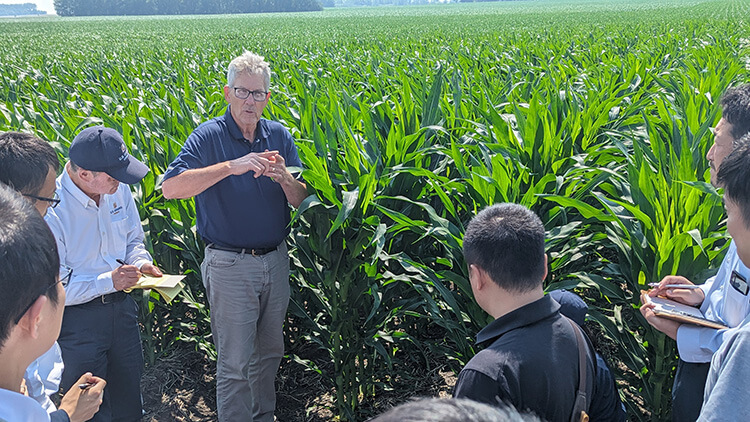
Above: Gary Prescher hosts a Japanese trade delegation at his family farm.
The 2023-24 chair of the Minnesota Corn Research & Promotion Council (MCR&PC) sees many of the council’s short- and long-term investments paying off for family corn farmers, rural communities, and all Minnesotans.

Gary Prescher, a Faribault County farmer, became council chair on July 1, taking over from Clarkfield farmer Doug Albin. Prescher is in his sixth year on the council and in his second stint as chair.
In conjunction with the Minnesota Corn Growers Association (MCGA), MCR&PC invests Minnesota corn check-off funds in efforts to strengthen rural communities, promote corn to the non-farming public, and increase the productivity and sustainability of corn production. A strong farm economy is the foundation of a strong rural economy, and the success of corn producers ripples through the entire state, supporting tens of thousands of non-farming jobs and providing a cornerstone of the success of a number of Fortune 500 companies in Minnesota.
Prescher describes the council as an organization that carefully stewards the Minnesota corn check-off and invests in activities to benefit the industry.
Three focus teams
The MCR&PC invests corn check-off funds based on the recommendations of Minnesota Corn’s three focus teams: Discovery and Development, Membership and Consumer Engagement, and Utilization. Prescher describes these teams — which are comprised of MCGA and MCR&PC grower-leaders — as the ‘three legs of a stool,’ all equally important.
The Utilization Team, which aims to maintain and develop markets for corn, has invested in a number of exciting projects close to launch in the marketplace. The team funds efforts to boost export markets and develop renewable corn-based products that can replace petroleum-based products, and it has championed ethanol as a low-carbon energy source that can meet society’s climate change goals. Science accepted by policymakers and environmentalists shows that ethanol can reduce the lifecycle emissions of greenhouse gases by nearly half compared to regular gasoline.
“We have projects researching the lifecycle analysis of the various transportation energy sources, which show that ethanol can be a very good option, both in the short term and in the long term,” Prescher said. “Ethanol can help meet the carbon goals that our country has, and that other countries around the globe have.”
The University of Minnesota-based National Science Foundation Center for Sustainable Polymers receives funding through the MCR&PC. A number of its projects are either coming to market, or are close to it, according to Prescher.
“They have discovered economical ways to produce plastics that function exactly like the polymers that come from a barrel of crude oil, only these new polymers are made renewably, from a kernel of corn.”
A very promising use for ethanol comes from the startup company ClearFlame Engine Technologies. Its proprietary technology allows ethanol to power diesel engines, reducing greenhouse gas emissions while supporting farm families and rural communities. The company has advanced toward commercialization quickly thanks in part to investment from Minnesota Corn’s Utilization Team.
“ClearFlame is a business that came to us early in its developmental cycle,” Prescher said. “Using ethanol in diesel engines — that’s a huge market! ClearFlame’s technology is getting closer and closer to launch. There have been a lot of miles of road testing.”
The technology can be used in a variety of diesel applications, including standby generators, the semi-tractor trailer trucking industry, and in the heavy-duty diesel equipment used in farming and construction.
Consumer engagement
Expanded outreach and awareness of the corn industry, particularly in Minnesota, depends on both farmers and consumers. This is what makes the work of Minnesota Corn’s Membership and Consumer Engagement Team so vital, Prescher believes.
“Just like our consumers, farmers place a high value on preserving the land, the natural environment for us and for future generations,” Prescher said. “But so many people are unfamiliar with farming practices these days. We need to show everyone the efforts we put into being good stewards.”
The heart of the effort is the system of district field managers who work with county corn organizations across the state and help each local group of farmer-leaders develop its own ideas and strategy for reaching their communities.
When it comes to the consumer, Minnesota Corn is at the center of the effort to engage the public in conversations about food, so that they can understand what happens on the farm, and how the food produced there is safe, abundant, and economical, through the efforts of Minnesota’s farmers.
“This is the outreach and education part of the MCR&PC’s work,” Prescher said. “We have a lot of (organization) sponsorships and scholarships that we fund. We also support education through Minnesota Agriculture in the Classroom, Farmamerica, and other programs that reach the primary and secondary schools in Minnesota. A significant part of this team’s budget goes to sponsorships. That can range from supporting 4-H and FFA to the different organizations across the state that we network with, for example Farmamerica in Waseca and The Children’s Museum of Southern Minnesota in Mankato. The University of Minnesota Landscape Arboretum in Chanhassen is another. They do a lot in terms of outreach, and they help get good information out to the public about how farmers keep the food supply safe and how we go about our business. It’s a way to make our case out there.”
Another innovative outreach program: MCR&PC funds a car engine and fuel systems expert who travels to vocational and technical schools and community colleges to speak to mechanics-in-training. This expert busts the myths that surround ethanol, and explains how Unleaded 88, a 15-percent ethanol/gasoline blend, is a great fuel option for cars made in 2001 and newer.
Prescher looks forward to another year of helping to steward the farmer funded investments and programs that provide a foundation for continued success among corn producers.