Crop farmers and consultants delve into nutrient science

Written by Jonathan Eisenthal
Bob Hoeft was a kid on the farm in David City, Nebraska, when Nitrogen fertilizer first got to be a big thing in American agriculture. That was the mid-1950s.
“The biggest change in nutrient management since then is that, now, we use science,” said Hoeft, a professor of agronomy at the University of Illinois. “Back then we (farmers) weren’t concerned with the science. The universities gave out recommendations and then we always added more than that. Now, every farmer you meet is concerned about the science and concerned about the environment. They know they are the first ones affected when farm nutrients get into the drinking water.”
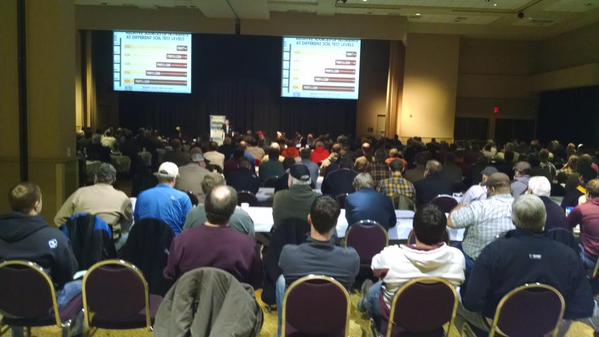
Over 500 Farmers and crop consultants crammed the biggest meeting room in the city of Mankato to hear Hoeft and other researchers advise them on the latest nutrient management practices.The annual Minnesota Crop Nutrient Management Conference, organized by the Minnesota Agricultural Water Resources Center (MAWRC) in partnership with the Minnesota Department of Agriculture and co-sponsored by the Minnesota Corn Growers Association, offered the best that current research and long experience has taught farmers about using fertilizer.
“Conference attendance has grown every year, especially among farmers,” said Warren Formo of the MAWRC. “We’re also seeing more young people in the crowd. Farmers are really plugged into the topic of nutrient management and they come here to learn about ways they might be able to improve.”
It’s a great opportunity for farmers and crop consultants to connect with university researchers on the latest developments in nutrient management. Much of the research being done is funded by farmers themselves through check-off investments.
A variety of topics were covered during the day, including Hoeft’s skip-a-row technique.
“We have done this (skip-a-row technique) on all kinds of tillage, all kinds of soils, and we have never failed with it,” Hoeft told the hundreds of audience members. “Think about it. If you have a knife every other row, then every row is never more than one row from a (line of fertilizer). It really works. And what’s more, you can use a smaller tractor, smaller tires, less fuel and you get less compaction of the soil on your field. We’ve done this with plow, chisel, disk and no till.”
One of the biggest trends in crop production is increasing the rate of seeds planted per acre.
“You don’t need to increase your nitrogen fertilizer when you are planting higher populations,” Dr. Jeff Coulter said during his presentation based on his multiyear research project conducted at University of Minnesota research stations in Lamberton, Waseca and Rochester. Though the three locations have different soil types, the conclusion was the same.
Farmers themselves funded the research through their check-off investment via the Minnesota Corn Research & Promotion Council.
Speaking in generalities, Coulter said farmers should use 36,000 seeds per acre as a baseline plant population, which does better than 30,000 in many years, but diminishing returns make increasing the seed rate to 42,000 an unnecessary expense. Quite independent of the seed rate, 155 pounds of Nitrogen per acre appeared to be an optimal fertilizer rate.
Retired farmer Jerry Payne agreed that farmers are all concerned with nutrient management — both the science and the politics.
“I come to these meetings because I don’t want to be surprised,” said Payne, who owns 1,600 acres of farmland west of St. Peter and still helps his renter gather information and make informed management decisions. “If the environmental groups are pushing for something new, I want to hear it here and get out in front of it.”
He added, “I’m not afraid to put in my two cents.”
Payne managed fertilizer plants in Pemberton and Marshall during the 1970s.
“Back then, you couldn’t get enough nitrogen on the land,” Payne said. “Today, we’re putting a fraction of the amount on and we’re getting better results.”
Hoeft confirmed that Minnesota is among the states that lead the nation, using about 0.8 of a pound of nitrogen to raise 56 pounds of corn.
“Precision ag is the biggest change in nutrient management since I started 25 years ago,” said Dave Geier, an agronomist at the Brownton Farmers Cooperative. He came to the conference to hear about the latest fertilizer science. “Twenty-five years ago the coops had GPS-based grid sampling, we had the GPS in all our equipment, but the farmers did not.”
Now that GPS-based auto steer has become almost universal, adoption of Hoeft’s ‘skip-a-row’ technique becomes a real possibility, because the nutrients can be perfectly offset, not placed directly under the seed (which would prevent germination), yet placed within reach of two rows of developing seedlings. With autosteer farmers no longer need to overlap fertilizer at the end of rows, a big increment in the downward trend in fertilizer use per bushel.
“Farmers are getting more computer-savvy and there’s an all-around higher level of education,” Geier said. “Farmers are more productive and cover more acres because of the tech and the know-how.”
Doug Benson, a crop and dairy farmer in Stuart, Minn., came to the nutrient conference specifically to learn more about maximizing the benefit of alfalfa in the rotation, and getting as much fertility as possible out of the manure from his farm.
“We are able to put very little additional fertilizer on, thanks to what we get from the alfalfa and the manure,” said Benson, who said that his family has shares in an ethanol plant, so he was squeezing in the nutrient seminars in between delivering grain to the ethanol plant and taking care of the livestock at their 250-head dairy.
“What we’ve seen so far from using manure as part of our nutrient program is that we have higher soil organic matter than our neighbors who don’t apply manure,” said Benson. “Under normal weather conditions the soil structure in our fields holds nutrients better and makes more nutrients available to the plants.”