Catching up with the Council: John Mages
The Minnesota Corn Research & Promotion Council (MCR&PC), which oversees the Minnesota corn check-off, is led by 11 grower-leaders from across the state with a wide range of backgrounds and experiences. In our new “Catching up with the Council” interview series, we’ll learn about their farms, work with Minnesota Corn, and thoughts on agriculture. Interviews for the project are by Jonathan Eisenthal.
John Mages, MCR&PC treasurer
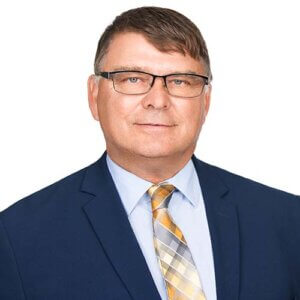
Belgrade, Minnesota
Tell us about your farm: Where is it, what do you grow, how long have you farmed, who do you farm with, and how long has your family farmed this land?
I farm with my wife, Cindy, and my oldest son, Andrew, near Belgrade, Minnesota. Andrew still works off the farm, up by Fargo, but he is a weekend farmer with us. I’m from a large family by Sleepy Eye, and there wasn’t really an opportunity there, so that’s how we ended up in Belgrade.
We started on our own by renting a farm in 1981, and then we bought our farm site in 1993. We crop farm—our corn goes to feed mills and local ethanol plants, and we raise soybeans for seed for a major seed company. We started with a farrow-to-finish hog operation, but we phased it out 10 years ago.
What do you like about farming? What do you find to be the most challenging aspects of it?
Farming means you are your own boss, and we kind of like that, as well as being out in nature all the time. When we are out working in the fields, we pass by a lake and have lots of great scenery.
One of the most challenging aspects is figuring out the marketing of your crops—trying to price it to make a living. Often when you sell, you watch the price go higher, or when you are waiting, it goes lower. That’s always the challenging part of the marketing. The thing is to know your cost of production, so you can know where to start.
Weed pressure changes over time. Water hemp moved into our region about eight or 10 years ago, and it can be particularly challenging because there can be resistance to herbicides. Water hemp has lots of seeds, and it germinates throughout the year—not just in the spring. If the corn or soybeans don’t quickly grow and spread a canopy, if the plants leave bare spots, water hemp will find those open areas and grow in them.
We are looking into the practice of cover crops, which can control weeds, but it can be difficult to get a cover crop started after harvest in the fall. Another challenge for beginning farmers, like our son Andrew, is finding enough affordable cropland to buy or rent.
Why is it important to you to participate in the MCR&PC?
As a farmer, whenever we sell crops, we pay into the check-off fund. The Council uses those funds to see how we can do a better job of producing crops and how we can do our nutrient management better. Also, the Council focuses on the promotion of corn. As the general public gets farther and farther away from farming, they lose touch with what’s happening on farms. Through promotion we can help explain what we are doing out here.
Do you have particular goals that you would like to pursue as a grower-leader?
I have served on both the Minnesota Corn Growers Association (MCGA) board and the Minnesota Corn Research & Promotion Council, and each one handles a different but important aspect of leadership for our industry.
MCGA works to promote positive legislation and to prevent laws that are misguided or hurt our ability to produce food, fuel, and fiber for our consumers. With the Council, one of the most important elements is to show the public how ethanol is a truly renewable fuel. According to the most scientific model of the lifecycle of energy and emissions, the U.S. Department of Energy’s GREET model, ethanol can help the country meet its low-carbon and energy-efficiency goals. The MCR&PC is all about using check-off funds to do sound research that will help the farmer look to the future and find the best path forward, to make sure we are maximizing our yields with the tools and resources we have available.
Research also helps guide us in our nutrient management decisions. There is never just one way of looking at things. Farmers are very good at trying new ideas. Let’s give them the opportunity to try new ideas and conduct research on their own farms—that’s part of the Council’s Innovation Grant Program. We also do a lot of research with third parties—for instance the University of Minnesota—to ensure that our research is scientifically valid and that its findings will be accepted by everyone.
[More: Learn about Minnesota Corn-funded research on the Minnesota Corn Podcast]
Who has inspired you by their example? What did you find inspiring about them?
Mike Leopold was my instructor for the Minnesota Agricultural and Rural Leadership (MARL) Program, and I liked the way he handled things. He talked about the need to lead and to communicate with the public about our issues, and his point was, “if you don’t do it, who is going to do it? You have to take the time to support your industry.” He passed away in October, and he is very much missed. I was in the MARL Class II, which was about 20 years ago. That experience influenced my decision to join the MCGA board.
How do you like to spend your free time? Do you have hobbies? Play a sport? Like to travel?
We keep an eye on the grandkids. They are starting to get into school activities. Our oldest is 12, getting into volleyball and basketball.
We also like to travel. We’ve been to all the states except the New England states, and those are the next on our list. We went to Europe and looked up our ancestral homes. We have relatives who live in Germany, so we went around with them. My mom’s family emigrated from the Czech Republic area, and my dad’s family was from southern Germany. We have a cousin over there who got in touch with us, and we have the same great-great grandfather He decided to get to get to know his American cousins a few years ago, and we had the great experience of traveling in Europe with him for two weeks. He and his family have been to the United States several times now.
What do you think is something about farming that might be surprising to the average consumer?
The high cost of everything, from machinery to inputs, might surprise people. Another surprising thing about corn specifically is all the things we can make with corn and all the ways we can use it. I think it’s now up to over 4,000 products that use corn somehow. Corn is used in a wide range of food products, of course, but it’s also used in bioplastics, things like paint and even diapers. It’s such a versatile crop to raise.