O’Connor presents corn quality report in South Korea

A Minnesota Corn grower-leader earlier this month participated in a U.S. Grains Council (USGC) event that highlighted the quality of the 2023 U.S. corn crop to grain buyers in a top export market.
Blooming Prairie farmer Jim O’Connor, a member of the Minnesota Corn Research & Promotion Council, participated in USGC’s 2023-24 Corn Harvest Quality Report rollout event in Seoul, South Korea.
O’Connor, who’s also a member of the USGC Board of Directors, was joined in the presentation by Nebraska Corn Board member Brandon Hunnicutt and Lee Singleton, a consultant at Centrec Consulting Group. The trio discussed the report’s results, U.S. production practices, on-farm technology, and sustainability in corn farming. About 170 grain buyers were in attendance.
“They asked some very, very good questions,” O’Connor said. “It’s an honor and a privilege to have the opportunity to go in front of our foreign customers.”
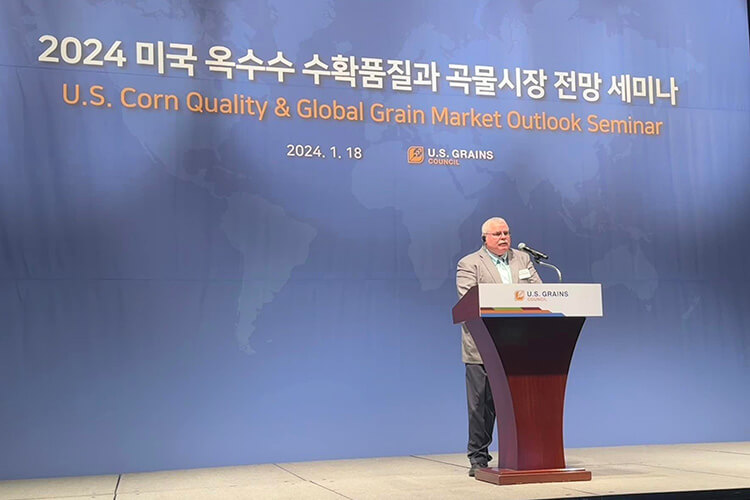
Each year since 2012, USGC has produced the Corn Harvest Quality Report to give foreign customers a detailed look at the year’s corn crop as it enters domestic purchasing channels.
The report is based on hundreds of grain samples collected at elevators in top corn-producing states. It provides a detailed overview of the grade factors, chemical composition, physical factors, and mycotoxins in the year’s corn crop.
The report is one of two USGC publishes each year on the quality of the U.S. corn crop. The second report, the Export Cargo Report, gives an overview of the U.S. corn crop based on samples from shipping points.
By publishing the reports, USGC aims to provide reliable and timely information about the quality of the U.S. crop to assist buyers in making well-informed decisions. “No other corn export market globally puts together such a comprehensive summary of its annual corn harvest quality,” said Manuel Sanchez, USGC director in China. “This is just one example of how we strive to strengthen our relationship with our top customers around the globe each year.”
In addition to producing the reports, USGC’s offices around the world gather grain buyers to present the results and provide updates on corn grading and handling. This year, events were held in China, India, Japan, Taiwan, Southeast Asia, Oceania, South Korea, Latin America Mexico, Europe, the Middle East, and Africa
South Korea is one of the leading purchasers of U.S. corn. Between 2018 and 2023, the country bought 12.2 million metric tons of U.S. corn—equivalent to 478.6 million bushels.
The U.S. faces significant competition in South Korea from Brazil and Argentina, in part because of price, but also because South Korean grain buyers prefer lower ratios of broken corn and foreign materials. O’Connor said that’s because most corn in South Korea is steam-flaked for use in the dairy and cattle industries. “If you have broken or soft corn, [steam-flaking] just does not work,” he said.
Corn varieties in Brazil and Argentina have a harder endosperm than U.S. varieties and therefore have lower ratios of broken corn and foreign materials.
In their presentation, O’Connor, Hunnicutt, and Singleton noted how the 2023 U.S. corn crop had the lowest percentage of broken corn and foreign material to date. They also noted how the 2023 U.S. corn crop was the largest on record and had a high protein concentration, and they promoted USGC’s corn sustainability assurance protocol. The protocol is a farmer-led initiative to show the strong institutional sustainability foundations underpinning U.S. agriculture, as well as the traditional and innovative techniques that U.S. corn producers are adopting daily.
In addition to meeting with buyers, O’Connor and Hunnicutt also visited the Incheon Port in northwestern South Korea to see how vessels are unloaded. They also visited South Korea’s two major feed suppliers and learned about Korean culture.
O’Connor thanked USGC’s South Korea office and its director, Haksoo Kim, for their work. “Those relationships that their staff people have on the ground are very valuable,” he said.
Learn more about the U.S. Grains Council at its website, grains.org.