Get to know the Growers: Ellyn Oelfke
The Minnesota Corn Growers Association (MCGA), the state’s grassroots organization for corn farmers, is led by 18 board members with a wide range of backgrounds and experiences. In our “Get to Know the Growers” interview series, we’ll learn about their farms, work with Minnesota Corn, and thoughts on agriculture. Interviews for the project are by Jonathan Eisenthal.
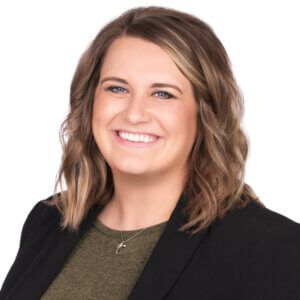
Ellyn Oelfke, MCGA board member
Glencoe, Minnesota
Tell me about your farm: Where is it, what do you grow, how long have you farmed, who do you farm with, how long has your family farmed this land?
I grew up in southwestern Minnesota, in Martin County, on my family’s fifth-generation corn and soybean farm, near the little town of Dunnell, right on the Iowa border. My dad farmed, my grandpa farmed, and that’s what instilled a love of farming and agriculture in me from a very early age. In high school, I was very involved with 4-H and FFA, and that eventually led me to the University of Minnesota, where I obtained a degree in agricultural communication and marketing. During my time at the U of M, I met my husband, and we have been married for four years, this December. Jacob is the sixth generation of his family farm, nestled in between the two little towns of Hamburg and Green Isle in Sibley County. I moved to be closer to him, and then in 2020, Jacob and I, along with his oldest sister and her husband, Ben and Jessica Flygare, took over the farm from the previous generation, and now this will be our fourth season operating the farm. We farm corn and soybeans using conservation practices such as no-till and cover cropping. We also have a black angus cow-calf herd and work in partnership with another local farming couple in their hog operation. Jessica and I also started our own small business growing cut flowers and pumpkins in 2022.
What do you love about farming and what do you find to be the most challenging aspects of it?
There is so much I love about farming. The biggest thing that I really do enjoy is just the opportunity to work alongside my husband every day. Like any operation there have been difficult times, and we know that there will be difficult times up ahead. But being able to work together and dream together for our operation and then put a plan in place to achieve our goals is something that we really value. Being on the land and being good stewards of the land and our livestock is something we take tremendous pride in. We just love what we do. It’s as simple as that. Challenges? I say we are sixth-generation farmers, but we are also beginning farmers in a sense. We had access to the land, and the building site, but we did have to finance it all as our own business. That was one of the biggest challenges. Stepping into that unknown. Market prices looked good. Interest rates were still reasonably favorable. Going into this year with market prices being so-so, interest rates still being incredibly high, and then also the challenges with the weather—it’s been really difficult. But these are things we can’t control.
What are beginning farmer initiatives supported by Minnesota Corn that you are able to get involved in, and offer your perspective and leadership?
For myself, I value that I have a voice on the Minnesota Corn board. I can advocate for other young, beginning farmers. There are a lot of really great beginning farmer programs through the Minnesota Department of Agriculture and USDA, within the FSA specifically, offering programs that have lower interest rates can help you succeed.
I also bring another perspective because I work full-time off the farm, and the primary reason for that is for health insurance. That’s another big thing that I am passionate about—trying to find health care options for young producers who want to be on the farm. Producers are dedicated to their farm, and they shouldn’t have to take that time away from their farm, and take that time away from their operation, just because they need health insurance.
Another area of interest is connecting young farmers with retiring landowners and farmers that are looking to retire but want to see their land continue to be farmed. As beginning farmers, we don’t always have the cash on hand to outbid another farmer down the road. So, just being able to connect those retiring folks with young, beginning folks who are just getting into the business, and trying to build their operation is something that is important to me.
Is networking one of the main benefits of being involved in Minnesota Corn? And what are other benefits, too?
Networking has been the number one thing so far from my experience on the Minnesota Corn board. Not only have I met tremendous folks who are currently on the board and council, but I have also met incredible people from all across the country. Being able to broaden my network of people in my corner is really something that has been a huge benefit from my experience on the Minnesota Corn board. Commodity Classic and Corn Congress are great networking opportunities. Last year, I participated in two National Corn Growers programs: the Women and Mentors Retreat in St. Louis, and the National Corn Growers Leadership Academy. I met some amazing people from other corn producing states and these are people I still keep in contact with, almost a year later, so that’s really neat.
Is there a leader in the ag world who has inspired you by their example? What did you find inspiring about them?
Dana Allen-Tully, our current president, is very inspiring and she has been a great mentor for me as a woman in agriculture and in a leadership position. I also have to really thank Harold Wolle, Jr. At the Women and Mentors Retreat, Harold was matched with me as my mentor. He has been really inspiring and has been a good sounding board, to just talk about ideas and get good advice, as a young person in agriculture. Also, I have to say my husband is someone who really inspires me because he has been through a lot of difficult transitions and challenges, but he has always come out stronger on the other side. He is very smart, and he is always trying to learn new things, and do what’s best for our business.
Do you have hobbies or interests beyond the world of farming?
The things I enjoy always seem to come back to the farm. One of my favorite things to do in the summertime is just to hop in the truck and drive around and check all our cattle on pasture, and just roll the windows down and do a crop tour. I also really love to garden, and that’s why I enjoy raising the cut flowers and pumpkins, with Jessica. I love to read, when I have the time. I also love maintaining our home, doing those homemaker things, and we are expecting our first baby in September. There’s a lot to do, preparing for the baby to be here, but we are incredibly excited.
What is something about farming that might be surprising to the average consumer?
One thing I don’t think consumers understand, and there’s been a narrative out that that agriculture is dominated by “factory farms,” so I think many consumers would be surprised to know that most farms are family owned and operated, and that’s something that we take pride in. Being the sixth generation, with the seventh on the way, we want to ensure that we leave the land better off for our son than we found it. When it comes to a farm, there is a face, there are real people behind the operation. We love what we do, and we take tremendous pride in it. We are also using the same products that they are, so that’s something that we share. Farm life can be idyllic, but it’s not that way all the time. Stress and worry are always there when it comes to livestock and crops, and we are so dependent on weather for the success of our operation every single year. You put a lot of faith in God, and that’s really all you can do.