St. Paul educator participates in Nourish The Future cohort
Written by Jonathan Eisenthal
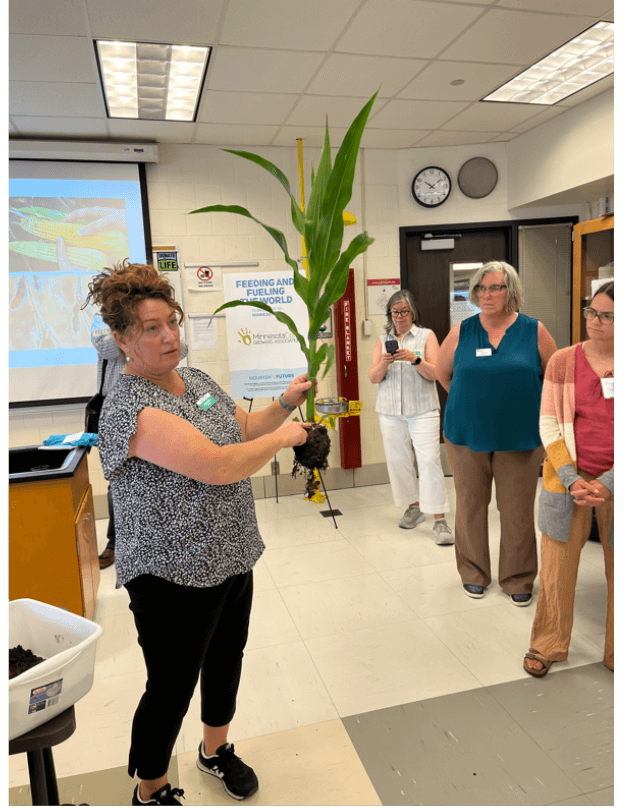
Class VI of Nourish The Future began in March, bringing together 32 teachers from across the United States, to learn how farming is done today. A key to the program’s success is that it is designed by science teachers for science teachers at the middle school, high school and college undergraduate level.
Lead teacher Heather Bryan is a science teacher herself, as are the three coaches who will work with the group. Not only are they science teachers, but they are also graduates of Nourish The Future Class V—a testament to the compelling nature of its approach: a mix of webinars and in-person events, meeting with scientists and researchers at the very top of the agriculture industry.
Many participants have little experience on the farm. This makes it an even greater impact when the entire class experiences Commodity Classic, one of the premier showcases of American farm know-how and technology. Nourish The Future’s funders, the National Corn Growers Association and the United Soybean Board, underwrite the trip, along with Nourish The Future’s yearlong series of experiences for these teachers. The educational content and programming for Nourish The Future are developed by educationprojects.org.
One of the teachers taking part this year is Merridith Joly, who has taught biology and chemistry for 29 years. She currently teaches at Gordon Parks High School, an alternative learning center in St. Paul, Minnesota.
Joly is very excited to join the Nourish The Future program because her ambition is to fill a gap at Gordon Parks, which recently lost its agriculture teacher. She notes that her school has a very diverse, urban student body, which includes kids with strong cultural traditions of agriculture from Hmong and Karen cultures. But many of these students have not had the benefit of a lot of opportunities and few have actually seen a farm. Joly is anxious to change that.
Joly said, “I’ve done science competition-based science. I’ve done research projects, taking students to the International Science and Engineering Fair. I enjoy reading papers and during the summer, I read for the Intel Middle School research paper competition. I enjoy reading papers from the ag science and chemistry categories the most. That is mainly what my focus is, right here at Gordon, to facilitate dialogue to help show students careers in ag and STEM science.”
Bryan said the first of the five webinars will bring the teachers right into the state of the art in agriculture research.
“Our first guest speaker will be Dale Ireland from Syngenta,” Bryan said. “He is a PhD that specializes in seed germination. He helps develop the seed material that resists disease, and thrives despite challenges like temperature, wet, things like that. Anything that might cause a seed to not perform well and germinate properly.”
The group will be going to St. Louis for a conference, where they will be learning about how STEM and agriculture intersect. They will get ideas and course materials that will support their curriculum standards in those areas, which teach students about modern agriculture and all the different professional roles it takes to support crop and livestock production. The number of careers in agriculture is growing exponentially.
A lot of the learning will be hands-on and experiential, just like the course materials the teachers will be able to then turn around and use in their classrooms. In addition to the Syngenta webinar, the group will take a tour through the crop research facilities of Bayer.
“Our goals is to bring phenomenal resources that are free to teachers to provide excellent educational, professional development, and leadership experiences,” said Bryan.