The crop is innovation: University of Minnesota’s Center for Sustainable Polymers
Written by Jonathan Eisenthal
There is a change in how chemists are made. The world has become so concerned with the fate of products like plastic and energy after their useful lives end that many chemists now enter the field not just to explore how elements and compounds interact or even to focus solely on the wonder-products that can come out those interactions.

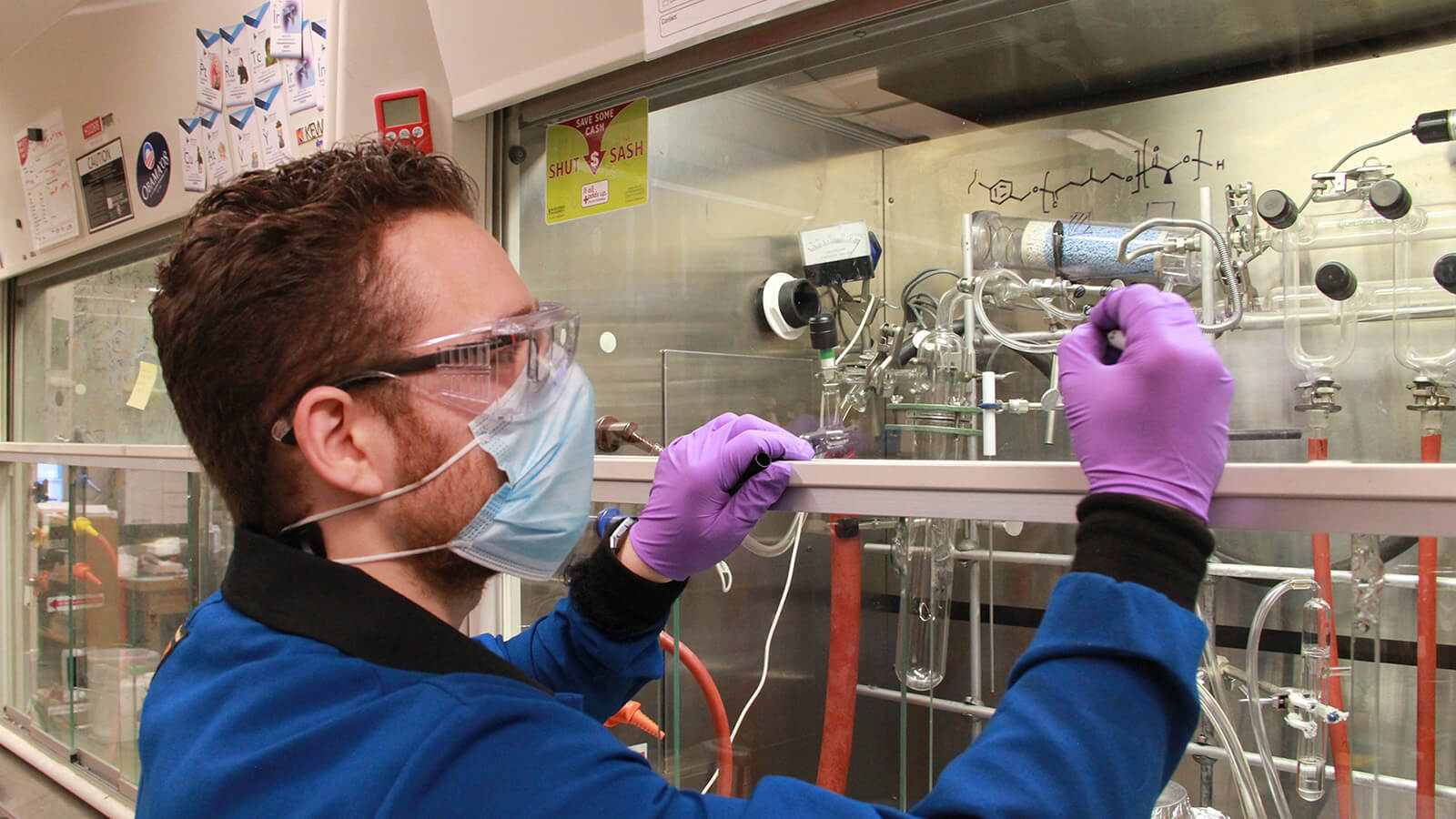
Perhaps taking inspiration from farming—the original zero-waste ethos—the new chemists are looking to re-use, recycle, and regenerate. In the past decade, the University of Minnesota’s Center for Sustainable Polymers (CSP) has become a literal farm for innovation in the realm of plastics, solvents, and other industrial materials, all made from renewable resources rather than petroleum, and all made with an eye to reducing waste and pollution. A dozen faculty and scores of student researchers work and learn and discover together at CSP.
A decade-long partnership between CSP and Minnesota corn farmers has resulted in a handful of revolutionary products and processes, with more on the horizon, thanks to the investments from the Minnesota corn checkoff.
The university launched CSP in 2009, anticipating that its mission and its resources would attract the attention and support of both the scientific community and private industries looking for answers to real-world problems. The public-private partnership has been very fruitful. CSP’s advisory board includes a who’s who of Fortune 500 companies like 3M, H.B Fuller, DuPont, Exxon-Mobil—companies looking for a future beyond petroleum. Companies like Aveda, offered their expertise in developing products using processes that are harmonious with the environment.
The Minnesota Corn Research & Promotion Council (MCR&PC) added its support to CSP at a critical juncture, in 2014. CSP had just been granted a long-term funding stream from the National Science Foundation’s Chemical Centers of Innovation (CCI) program. Funding from Minnesota corn checkoff allowed CSP to extend and fully fund research ideas that have wrought a series of revolutionary processes and products that use corn as a feedstock.
Chad and Krista Willis are Willmar-area farmers that have been active in promoting the uses of corn for more than two decades. Krista volunteers with CommonGround Minnesota, an organization that brings farm women and social influencers together to help communicate how farming and food production are really done and why farmers make the choices they do. Chad Willis has served as chair of the U.S. Grains Council and he was chairman of the MCR&PC when the decision was made to join the efforts of the Center for Sustainable Polymers. Chad and Krista both support investing in scientific research that pursues the environmental benefits to using corn as feedstock.
“The Corn Council funds research that will hopefully benefit farmers in the future,” Willis said. “When you make an investment, you don’t know if it’s going to pay off or not. That’s why they call it research. The whole world has gone to more renewables for plastics and other products. So why not make it from corn?”
They both feel that consumers drive this equation that favors renewables, and the research at the Center for Sustainable Polymers is a very efficient investment in pursuit of demonstrating that corn=environmental benefit.
Krista said, “We need to keep corn in front of them—science and industry—to help them see it as the multi-tool with excellent applications in food, fuel, and energy.”
CSP’s growing stable of spinoff companies prove the concept: Låkril Technologies, Valerian Materials, Phoam Labs, and Loop CO2 have all been born at CSP, and use corn to make plastics and other industrial materials. Phoam Labs offers a new take on a ubiquitous product—the hard foam used to make floral arrangements. Their version is biobased and much more earth friendly. LoopCO2 has created a bioplastic that features accelerated decomposition when composted. In 2022, Valerian Materials became the leader of a federal program called BioMADE, which included 9 new projects, and won $20.6 million in federal funding. All these companies that originated with CSP research promise a future where we won’t see massive islands of plastic swirling in the middle of the world’s oceans.
That kind of innovation and success has created a national reputation for the Center for Sustainable Polymers. CSP’s beacon drew Annabelle Watts, who pursued her graduate and post graduate research here from 2013 to 2018. Seeking to continue to serve its mission, Watts took of the role of managing director of the center.
“Many chemists have come here to the University of Minnesota because of CSP’s reputation,” said Watts. She believes that one of the center’s most important assets is its “ecosystem”— an environment in which scientists learn from one another and boost their power to solve problems exponentially.
Watts offered her personal outlook: “For me, I would say that I want to solve problems that are important to the future of our world without doing harm. And so, the concept of doing research and gaining a deep understanding of how to do chemical research, with the overarching concept of sustainability: how we make materials, where we get those materials from, how we process them, how we might use them and where they end up—this is all critically important.”
“Minnesota Corn Growers and Minnesota Corn Research and Promotion Council really have focused on supporting the research projects that fall under the umbrella that CSP cares about,” Watts said.
One of the ways that CSP cultivates the potential of its researchers and the richness of the ecosystem they work in is a program called Beyond the Classroom.
“The Beyond the Classroom series brings students into the CSP environment and offers experiences that are cross disciplinary, and often bring students together with representatives of business and industry …for example, we brought a group of researchers to tour a plastic film recycling plant in Rogers, Minnesota. We got a tour of their facility, got to understand where that plastic film comes from, what they’re doing on site, their business model. The researchers could see the equipment, see how these things are being handled, and better understand actual recycling versus what we as society and the community see as recycling.”
Chad Willis says farmers fund science in “pursuit of more grind.” More uses for those corn kernels. Ethanol fuel is the model for success, showing how a new use can support markets and improve farmer prosperity, while also improving environmental outcomes. Working in partnership with both industry and science is fundamental to the ethanol industry, and it is proving to be key to the development of additional corn uses.
One current project at CSP is in partnership with the National Corn Growers Association and MCR&PC, working with researchers to develop a polymer coating for nitrogen fertilizer. “It offers a slow-release mechanism for the nitrogen, which will help prevent it going where we don’t want it to, and the coating is biodegradable so there won’t be any residual plastic in the environment. It’s a benefit to the farmers. It’s a benefit to the environment. This should be tremendously appealing to consumers” Willis said.
Since 2014, MCR&PC has invested over $4 million in the development of new corn uses at CSP and spinout companies Låkril and Valerian Materials. Together, Låkril and Valerian Materials have the potential to capture a market that, if filled with corn-based products, could require more than 1 billion bushels of corn each year. The key to success is making this technology cost-competitive with conventional petroleum-based products, a goal that Låkril and Valerian have successfully achieved. The journey from concept to completion can be lengthy, but with recent advancements by Låkril and Valerian Materials, corn farmers are now closer to accessing new market opportunities.