New tech makes ethanol the tiger in the diesel tank
by Jonathan Eisenthal
Producers of grain and ethanol have dreamed about a means to power heavy equipment diesel engines with the cleaner-burning alternative fuel made from corn. A new technology, now in its third year of development at Marquette University, puts a flex fuel solution (using any blend from E0 gasoline to E98) within reach. The aim is to offer a heavy-duty engine capable of running on ethanol, requiring no diesel fuel, and performing just like the diesel engine in off-road heavy machinery applications like moving earth and picking corn.

Minnesota Corn joined the project, with a contribution from the Minnesota corn checkoff, to help fund the project in this year when researchers plan to demonstrate the new engine technology—the first step towards heavy equipment manufacturers adopting the technology and offering it as standard equipment for any diesel application, from farming to construction.
The main funder of the project is the U.S. Department of Energy, but the project has garnered support from a number of partners, including the Missouri Corn Growers Association, John Deere, ClearFlame Engine Technologies, and others.
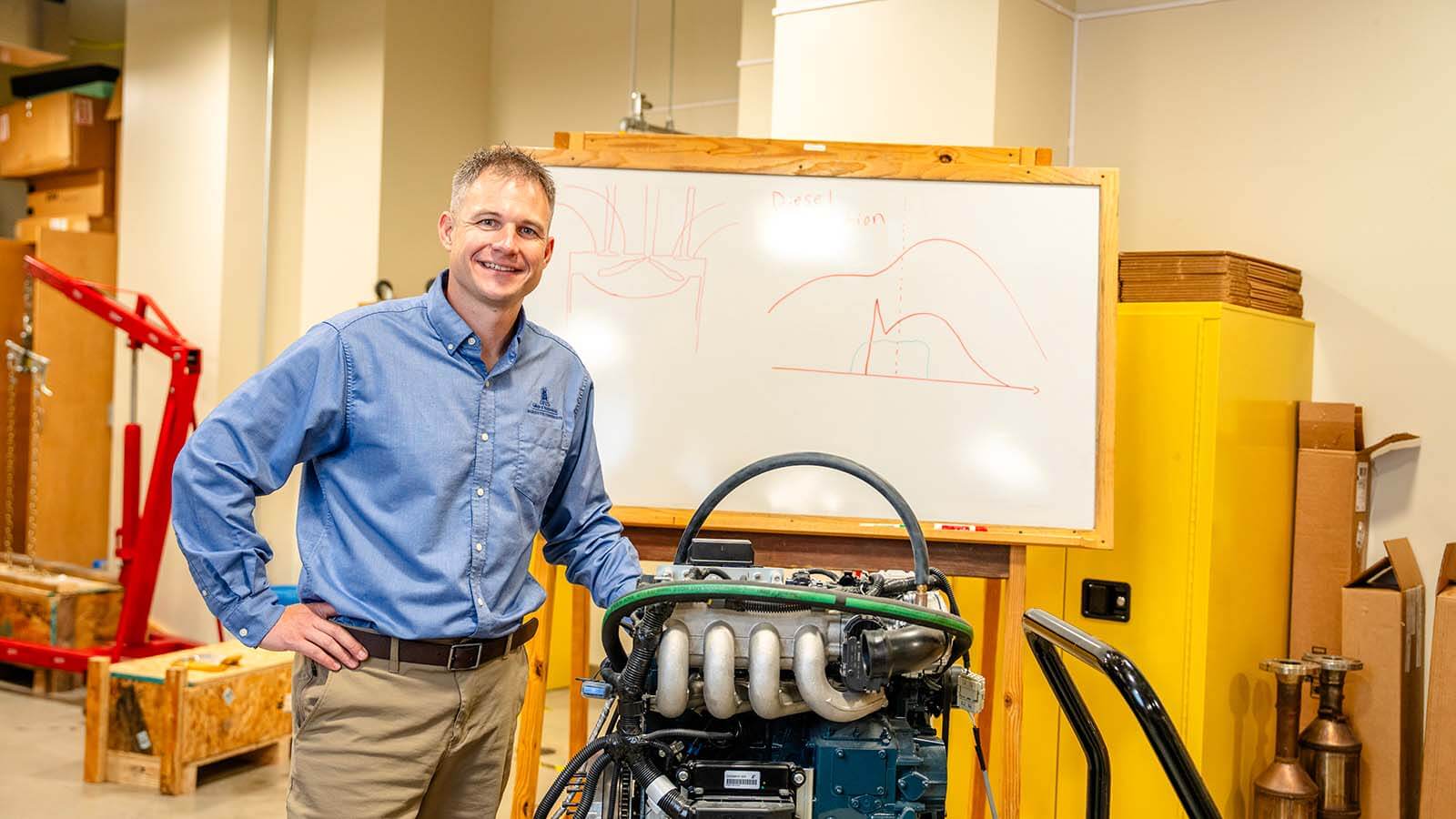
“We call it an ‘actively fueled pre-chamber,’” said Prof. Adam Dempsey, the project leader. “It is a little chamber that is added to the cylinder head of the diesel engine that has its own fuel-injector and its own spark plug in it. Essentially, that’s all you have to change about the engine. You don’t have to change the air handling system. You don’t have to change the compression ratio. You don’t have to change the direct injection system. What we do with this pre-chamber igniter system is, during the compression stroke, the direct-injected ethanol needs some ignition aid, and there is really no better ignition aid than an already burning flame. So what we do is we inject a little bit of ethanol in the pre-chamber and then spark it at the appropriate time, near the start of direct injection in the main combustion chamber. The prechamber has holes in the bottom of its nozzle, and it basically shoots a burning jet flame across the main chamber of the cylinder, and then when you direct inject ethanol and it comes in contact with that jet flame, it ignites almost instantaneously. It really makes ethanol’s high octane and its resistance to auto-ignition inconsequential. The burning jet flames in the main chamber make it auto-ignite very quickly. This engine technology sounds like an ordinary diesel, it performs like a diesel, it has very high torque at low speed and is never plagued by knock or pre-ignition. It is a diesel engine running on any blend of gasoline and ethanol.”
“We have done experiments on this in our lab,” Dempsey reports. “We have prototypes on our single cylinder engine. We have run this on E10, E15, E85 and fuel-grade ethanol—E98. The performance is essentially identical to the diesel engine. We have to tailor the amount of fuel we inject to make the torque, and overcome the lower energy content of the ethanol, but that is trivial and easy to do. There is no diesel fuel, and we aim for the engine to be flex fuel and still have the same torque curve and performance characteristics as the base diesel engine. So, the customer or the operator is not sacrificing any vehicle performance, but he or she is now able to run on any blend of gasoline and ethanol.”
A prototype has been built using a 9-liter John Deere diesel engine: turbo-charged, direct injected—typical for an engine in any modern piece of agricultural equipment. Dempsey’s team added prechambers to all six cylinders. Final assembly of the special equipment is underway at John Deere engine works in Waterloo, Iowa. Dempsey and a graduate student will take the 6-cylinder prototype to an engineering testing house in Indiana and begin the testing and demonstration work, which will continue throughout the winter and into the spring. They will report the results to the Department of Energy in the summer of 2025. This demonstration takes place strictly within the laboratory setting, but Dempsey feels the next logical step after this project concludes would be to test the technology in actual working conditions, such as a John Deere tractor or combine and conduct field testing.
“Currently, ethanol is a well-proven commodity in the transportation market for light duty vehicles,” said Devin Hoffarth, Market Development & Industry Relations Director for Minnesota Corn. “We want to continue to expand the uses of ethanol because we all know the benefits to the environment and to the farm economy. The idea appeals to many farmers, as it enables them to fuel farm equipment with energy made from the crops they have raised.”
In the bigger energy picture, where alternative fuel sources are an important solution to reducing greenhouse gas emissions and overall carbon footprint, ethanol is a solution that rises to the top.
“Ethanol becomes an especially appealing solution for the heavy, off-road engines when their applications require long hours of continuous operation,” Hoffarth noted. “Ethanol provides the flexibility for continuous operation without sacrificing performance. Building on our work with ClearFlame Engine Technologies for onroad applications, this was seen as the next step for heavy-duty applications. The ClearFlame technology is now available, converting class 8 trucks to run on E98, primarily marketed to fleet operators as a solution that allows the use of existing refueling infrastructure. The Marquette University research is an opportunity to accelerate the technology for off-road applications with the potential of getting the attention of OEMs to include this technology in its offerings.”
Prof. Dempsey reports that, while the focus of this research project is off-road machinery, it would be equally applicable to the type of diesel engines used in long-haul trucking. The United States already has carbon reduction regulations for highway vehicles, due to begin in 2027. “We would love to Using prechamber igniters attached to each cylinder, the prototype engine developed by Marquette University could allow heavy-duty equipment to run on lower-carbon fuels like ethanol without sacrificing performance. see this technology go into a row-crop tractor, or a combine,” Dempsey said. “Something that has a 9-liter diesel engine in it, typically John Deere equipment, and then test it in their proving grounds. We could envision a project that does all the engineering work to have a flex fuel system and a flex fuel tank and all that stuff onboard a vehicle, and then carry out a field demonstration of that technology. Ultimately, we hope John Deere would take it and put it in a product.”