Biegler made stewardship a leading issue for Minnesota Corn

Written by Jonathan Eisenthal
Environmental impact might be the public’s greatest concern with agriculture.
People may be surprised when they discover the environment also tops the list for many farmers, too.
In his nine years on the Board of Directors for the Minnesota Corn Growers Association (MCGA), Bryan Biegler helped to make stewardship of natural resources a front-and-center issue for Minnesota’s largest commodity group.
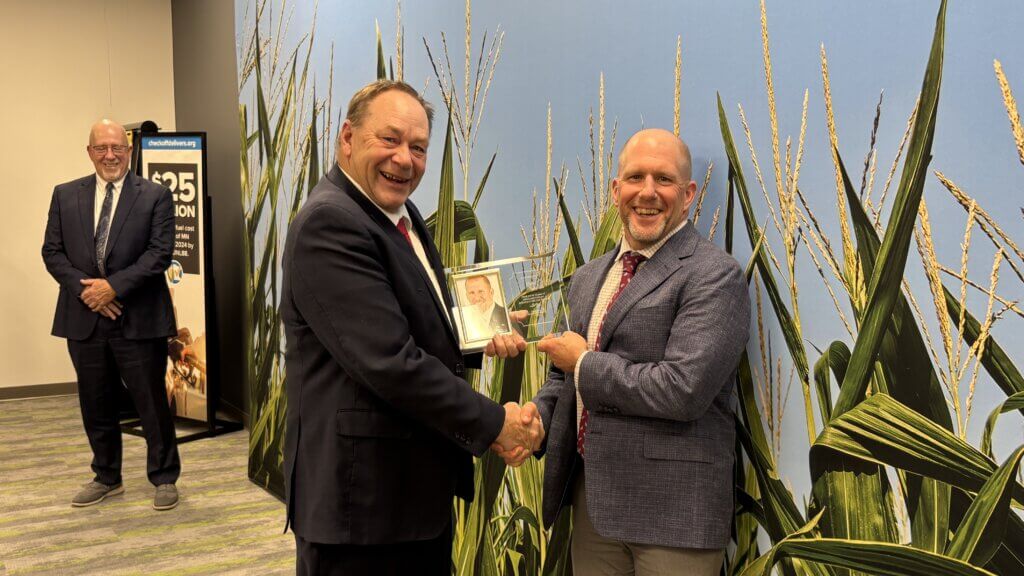
After three 3-year terms on the MCGA Board of Directors, including a year as president, Biegler brought his tenure to a close in January at the Minnesota Corn Growers Association annual meeting.
A farmer in Lake Wilson, near Marshall, Biegler has used strip till cultivation for 12 years, as well as cover crops, as part of his vision of maintaining and improving the environmental condition of his family’s farm.
“Not every conservation technique is going to work in every field or every farm, but every farmer is concerned about developing a strategy to succeed in both raising the food we need and keeping our natural world healthy at the same time,” said Biegler.
To show that Minnesota Corn’s farmer-leaders truly value natural resources, Biegler helped implement a voluntary program to evaluate the environmental impact of farms among the organization’s leadership using a third-party. A deep dive into how each farmer does things, and what are the actual results using farm-level data instead of relying on state or national averages. Some three quarters of the members of Minnesota Corn’s board and council have jumped at the opportunity to get a close read of what they are doing right and other practices that could help improve their land. These individual farm reports examined practices to maintain and improve soil and water quality, and to support plant and animal habitat and diversity. Minnesota Corn receives an aggregated report of all data collected across tens of thousands of acres but doesn’t receive the individual farm reports.
“Our sustainability and conservation initiatives have been very important,” Biegler said. “We hired a third party to conduct the assessments, to show the good practices that we are doing on our own farms. Unfortunately, some people think farmers are just destroying the ground and, dumping tons of chemical on there. With these sustainability reports in hand, we can go in and talk with legislators, and other leaders, and it gives us a lot of traction, real credibility.”
Minnesota Corn invests in a scientific approach to improving farming practices. Through the Minnesota corn checkoff, Minnesota Corn underwrites scientific research projects on nutrients, soil, and chemical controls. Work has gone forward to use corn as a feedstock for everything from fuel to plastics, in order to offer cleaner, more environmentally sustainable alternatives to petroleum-based materials. It’s a path to sustainability, both economic and environmental. Those investments are key to Minnesota Corn’s credibility in policy discussions, Biegler feels.
“There’s a certain amount of respect we’ve gotten from everybody,” Biegler said. “When we talk about nitrogen issues with legislators, or officials at the department of agriculture, leaders of non-government groups, they ask us about information we have, because of all the checkoff funded research at the University of Minnesota.”
Biegler also pointed to Minnesota Corn’s Innovation Grant program.
“That kind of on-farm research, driven by farmers, brings a real-world angle. We’ve gotten to be a trusted source of information,” Biegler said.
Biegler found Minnesota Corn to be a great outlet in which to hone his leadership skills. Now that he has moved on, he hopes new leaders will consider joining the organization and bringing their fresh perspectives to the task of leading the farmer grassroots organization. He highly recommends the experience.
“From the very start, everybody on the board was very supportive, and they would say ‘If you have questions, just ask us. You’ll do fine,’” Biegler said. “The Minnesota Corn staff is phenomenal. Whenever a question has come up, or I have a need of something, they’ve always been willing to help me out.”
Reflecting on what he has learned about leadership, Biegler feels that making a personal connection with the other person is the most valuable skill he has sharpened.
“Sometimes you forget that they’re people too—politicians. If you go in and find a common interest and talk to them like a regular person, you often end up getting to having a pretty good conversation with them,” Biegler said.
He makes a point of looking at the personal items in the office, for instance a time when he noticed a lawmaker had attended Iowa State, where Bryan’s wife, Lauren, went to school. It became a nice topic of conversation.
“One year, me and Laura and the kids, we went up to Maine for vacation, and along the way we stopped out in Pennsylvania to see GT Thompson, the chairman of the House Ag Committee. We stopped in his hometown and spent the day with him. It’s just little things like that. We talked a little bit of politics, but there’s plenty other times we can talk politics, so this was more just to getting to know him and knowing where he was at and his background. His family were dairy farmers.”
Biegler says taking a personal approach makes meetings with high-ranking officials far less intimidating, and makes communication on the important issues much easier.
Biegler is looking forward to taking a breather, and returning his focus to his family—two high schoolers and a middle schooler add up to lots of activities and lots of plans for the future, all of which Bryan can be more closely involved with now.