MCGA advocates for farmer-focused solutions to address record fertilizer costs
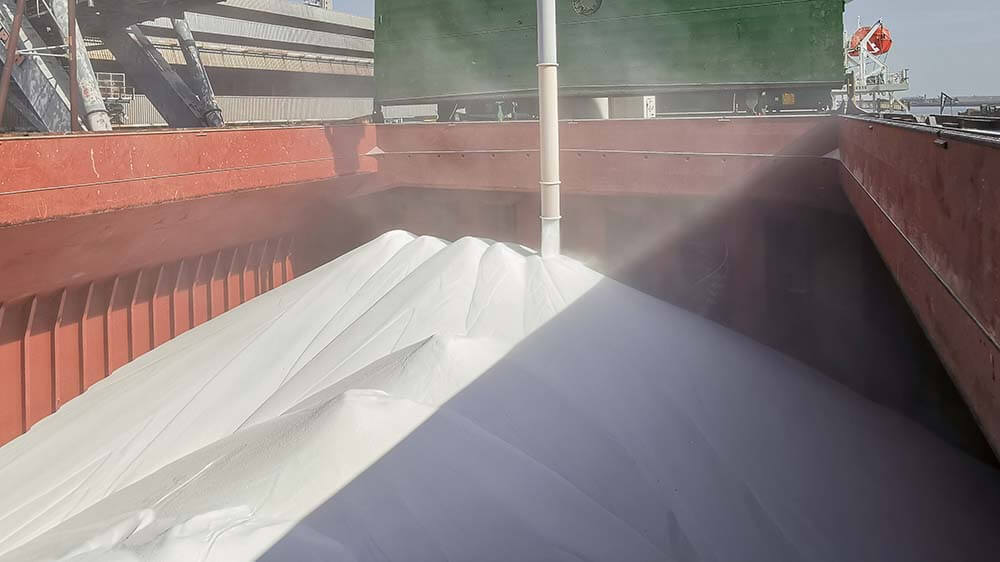
Even before fertilizer price and supply issues escalated due to the conflict in the Middle East, Minnesota’s corn farmers had been struggling with stubbornly high input prices, especially fertilizer.
The Minnesota Corn Growers Association (MCGA) has a history of advocating for long-term, permanent solutions to address record fertilizer costs, but the Middle East conflict has accelerated efforts. Economic relief will not be realized overnight, but recent announcements from legislators should build a foundation for addressing fertilizer price volatility.
In March, Senator Amy Klobuchar – working with colleagues across the aisle – introduced two bills focused on fertilizer issues. First, the Fertilizer Transparency Act, S.4152 (Thune-Klobuchar), would create a mandatory price reporting system to offer market participants of all sizes with comparable levels of market information on fertilizer components. This bill is also cosponsored by Senators Grassley and Baldwin.
In 2023, under a report requested by Senators Thune and Klobuchar, the Agriculture Food and Policy Center at Texas A&M identified a lack of competition in the fertilizer market and suggested mandatory price reporting as a tool to increase transparency. The Fertilizer Transparency Act, if it were to become law, would direct the Secretary of Agriculture to establish a program of fertilizer and fertilizer product price information weekly reporting for manufacturers and wholesalers and cover all applicable fertilizer products for nitrogen, phosphorus, and potassium.
Before the end of March, the U.S. House of Representatives introduced the companion bill led by Rep. Dusty Johnson (R-SD) and co-sponsored by Representatives Brad Finstad (R-MN), Mariannette Miller-Meeks (R-IA), Randy Feenstra (R-IA), Zach Nunn (R-IA), Angie Craig (D-MN), Nikki Budzinski (D-IL), Josh Riley (D-NY), Jimmy Panetta (D-CA), and Sharice Davids (D-MO).
Second, the Homegrown Fertilizer Act (Klobuchar-Marshall) would create a grant and loan program to expand domestic fertilizer production and improve fertilizer storage capacity. The Homegrown Fertilizer Act would invest in American manufacturing, support innovation in agricultural inputs, and put more options in farmers’ hands to source fertilizer for crop needs.
At the state level, MCGA is supportive of a green-ammonia project proposed for southern Minnesota, and seeking funds from the Minnesota Legislature to help support project development. The proposed ammonia project would use a system of modular production systems to convert electricity, air, and water to produce roughly 12,000 tons annually of green anhydrous ammonia and is a joint project of Central Farm Service and TalusAg. If successful, it would be Minnesota’s first commercially available supply of green ammonia.
MCGA issued a joint support letter with Minnesota Farmers Union when the project was recently before the Senate Energy, Utilities and Climate Committee seeking funding from the Renewable Development Account. This is an example of a domestic fertilizer production project that could also be supported through the federal Homegrown Fertilizer Act, if it were to become law.
Tariffs have received substantial attention in the last year, as the Trump administration works to address new trade agreements and the U.S. trade deficit. Tariffs levied as a result of anti-dumping and countervailing duty investigations have received less attention but also adversely impacts fertilizer affordability.
At the request of manufacturers of phosphate fertilizer, the International Trade Commission has levied countervailing duties (CVDs) on phosphate fertilizer imports from Russia and Morocco. These two counties combined account for approximately 17 percent of the global supply of phosphate. MCGA was part of a national and state group coalition asking the U.S. Department of Commerce to revoke those duties in a letter citing challenging economic conditions for U.S. famers and the current CVDs are constraining the supply of phosphate fertilizer.
In a separate letter, state associations for corn and soybean farmers and national agriculture groups took their ask directly to The Mosaic Company and J.R. Simplot to renounce their support for CVDs on phosphate fertilizer and to work with end-customers to allow additional supplies of phosphates to enter the U.S. at an affordable price.
Unfortunately, there are no immediate or silver bullet solutions to the fertilizer price challenge. It will likely take several approaches to address the intractable problem of fertilizer cost and supply. MCGA is working on solutions at both the state and federal level to increase options for fertilizer choices, market competition, and transparency with the goal to alleviate supply and price demands in the future.