Study at Wabasso farm explores impact of cover crops on nitrates
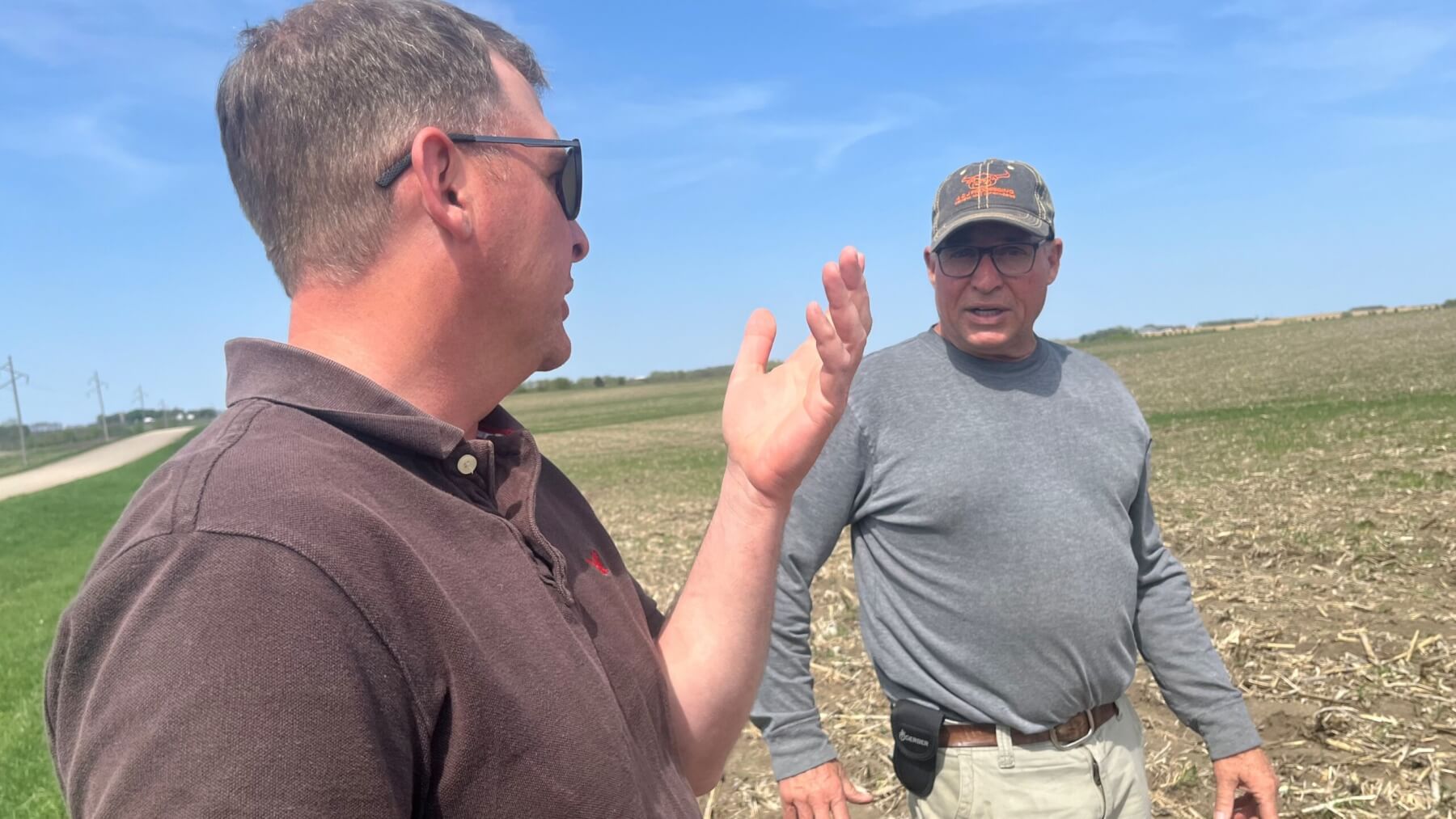
Cover crops reduced nitrate levels in tile drainage lines by about 25 percent, a Discovery Farms study found at the farm of Curt Trost in Wabasso, Minnesota.
Discovery Farms Minnesota, administered by the Minnesota Agricultural Water Resources Center (supported by Minnesota Corn) and with technical assistance from the Minnesota Department of Agriculture, studies the effects of conservation farming methods on real, working commercial farm operations. Starting more than a decade ago, the program began installing monitoring devices that measure runoff and outflow from tile drainage, and looking at the nutrients nitrate and phosphorous, as well as the amount of soil carried by these water flows.
Curt Trost became interested in Discovery Farms Minnesota by reading the newsletter of Soil Scientist George Rehm, a professor in the University of Minnesota Depart of Soil, Water and Climate, who served as the program’s first coordinator.
Trost’s curiosity and urge to solve a pressing agronomic problem drove his interest.
He had a draw at one end of a field that developed gullies every year. About a decade ago Trost decided to try a combination of limited tillage and cover crops to try to solve the problem of soil erosion. He was also very curious about how much of his fallplaced nitrogen was leaving the field through tile drainage and runoff.
Discovery Farms came in 2017 and set up monitoring stations at two positions, one in each of two adjacent fields; one ten acres, the other twelve. For the first four seasons Trost kept management on the two fields the same, to create a baseline. Nitrate flow in his tile lines was very similar in both fields. Then, starting in crop year 2021 and continuing today, Trost has used winter rye following soybeans and a cover crop mixture following corn. Unfortunately, drought set in in 2021. Under those conditions, the nitrate levels were almost identical. But in years 2022 through 2024 (most recent available), the cover crop fields showed a dramatic reduction. In 2022, the cover crop field had a concentration of 14.3 milligrams per liter, compared to 18.1 milligrams per liter in the field without cover crops—a 21% reduction. The difference was even more dramatic in 2023, a more than 47% reduction.
“I’ve been very happy with the yields through this whole process of reducing tillage and using covers,” said Trost. “One of the things we have found in the study is that I’m actually adding soil, building organic matter, with this change, and the soil conditions are excellent.”
Trost walked in the field and thrust a hand into the soil to demonstrate that it was pillowy, and not at all hardpacked, making an excellent condition for planting—totally without cultivation. His son-in-law, Justin Morin, was air-seeding soybeans into this test field, just wrapping up planting for the year at their operation, on May 7. They plant right into the rye cover crop, but terminate it with glyphosate prior to the emergence of the crop.
The Discovery Farms monitoring stations, powered by solar energy, require no management by Trost. Hydrologists Scott Matteson and Katie Rassmussen process data from the water samples collected from both a surface flume and an uptake pipe connected to Trost’s tile drainage system. Using a relatively new technology that accesses a cellular network, Trost can see nitrate levels in real time.
“Curt Trost’s study was one of the first Discovery Farms Minnesota has undertaken to assess specific practices,” noted Tim Radatz, the current program director. “When Discovery Farms first started, we were focused on capturing and establishing levels of soil and nutrient loss across the state for farms and practices that were common to the area. This approach established a baseline of data from real world farms, tracking these concerns across different weather conditions and regional differences. The baseline data showed the need to look more closely at nitrate loss in tile drainage. Cover crops have been promoted to address many water issues in the last decade or so. We wanted to test out that practice to see what was happening as there hasn’t been much data collected on real, working farms. Curt’s farm, and this study design using paired basins of equal size and similar productivity, was the perfect situation to get some data on cover crops in a corn/soybean situation in Minnesota.”
Trost takes a pragmatic approach, remaining skeptical of split applications of fertilizer for his operation, while finding that reduced tillage works very well. His approach to cover crops has evolved. Attempts at flying on seed mixtures didn’t result in as much biomass as he wanted, so he switched over to planting winter rye after harvest. While it didn’t make much headway in the fall, it produced hundreds of pounds of surface biomass per acre in the spring—helping in the spring months when excessive rainfall can cause erosion and nutrient loss.
“The main challenge with cover crops in Minnesota on corn and soybean farms is getting them established in the fall because there is not much of a time period for germination and growth,” Radatz observed. “Compared to other parts of the country or other farms that harvest crops earlier in the year (think corn silage), this is a huge challenge. I was very curious with the limited cover crop growth in the spring at Curt’s farm how it would impact water quality and we have been pleasantly surprised that the impacts are this good.”