Adding Value to Dried Distillers Grains (DDGS)
Padmanaban Krishnan
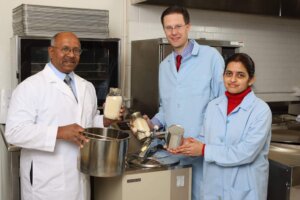
Using his experience as a food scientist, Krishnan’s research is focused on the processes that identify applications for dried distillers’ grains (DDGS), which are produced during the ethanol process, and DDGS usage. DDGS have potential to be broken down into compounds that enhance health, nutrition and disease prevention. Adding value to the co-product produced in abundance would provide a major economic boost for corn farmers.
DDGS Usage – Fit for human consumption
While currently labeled as an ingredient that should be hidden from human taste buds, Krishnan believes distillers grains could become a treat to the palette and be used as a feedstock for aesthetically pleasing foods. The quest has taken him through a series of experiments in how to refine distillers’ grains. It comes down to washing, Krishnan believes.
Because ethanol production creates a huge volume of carbon dioxide, Krishnan is exploring an innovative method to use ‘Supercritical CO2’ as a ‘green solvent’ to take impurities out of the raw distillers’ grains. His method is yielding exceptional food grade flour that could be used in food fit for human consumption.
Expanding the benefits of DDGS
Krishnan is also focusing on identifying pigments, metabolites, vitamin precursors and more with economic value that can be optimized from DDGS.
Step one of his research is identifying a process that extracts the compounds from DDGS using solvents and practices that are considered safe for applications in food. Once his research identifies it, Krishnan can pull out the functional ingredients that have value.
Carotenoids, which include yellow, orange and red organic pigments, derived from DDGS have been identified as one market with great potential. The pigments can act as an antioxidant in the body as well as a colorant and are found in a number of food products. Krishnan’s research includes perfecting the extraction process of the pigment so it can be added back into food as an aesthetic or added health benefit.