Predictive tools for corn management and breeding decisions
Candice Hirsch
Candice Hirsch
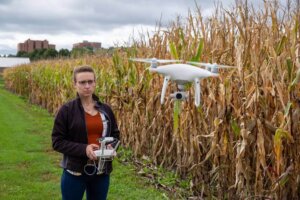
Hirsch believes drones could offer farmers powerful predictive tools for corn management at a lower cost.
Her research seeks to use periodic drone flights over farm fields during the course of the growing season to track stand count, plant height, canopy closure and growth rate. In addition to those morphological traits, Hirsch will also be able to measure how plants adapt to cold, heat and water stress using drone technology that identifies spectral wavelengths.
All of this information obtained during the drone flights have the potential to predict performance at the end of the season. A geneticist by training, Hirsch sees the power of ‘big data’—crunching large volumes of data into useful predictive models—and she wants to put that power into the hands of farmers.
“We are trying to use this technology to determine how plants in different parts of the field are responding to their microenvironment and we rely on our agronomist partners to interpret and determine how you would actually use this information in directing targeted management decisions,” said Hirsch.
Her research is happening now on Minnesota farms by flying drones over a field taking many pictures, which are then stitched together to create a digital reconstruction of the field.
With each flight, Hirsch will be able to measure how a plant is performing based on appearance, as well as what is happening below the surface, including photosynthetic efficiency and its ability to transport sugars. By evaluating the plant’s growth under changing environmental conditions, she will then be able to compare that performance across different genotypes, evaluating their stress responsiveness.
In the end, Hirsch wants to be able to hand a piece of software over to farmers so they can use their drones to predict how the crop will finish, and perhaps even perform meaningful rescues with in-season management decisions.