Legislative Update: 2022 Session is underway
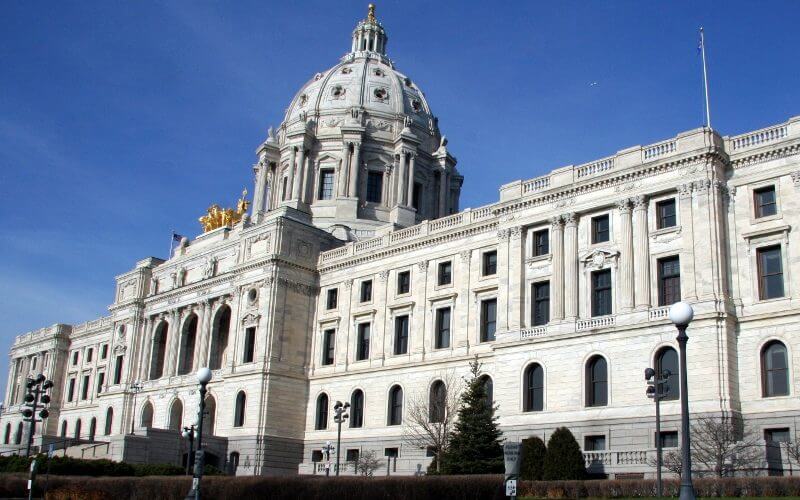
The annual process of trying to achieve state public policy outcomes that increase opportunity and resilience for corn farmers is in full swing for the Minnesota Corn Growers Association (MCGA).
Since the start of the state legislative session on Jan. 31, MCGA staff and grower-leaders have been busy advocating for policies that will benefit corn farmers and rural communities. The efforts are a core part of MCGA’s broader mission of identifying and promoting opportunities and increasing quality of life for corn farmers.
During the first two weeks of session, MCGA staff have been busy meeting with legislators to familiarize them with key policy priorities. Meanwhile, lawmakers have been hearing rundowns of what they might expect to be working on before the 2022 session adjourns in May.
The following provides a brief rundown on the key issues facing legislators this session and of MCGA’s policy priorities. Throughout the session, get the latest updates on legislation affecting Minnesota’s corn farmers by visiting mncorn.org.
2022 session overview
Minnesota continues to be the rare state where the Democratic Party controls one chamber and the Republican Party controls the other. The DFL narrowly controls the state House, while the GOP narrowly controls the state Senate. The governor, Tim Walz, is a Democrat.
After passing a two-year state budget last year, lawmakers have a host of other issues they will be focused on in the coming months. On top of that list is what to do about a $7.7 billion projected surplus for the 2021-23 biennium. Lawmakers could pass a supplemental budget to allocate some of the surplus, but they aren’t required to.
An early priority of Senate Republicans and Gov. Walz is to replenish the state unemployment insurance fund. To ensure the fund remained solvent as tens of thousands of Minnesotans accessed unemployment benefits during the height of the COVID-19 pandemic, the state borrowed more than $1 billion from the federal government. If the state doesn’t act soon to replenish the fund, businesses would be on the hook to repay the federal debt.
Other areas of focus for legislators could be a bonding bill, bonus pay for frontline workers during the pandemic, public safety and tax cuts. Additionally, the legislature is tasked with redistricting after the 2020 census, but it’s highly unlikely the DFL-controlled House and the GOP-controlled Senate will reach a consensus on a plan before the Feb. 15 deadline. That means redistricting in Minnesota will once again likely be decided by the courts.
Below is a rundown of MCGA’s priorities this session.
Renewable fuels/ethanol
Since 2020, MCGA has urged the adoption of legislation that would create a statewide E15 standard for unleaded gasoline. In 2022, MCGA has been working with Rep. Mike Sundin (DFL-Esko) and Sen. Torrey Westrom (R-Elbow Lake) to introduce the statewide E15 bill. We’re hopeful to see those introduced soon. Increasing biofuel use in our transportation fuel provides consumers higher octane, lower costs and reduced tailpipe emissions, in addition to supporting biofuel producers in rural communities. It is time for the legislature to take this common-sense step, which will benefit consumers and communities across the state.
Additionally, MCGA will be advocating for legislation that would assist retailers in replacing old equipment, which would enable higher blends of ethanol to be sold. We want to maintain money that was appropriated to the Minnesota Department of Agriculture (MDA) for biofuels infrastructure grants. MDA recently issued a request for proposals to award grant funds to retailers. In St. Paul this year, MCGA will pursue other available options to enable higher ethanol blends at retail fueling locations across the state.
Another MCGA-supported bill would provide retailers with income tax credits, based on the amount of ethanol-blended fuel they sell.
Conservation
MCGA will be supporting a bill that would require the creation of a state-funded healthy soil management practices grant program at MDA. The grant program would provide equipment grants to farmers to implement and maintain soil health practices. To receive funding, projects would need to meet at least one of six criteria. Those include increasing the quantity of organic carbon in soil, integrating perennial vegetation and increasing use of precision agricultural practices.
Governance and regulation
MCGA is continuing to work to ensure farmers have ample access to crop-protection tools used to produce a successful corn crop each year. We will also look for opportunities that would ease project permitting and regulatory burdens, which can stifle development and expansion of agriculture-related business and processing across the state.
Rural Communities
With a large projected surplus and significant federal funding allocated to Minnesota, MCGA will be advocating for a tax environment that provides economic certainty and relief for farmers and rural business. In addition, we support transportation investments in road, bridge and rail infrastructure in rural communities and support the build-out of broadband networks.
Timeline of 2022 state legislative session
Jan. 31: State legislative session begins
March 25: First committee deadline
April 1: Second committee deadline
April 8: Third committee deadline (this deadline is specifically for major appropriation and finance bills)
April 9-18: Easter/Passover break
May 23: Legislature adjourns
Be sure to follow the MCGA blog and its social channels (Facebook, Twitter) for updates. You can also follow Amanda Bilek, MCGA’s Senior Public Policy Director, on Twitter (@AjBilek).