Past NCGA President Tom Haag subscribes to a consensus-building leadership style
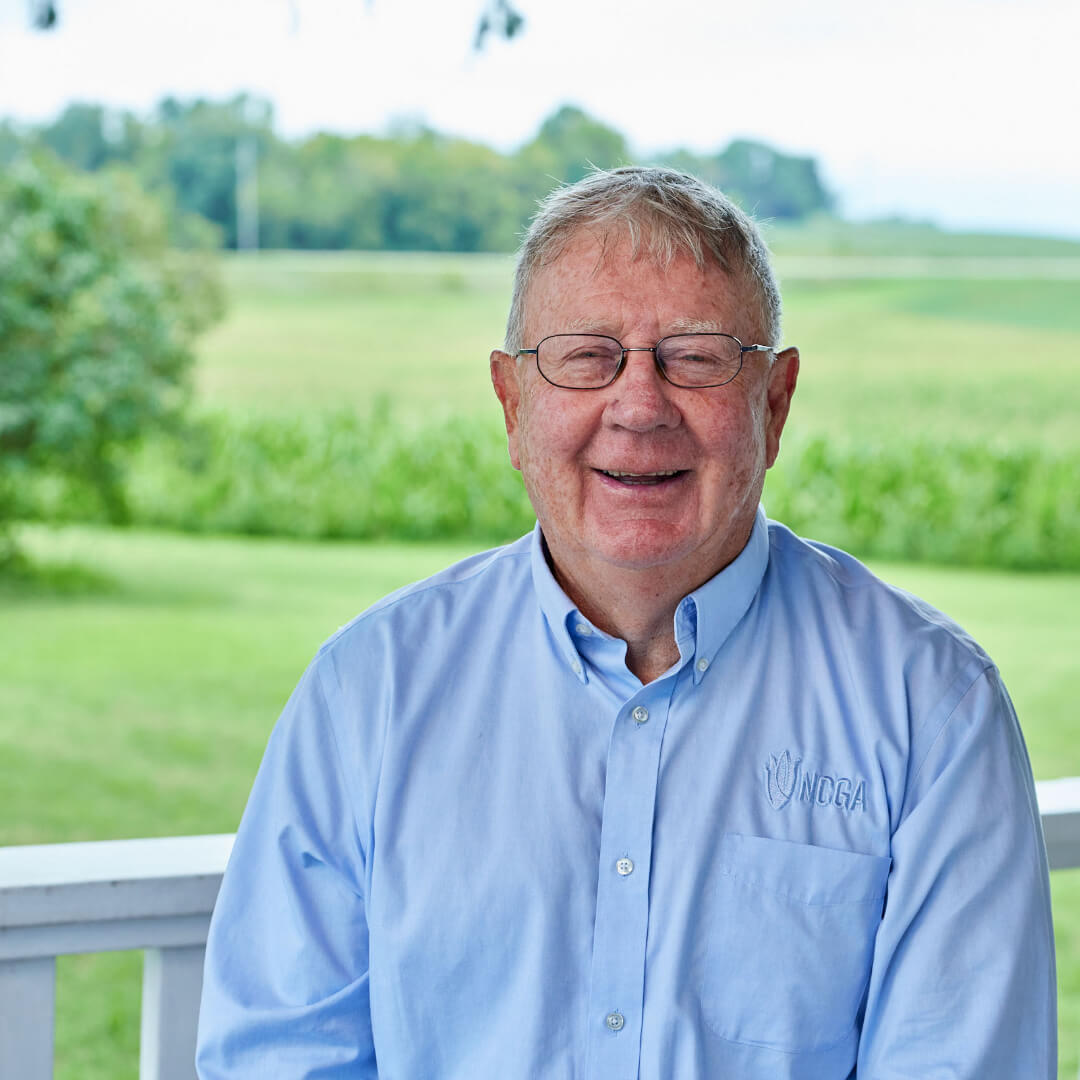
For the past four years, at least one Minnesotan has been a member of the executive leadership team on the National Corn Growers Association (NCGA) Board of Directors. Tom Haag of Eden Valley served as NCGA First Vice President in 2021-22, NCGA President in 2022-23, and NCGA Chairman in 2023-24. Meanwhile, Harold Wolle of Madelia served as First Vice President in 2022-23, President in 2023-24, and Chairman in 2024-25.
As Harold prepares to transition out of the executive leadership role next month, freelance writer Jonathan Eisenthal caught up with him and Tom to hear about their experiences leading NCGA. Minnesota Corn thanks Harold and Tom for their dedicated efforts on behalf of corn farmers and wishes them the best in future endeavors.
Read Harold’s reflections on serving in NCGA leadership here, and read Tom’s below.
If you have watched Tom Haag transfer grain from the grain wagon into the bin or the grain dryer, you know that he doesn’t hurry, and he takes great care to do the job right. Haag took the same approach in the decades he spent as a farmer-leader, including his time as a leader of the Meeker County Corn Growers, the Minnesota Corn Growers Association, and NCGA.
Asked what appealed to him about service to the organization and the industry, Haag said he was intrigued by the board room discussions and debates over policy. Because these leaders came together with different ideas, but with the common goal of helping farmers succeed, Haag found the process inspiring.
“You knew you had to work with people, for them to be successful and for you to be successful,” Haag observed. “You could talk things over and say, ‘Why are you pushing for this?’ And then you heard their reasons, and you could understand. Going forward on that basis, you could work with them now and agree with what they want to do with a particular policy or a need that’s out there.”
He saw there were times when it was equally important to be assertive.
“At times you don’t want to agree with them, and that’s when you have your good discussion, and you hope you bring out your good points and they bring out their points,” Haag said. “I think that was the start of it for me. That’s when I noticed it was getting in my blood. Every year, I found myself a little bit more intrigued about what’s going on.”
One of the most significant issues of Haag’s term was Mexico’s proposed ban on biotech corn imports, a move that would have harmed U.S. farmers and Mexican consumers. In an October 2022 opinion piece and a December 2022 letter, Haag and other farmer-leaders asked the U.S. Trade Representative (USTR) to help remedy the situation. After Mexico updated its decree in February 2023, Haag led NCGA’s call for the USTR to file a dispute settlement under the U.S.-Mexico-Canada Agreement (USMCA). In statements and interviews, he noted the positive impacts of biotech corn and said Mexico’s move would erode the integrity of the USMCA.
“Singling out corn—our number one ag export to Mexico—and hastening an import ban on numerous food-grade uses makes USMCA a dead letter unless it’s enforced,” he said in February 2023.
Haag said it took significant time and effort to get USTR to prioritize the issue. An NCGA open house and panel discussion on the ban generated some momentum—the event was covered by prominent media outlets and attended by key legislative staffers—but he said NCGA board members became discouraged. That changed, Haag said, after he received a personal phone call from USDA Secretary Tom Vilsack, who encouraged him and the other farmer-leaders not to give up.
“When I reported to the board about this call, everyone got a boost of confidence that all this work by the board and the staff of National Corn would bear fruit,” Haag said.
Eventually, NCGA farmer-leaders got a meeting with a representative of USTR, who Haag said then made the issue a top priority. In June 2023, the USTR filed a dispute settlement in response to the ban, and in December 2024, a panel ruled that Mexico’s ban violated its commitments under USMCA.
In addition to leading NCGA through Mexico’s biotech corn proposal, Haag led the organization as it hired a new CEO and underwent a strategic planning process. He tasked Harold Wolle with leading the effort to select a new CEO and asked board member Kenny Hartman of Illinois to chair a committee to develop the new strategic plan once the new CEO was in place. That led to the hiring of Neil Caskey as CEO and the adoption of a new strategic plan in early 2024.
Looking ahead, Haag points to one of the main functions of NCGA’s leadership, to be the face of agriculture and to tell the stories that will help the public understand the “hows” and “whys,” and to ensure their ongoing support.
Nowhere is that more evident than in the process of trying to pass the next Farm Bill. Congress passed many corn grower Farm Bill priorities as part of the reconciliation package, including a strengthened safety net, protecting and enhancing crop insurance, increasing funding for export promotion, and maintaining voluntary adoption of conservation practices. But NCGA and its partners are still advocating for a full Farm Bill reauthorization in the months ahead.
“We’re the ones who can convince the public how these parts of the Farm Bill benefit them, in creating a more secure food system,” Haag said. He feels that crop insurance may be the most important provision of the Farm Title. “I always tell people it’s like home insurance. You have to have it. God forbid there’s a fire. Nobody wants to collect on insurance, but you still want it in your back pocket in case you need it.”
Haag notes the average age of U.S. farmers—58 years old, as of the 2022 Census of Agriculture. Crop insurance plays a critical role in helping the next generation step into farm production roles.
“Especially with the younger farmers that are just getting started, where they need that safety net, because they don’t have the equity yet to, be able to afford bad years. That little bit of insurance helps young farmers stay even with the operating and equipment loans they need and stay afloat when prices are bad, or disaster hits their operation.”