Spotlight on research: Corn farmers investing in innovation
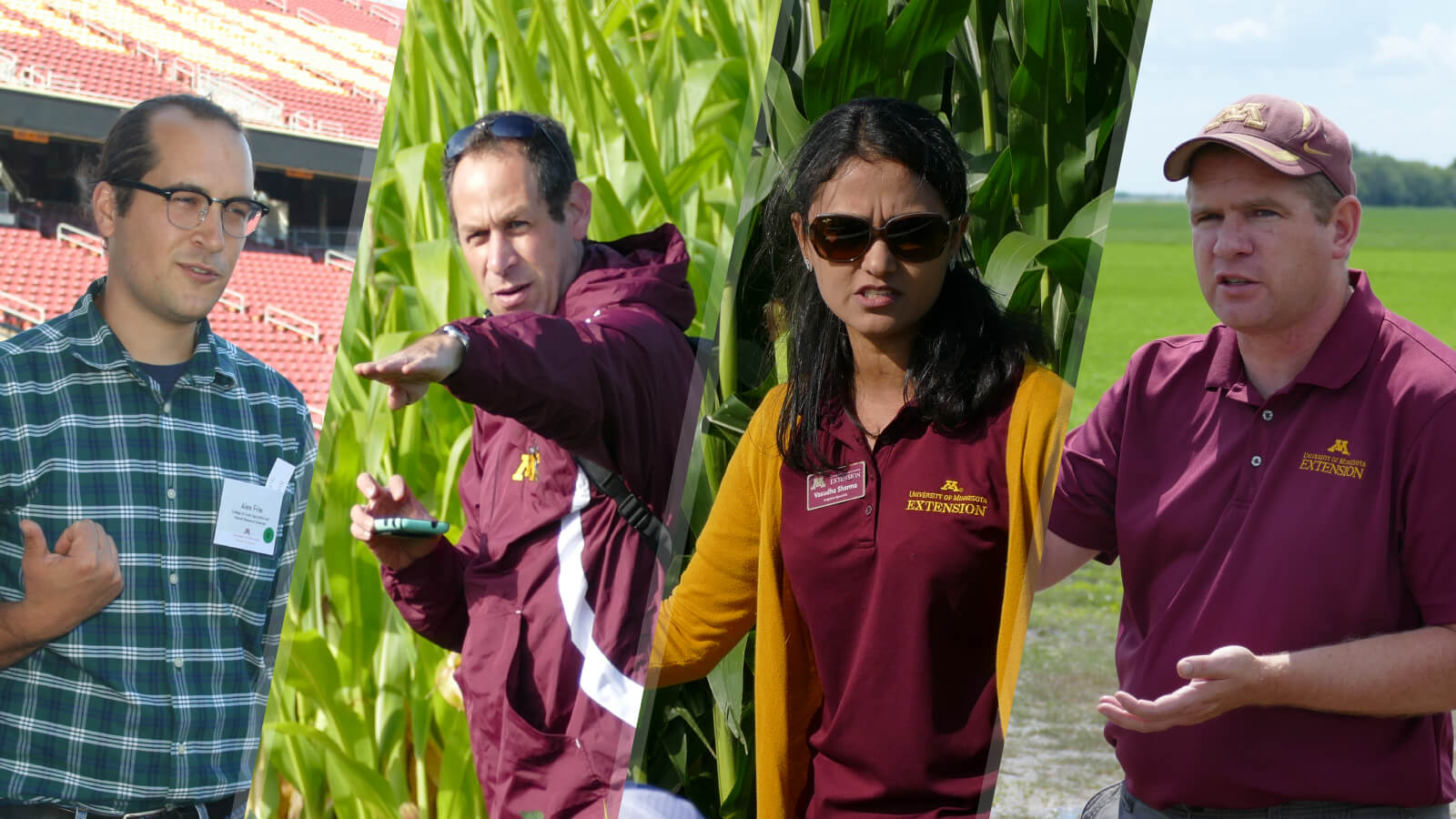
Through corn farmers investment in the Minnesota corn check-off, Minnesota Corn Research & Promotion Council (MCR&PC) invests more than $2 million annually in research that improves on-farm practices while identifying new markets for the state’s corn crop. The following provides a brief overview of ongoing projects and initiatives led by university researchers and other experts.
To learn more about farmer-led research through the Minnesota Corn Innovation Grant Program, or to read final reports from completed research projects, visit mncorn.org/research.
Funding the Minnesota Agricultural Water Resource Center (MAWRC)
Project lead: Warren Formo, MAWRC
Project overview: Funding from the MCR&PC helps MAWRC provide information to farmers on nutrient management and water-related issues. MAWRC also shares relevant information with the general public to further build awareness and a better understanding of the conservation efforts farmers implement.
Why it matters: Information on nutrient management and water-related issues can help farmers identify and address environmental risks, and help others better understand farm practices.
[Read more: MAWRC makes the most of water on the farm]

Funding a water-quality educator at University of Minnesota Extension
Project lead: University of Minnesota Extension
Project overview: This grant helps to support a full-time educator position at University of Minnesota Extension. The position is held by soil scientist Brad Carlson, who oversees the Nitrogen Smart educational program, which teaches producers fundamentals for maximizing economic return on nitrogen investments while minimizing nitrogen losses.
Why it matters: Farmers are always working toward continuous improvement, and an Extension educator dedicated to water quality topics will assist farmers in adopting nutrient management best practices.
[Read more: Nitrogen Smart offers latest in nutrient management at home]
Evaluating the prevalence of corn pests in Minnesota
Project lead: Bruce Potter, University of Minnesota
Project overview: Potter and his team are developing a statewide network of traps for key corn pests, such as the European corn borer and corn rootworm. They also plan to evaluate yield loss at several locations due to a fungal pathogen and conduct a fall survey of corn diseases and European corn borer larvae.
Why it matters: Getting a broader look at the status of various corn pests across Minnesota could help farmers make better pest-control decisions.
[Learn more: Elias explains his research on the Minnesota Corn Podcast.]
Developing a third Advanced Nitrogen Smart course
Project lead: Brad Carlson, University of Minnesota Extension
Project overview: Carlson is working to develop an Advanced Nitrogen Smart course highlighting the impacts that changing weather and climate patterns have on nitrogen management.
Why it matters: Developing this course could help farmers adapt to climate change.

Developing corn-based bioplastics
Project lead: Marc Hillmyer, Center for Sustainable Polymers, University of Minnesota
Project overview: Hillmyer’s research aims to replace petroleum as the raw material from which plastics are made with renewable sources like corn.
Why it matters: Creating stronger and more durable corn-based plastics could drastically reduce the environmental impacts of plastic and create new markets for corn growers.
[Learn more: Hillmyer’s research is discussed on the Minnesota Corn Podcast.]
Finding value in dried distillers grains with solubles (DDGS)
Project lead: Padmanaban Krishnan, South Dakota State University
Project overview: Krishnan and his team are working to refine DDGS, which are byproducts of ethanol production, to make them fit for human consumption. They are also working to determine which components of DDGS offer the best value in order to extract them from the grain.
Why it matters: Identifying additional uses for DDGS could create new markets for corn byproducts.
[Learn more: Krishnan’s research is discussed on the Minnesota Corn Podcast.]
Creating an ethanol-powered electric vehicle (EV) range extender
Project lead: Will Northrop, University of Minnesota
Project overview: Northrop and his team are working to create a system in which an E85-powered internal combustion engine not connected to a vehicle’s wheels would charge an in-use EV, furthering its range. Ethanol is the ideal fuel for this process because it can more efficiently be made into hydrogen and carbon monoxide than standard unleaded gasoline.
Why it matters: As electric vehicles grow in popularity, an ethanol-powered range extender could help create a new market for the biofuel.
[Watch: Northrop discusses the role of ethanol in EVs.]
Stopping the spread of plant disease with an enzyme
Project lead: Mikael Elias, University of Minnesota
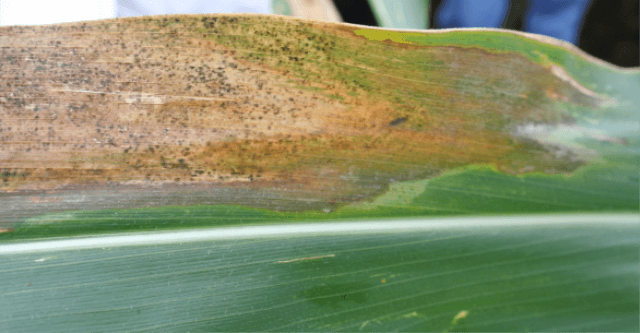
Project overview: Elias’ team is building an enzyme that doesn’t allow the bacteria that causes diseases like Goss’s Wilt to communicate with one another. Without that ability to communicate, such bacteria do not reproduce and have a harder time spreading.
Why it matters: Reducing diseases that dramatically reduce crop yield increases profitability for farmers and their overall sustainability efforts.
[Learn more: Elias explains his research on the Minnesota Corn Podcast.]
Using drones to evaluate crops
Project lead: Candice Hirsch, University of Minnesota
Project overview: Hirsch and her team are using drones to collect data on crops, with the goal of helping farmers in detecting and understanding non-visible early symptoms for earlier management interventions.
Why it matters: Having a better grasp of the microenvironments within a given field could help farmers understand the specific mechanisms plants use to respond to their environment and also will lead to development of more resilient plants for the future.
[Read more: The predictive power of drones in the field]
Mapping the mineral content of Minnesota’s soils
Project lead: Dan Kaiser, University of Minnesota
Project overview: Researchers are measuring the ratios of different clays found in Minnesota soils which vary in their potassium (K) holding capacity, therefore their ability to supply K to the corn crop.
Why it matters: A better understanding of the mineral content of soil in a given area could help a farmer more efficiently apply fertilizers.
[Learn more: Kaiser explains his research on the Minnesota Corn Podcast.]
Helping farmers reduce nitrogen emissions

Project lead: Tim Griffis, University of Minnesota
Project overview: Using indoor growing chambers, Griffis is testing how nitrogen emissions from farm fields in the form of the gas nitrous oxide are impacted by warmer and wetter weather conditions. He also is looking into “designer” soil microbes that can fix nitrogen out of the atmosphere.
Why it matters: By utilizing microbes that can fix atmospheric nitrogen, farmers could potentially use less fertilizer, thereby lowering nitrous oxide emissions and nitrogen runoff into groundwater.
[Watch: Griffis discusses his research.]
Developing best-management practices for cover crops and manure integration
Project lead: Melissa Wilson, University of Minnesota
Project overview: Wilson is experimenting with cover crops and liquid manure application, assessing whether such practices affect soil health and corn and soybean yields.
Why it matters: This system has potential to give farmers more flexibility for manure application, and provides soil health benefits.
[Learn more: Wilson explains her research on the Minnesota Corn Podcast.]
Measuring how nitrogen rates affect environmental factors
Project lead: Fabian Fernandez, University of Minnesota
Project overview: Fernandez and his team are applying different amounts of nitrogen on corn fields to determine how application rates affect grain yields, and water and air pollution.
Why it matters: A better understanding of how different nitrogen-application rates affect the environment could help farmers more efficiently use fertilizers.
Evaluating irrigation-management tools
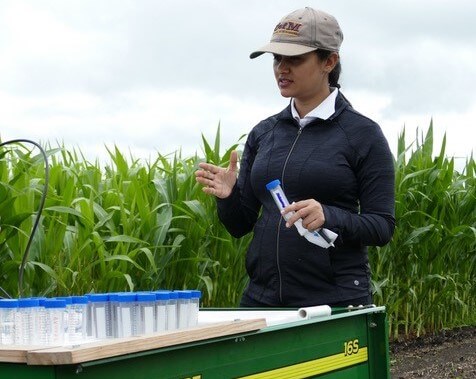
Project lead: Vasudha Sharma, University of Minnesota Extension
Project overview: Sharma is evaluating the impact of four irrigation water management strategies that differ in their complexity on corn yield and nitrate leaching.
Why it matters: By more precisely watering crops, farmer could save water and improve yields.
[Watch: Sharma discusses her research.]
Working to create ethanol-powered diesel engines
Project lead: ClearFlame Engine Technologies
Project overview: ClearFlame is working to develop an ethanol-powered engine that can be used in long-haul trucking.
Why it matters: Using ethanol instead of conventional fuels in trucking would have environmental benefits and positively impact farmers and rural communities.
[Read more: Ethanol’s role in the future of heavy duty transportation]
Creating a corn-based acrylic acid
Project lead: Lakril Technologies
Project overview: Lakril is working to create an acrylic acid made from corn instead of petroleum.
Why it matters: A corn-derived acrylic acid could reduce carbon dioxide emissions by nearly one-third, compared to the traditional product.